No, laser treatment cannot promise that every tattoo clears fully. A 2026 trial of 30 people reported complete clearance in 10% of picosecond-treated sites after five sessions. Black ink responds well in studies, while yellow and green ink are harder. Ink color, depth, and skin type set how far a tattoo fades. We explain the numbers, the science, and the session counts below.
Key Takeaways
- Some tattoos fade completely, but no study supports a promise of 100% removal for every tattoo.
- A 2026 split-tattoo trial found complete clearance in 10% of picosecond sites and none in nanosecond sites.
- Published studies report 3 to 8 sessions in one series, and Q-switched lasers can need up to 20.
- Tissue studies show the lymphatic system carries tattoo pigment away from the skin.
- Medicare excludes procedures directed at improving appearance, so ask your own plan about coverage.
Can Tattoos Be 100% Removed With Laser Treatment?
Tattoos can fade completely in some cases, but no study supports a promise of 100% removal for every tattoo. Results depend on the ink, the skin, and the number of sessions.
A 2026 split-tattoo trial in Plastic and Reconstructive Surgery treated 30 people five times, three months apart. Complete clearance occurred in 10% of picosecond-treated sites and in none of the nanosecond-treated sites. Satisfactory clearance reached 73.3% with picosecond pulses and 23.3% with nanosecond pulses.
A provider who offers laser tattoo removal reviews ink color, depth, and skin type before setting a plan. That review sets realistic expectations for each tattoo.
A 2015 Journal of Cosmetic Dermatology study followed 64 patients with 75 tattoos. The authors wrote that final results can take two to three years. They also noted that complete clearance is impossible in some cases.
Clinicians answer “can tattoos be 100% removed” with a range, not a promise. The reason sits in the ink itself, so the next section covers what breaks down tattoo ink.
What Breaks Down Tattoo Ink During Laser Treatment?
A laser breaks down tattoo ink with very short light pulses that shatter the pigment into smaller fragments. A 2012 review in Dermatologic Surgery describes quality-switched (Q-switched) lasers as the tool that made removal of unwanted tattoos practical.
Dermal macrophages, immune cells in the skin, then capture the fragments. A 2018 Journal of Experimental Medicine study in mice showed that pigment particles can be captured, released, and recaptured by these cells. Tattoo persistence therefore relies on macrophage renewal, according to that study.
A 2017 Scientific Reports study of human tissue found that the smallest pigment particles reached lymph nodes most readily. Smaller fragments therefore matter, and each session shrinks more of them. The same pathway raises a common question about where the ink goes.
Do You Pee Out Ink After Laser Tattoo Removal?
You do not pee out ink after laser tattoo removal in any measured amount, because the lymphatic system carries the fragments away. No study reviewed for this article measured tattoo ink in urine.
The 2017 Scientific Reports study used skin and lymph tissue from human donors. Researchers found organic pigments, metals, and titanium dioxide moving from tattooed skin to regional lymph nodes. A 2026 literature survey in the European Journal of Microbiology and Immunology reported pigment-laden macrophages in lymph nodes that drain tattooed skin.
These findings describe pigment transport, not a urine test. Studies on laser fragments specifically remain limited, so the exact route of every particle stays unmeasured. The slow pace of this clearing explains why sessions sit weeks apart.
How Many Sessions for Laser Tattoo Removal Does a Tattoo Need?
How many sessions for laser tattoo removal a tattoo needs varies from 3 to 8 sessions in a 2024 study to 20. Published numbers come from small groups, so each tattoo needs its own estimate.
The 2024 Journal of Cosmetic Dermatology study followed 11 patients who needed an average of 5.09 treatments. Sessions were spaced two to three months apart. The Kirby-Desai scale had predicted 9.9 sessions for the same tattoos.
A 2012 Dermatology Times report quoted Dr. Geronemus on an average tattoo needing six to 10 nanosecond treatments. He added that up to 20 sessions are sometimes needed.
The Kirby-Desai scale scores six factors to estimate the session count. A 2009 study of 100 patients found a correlation of 0.757 between the score and the sessions needed. The graphic below shows those six factors.
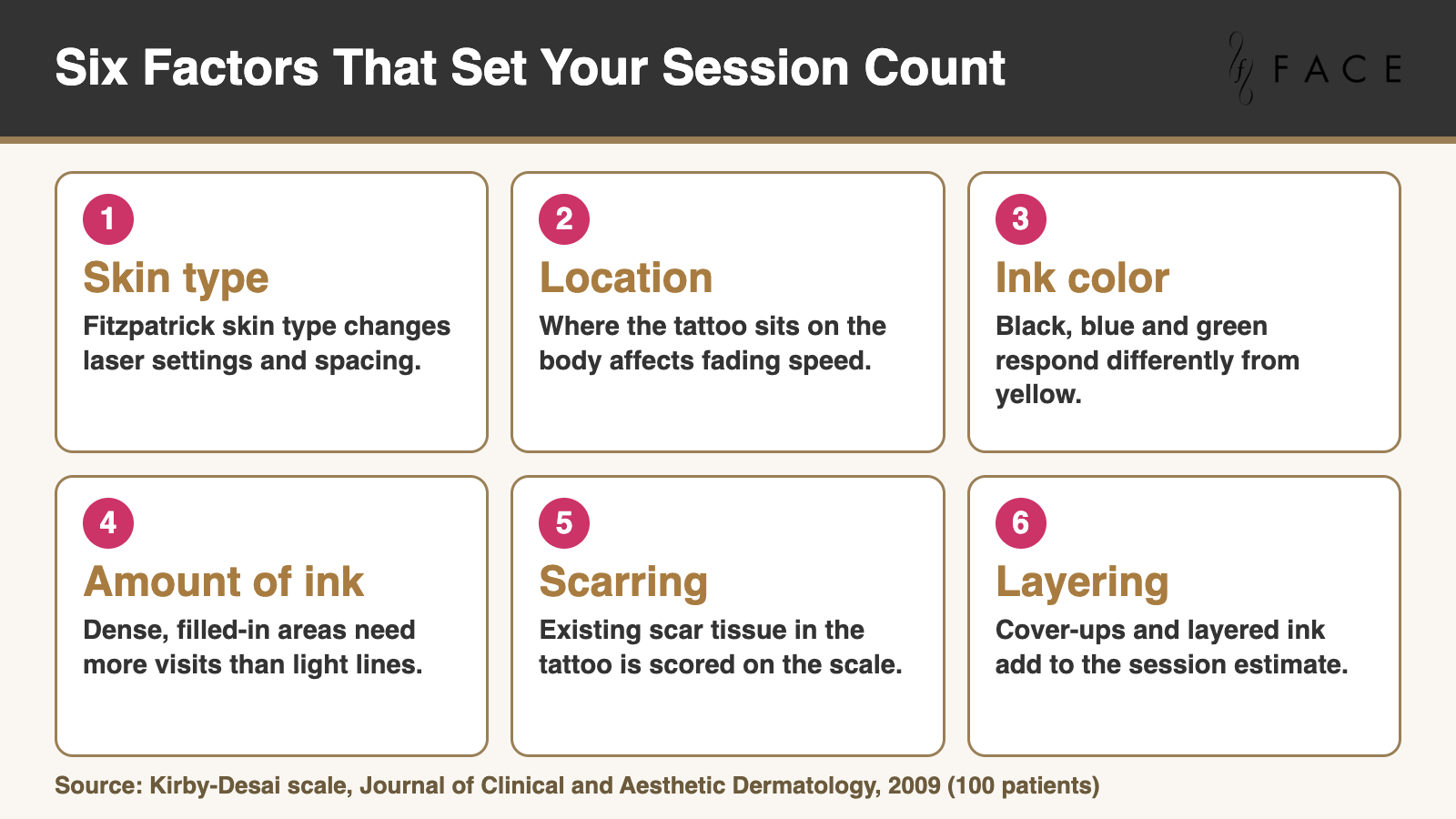
The table below compares session counts reported in published studies.
Each row reports a different laser and a different group, so the counts cannot be added together. Trials space visits from six weeks to three months. A typical visit follows the steps below.
- Your provider examines the tattoo and records ink colors, size, and location.
- You and your provider choose a comfort method, such as topical anesthetic cream.
- Short laser pulses pass over the tattooed area.
- Your provider applies ointment and covers the skin, as described in a 2001 American Journal of Clinical Dermatology review.
- Skin rests for several weeks while the body clears ink fragments.
Each step sets up the next visit, and ink color changes how that visit is planned.
How Does Ink Color Change Laser Tattoo Removal Results?
Ink color changes laser tattoo removal results because each pigment absorbs different wavelengths of light. A 2012 Dermatologic Surgery review reported that some colors clear more completely with particular wavelengths.
A 2001 American Journal of Clinical Dermatology review matched lasers to colors. Ruby and alexandrite lasers suit black, blue, and green ink. The 532 nm Nd:YAG laser suits red ink, and the 1064 nm Nd:YAG laser suits black and blue ink.
A 2022 Journal of the American Academy of Dermatology systematic review covered 36 studies out of 3,037 found. Picosecond lasers showed superiority for blue, green, and yellow pigments. Both laser types were safe and effective for black tattoos.
A 2017 British Journal of Dermatology trial treated 30 black tattoos on 21 patients twice, six weeks apart. Picosecond and nanosecond pulses gave no clearance difference after those two sessions. Picosecond pulses scored lower on pain, at 3.8 versus 7.9 on a 10-point scale.
Yellow ink has a smaller evidence base. A 2015 case series of six yellow-ink tattoos reported one complete clearance after a single session. The other five needed two to four treatments to pass 75% clearance.
FACE offers the Enlighten laser, which provides both picosecond and nanosecond pulse options. Multi-color tattoos use more than one wavelength. The chart in the next section shows what clearance looked like session by session.
What Should Laser Tattoo Removal Before and After Photos Show?
Laser tattoo removal before and after photos should show the same tattoo, angle, and lighting at each visit. Published trials judge clearance from blinded review of standardized digital photographs.
A good photo set includes the following details.
- A starting photo taken before the first session
- The same distance, angle, and lighting for every photo
- The number of sessions and the weeks between them
- The ink colors, since black and yellow ink behave differently
- A follow-up photo taken months after the final session
The 2015 Journal of Cosmetic Dermatology study tracked clearance by session. Black ink reached a median of 30% after one session and 40% after two. Gray ink reached 50% after one session and 70% after two.
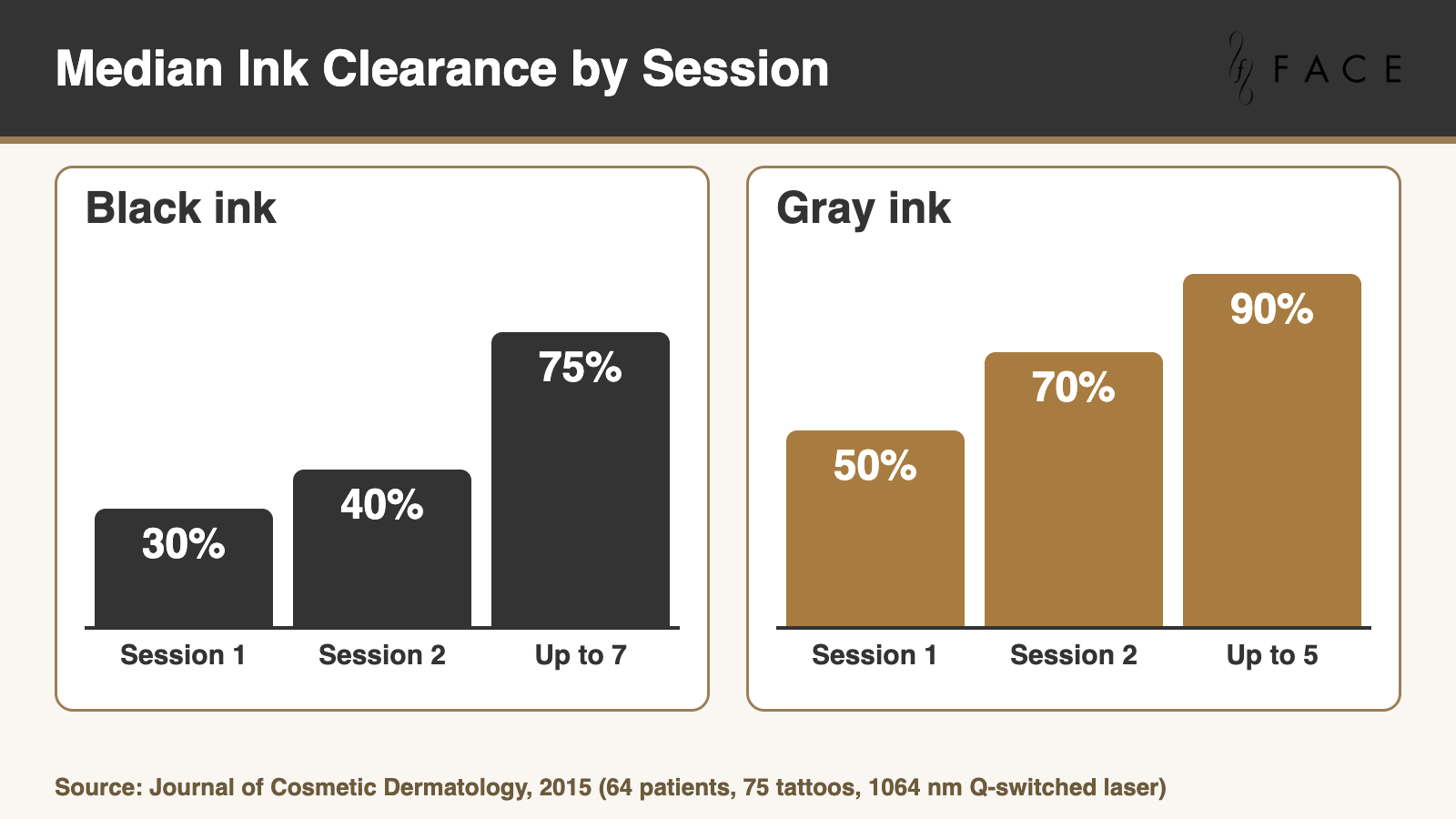
The chart above shows median clearance for black and gray ink. Black ink reached 75% after up to seven sessions. Gray ink reached 90% after up to five sessions.
Timing also affects what photos show. The 2024 study reported more clearance at the 4-to-5-year follow-up than at six months. Ink breakdown therefore continues after the last session. Our tattoo removal gallery shows patient cases from our practice.
What Else Should You Know About Laser Tattoo Removal?
Does Insurance Cover Tattoo Removal?
Medicare does not cover tattoo removal when the goal is appearance, and private plans set their own rules. The Medicare Benefit Policy Manual, Chapter 16, section 120, excludes procedures directed at improving appearance.
The same section makes exceptions for repair of accidental injury and for malformed body members. Private insurers write their own definitions, so a plan document or a call to the insurer gives the answer. Providers can explain what documentation a plan requests.
Will Tattoo Removal Leave a Scar?
Tattoo removal with a Q-switched laser is studied for minimal scarring, and published trials report none. A 2001 review compared nonspecific methods with Q-switched lasers and found fewer scarring and texture changes with lasers.
The 2012 repeated-exposure trial of 18 tattoos on 12 adults reported no scarring. The yellow-ink case series also reported no scarring or texture change. Both studies were small, so providers still set energy and spacing for each person. Gentle skin care and at-home scar care support healing between visits.
Can Microblading and Other Cosmetic Tattoos Be Removed?
Microblading and other cosmetic tattoos can be removed with lasers, but they need extra planning. A 2023 review in Lasers in Medical Science covered 11 studies and 129 patients treated for eyebrow pigment.
Cosmetic inks often contain iron oxide or titanium dioxide. A 2018 Dermatologic Surgery review explains that these pigments can darken under pigment-specific lasers. Providers who offer microblading removal plan the laser choice around that response.
How Should You Care for Skin Between Sessions?
Follow the written aftercare steps from your provider between sessions, and protect treated skin from the sun. Our guide to sun-safe laser care explains how laser patients protect their skin outdoors.
Questions about spacing belong with your provider. Trials space visits from six weeks to three months. The right gap depends on skin type, ink density, and healing.
How Does FACE Medspa Help With Laser Tattoo Removal?
FACE Medspa helps with laser tattoo removal by examining your tattoo, explaining the evidence, and building a session plan around your skin. We treat unwanted tattoos with a laser that offers picosecond and nanosecond pulse options.
We start with an exam of ink colors, depth, and location. Then we explain what fading looks like for your tattoo and how many visits studies suggest. No provider can promise a specific outcome. Our tattoo removal treatment page explains how that process works.
Our team answers “can tattoos be 100% removed” for your own tattoo after an exam. Laser energy devices keep improving, and our guide to laser energy devices covers the basics.
Patients from Bloomfield Hills and nearby towns come to our practice. You can book a tattoo consultation to review your design with a provider. Bring photos of the tattoo and any earlier treatment notes. That background helps the provider estimate sessions.
Every step gets explained before treatment begins, and your questions come first. We also review expected fading, spacing between visits, and aftercare in plain language. The FACE Medspa specialists plan each session around your goals and your skin.