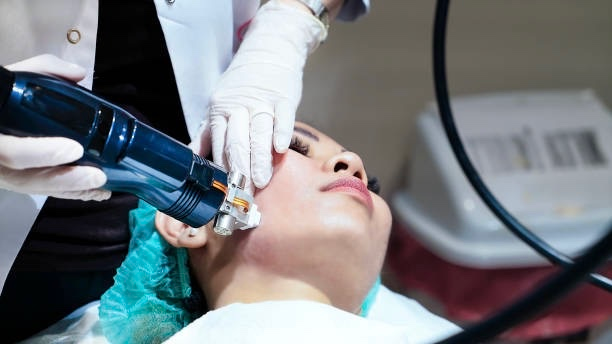
CO2 laser recovery takes about a week of visible healing followed by two to three months of fading pinkness. Redness and swelling dominate the first 48 hours, crusting and peeling peak around day 3 to 5, new skin surfaces between days 8 and 14, and collagen keeps rebuilding for up to six months after that. This article walks the whole timeline day by day, names the day most patients find hardest and explains why, covers what actually speeds healing according to controlled research, addresses the delayed effects that surface weeks later, and answers how CO2 compares with microneedling, blepharoplasty, and a facelift.
What Are the Stages of CO2 Laser Recovery?
The stages of CO2 laser recovery are inflammation, crusting and peeling, re-epithelialization, and remodeling. The first three happen in roughly two weeks and are the part you can see in a mirror, while remodeling runs quietly for months and produces the result you actually paid for. Confusing the two is why so many patients panic at day 5.
Demand for these treatments keeps climbing. The American Society of Plastic Surgeons counted 3,703,305 laser skin resurfacing procedures in 2024, a six percent rise over the prior year and the fastest growth of any minimally invasive category.
Depth drives everything about your timeline. A superficial pass aimed at pigment heals faster than a deep pass aimed at scars, which is why CO2 laser resurfacing does not have one universal recovery length. Your settings determine your calendar.
What Do You Look Like Right After a CO2 Laser?
Right after a CO2 laser you look sunburned, with red, swollen, tight skin that feels hot to the touch. Erythema is essentially universal at this point, reported in 95.38 percent of patients in one 65-patient series, alongside a burning sensation in 92.30 percent. Neither is a complication. Both are the treatment working.
Some pinpoint bleeding and oozing is normal depending on how deep the treatment went. The skin weeps because its barrier has been fractionated into thousands of microscopic columns, and that fluid is part of the healing cascade rather than a sign of injury.
Swelling peaks overnight rather than immediately. Most patients look worse the morning after their appointment than they did leaving the office, particularly around the eyes, which is worth knowing before you look in the mirror on day two.
What Does CO2 Laser Recovery Look Like Day by Day?
CO2 laser recovery follows eight recognizable stages from the day of treatment through month six. Redness and swelling own the first two days, crusting and peeling own days 3 through 7, fresh pink skin arrives between days 8 and 14, and the color fades across the following two to three months while collagen rebuilds underneath. The table below maps each stage against the published evidence.
| Stage | What the skin looks like | What is happening underneath | What the evidence shows |
|---|---|---|---|
| Day 0 | Deep red, hot, tight, possible pinpoint oozing | Micro-thermal columns created, inflammatory cascade begins | Erythema in 95.38 percent, burning sensation in 92.30 percent |
| Days 1 to 2 | Swelling peaks, especially around the eyes | Fluid shift and active inflammatory phase | Edema and erythema expected through the first week |
| Days 3 to 5 | Bronzed tone, crusting, tight dry sheets beginning to lift | Treated tissue migrating to the surface | Average scab duration 4.1 days |
| Days 5 to 7 | Active peeling, patchy appearance, new pink skin showing through | Re-epithelialization underway | Re-epithelialization averaged 5.5 days with single-pass CO2 |
| Days 8 to 14 | Peeling complete, skin bright pink, smooth and sensitive | New epidermis intact but immature | Average erythema duration 5.2 days; complete re-epithelialization by one week in one surgical series |
| Weeks 2 to 4 | Pinkness fading, makeup usually possible, texture improving | Barrier function rebuilding | Erythema past 2 weeks in 4.6 percent, all resolved by 5 weeks |
| Weeks 2 to 8 | Occasional small bumps or breakouts | Follicular re-epithelialization irregularities | Milia in 29.9 percent and acne aggravation in 20 percent |
| Months 3 to 6 | Color normalized, firmness and texture still improving | Collagen remodeling continuing | Tightening builds over 3 months with improvement up to 6 months |
Sources: Annales de Dermatologie et de Vénéréologie retrospective analysis of 46 fractional CO2 treatments; International Journal of Research in Dermatology 65-patient complication study; Journal of Plastic Reconstructive and Aesthetic Surgery combined resurfacing series; Clinical Cosmetic and Investigational Dermatology skin resurfacing review; American Society of Plastic Surgeons 2024 Procedural Statistics Report.
Two device settings shift that whole table. Active FX and Deep FX heal on different schedules, with the more superficial Active FX treatment running shorter in duration than the deeper Deep FX pass.
What’s the Worst Day After a CO2 Laser?
The worst day after a CO2 laser is day 3 for most patients, and day 2 for anyone whose main complaint is swelling. Day 3 is when crusting is at its most obvious, the bronzed discoloration is at its darkest, and peeling has started but is nowhere near finished, so the skin looks patchy rather than uniformly healing. Nobody enjoys the day 3 mirror.
The numbers explain why it lands there. Scabs average 4.1 days in duration, which puts day 3 near their peak, while erythema averages 5.2 days and is still fully present at the same time. Two effects overlap at their worst point on the same day.
Discomfort is usually not what makes day 3 hard. Pain scores in the same study averaged 3.3 out of 10 for patients premedicated with topical anesthetic and 4.1 out of 10 for those who were not, so the difficulty is visual rather than physical. Knowing that in advance is most of the battle.
How Long Does It Take for Skin to Look Normal After a CO2 Laser?
Skin looks presentable about 7 to 10 days after a CO2 laser and looks fully normal about 2 to 3 months after. Those are two different milestones and patients who expect only the first one are consistently caught off guard by the second. The surface closes long before the color settles.
Presentable means re-epithelialized and coverable. By days 8 to 14 the peeling is done and the new skin is intact but bright pink, and most patients feel comfortable in public with mineral makeup at that point. One series recorded complete re-epithelialization in every patient by one week.
Fully normal means the pinkness has gone. Residual erythema persisting past two weeks occurred in 4.6 percent of patients in one series and resolved in all of them by five weeks, while the broader literature describes color fading over two to three months and occasionally longer with deeper treatments.
Does CO2 Laser Recovery Hurt?
CO2 laser recovery is uncomfortable rather than painful, with most patients describing a sunburn sensation instead of sharp pain. Measured pain averaged 3.3 out of 10 in patients who received topical anesthetic beforehand and 4.1 out of 10 in those who did not, across 46 fractional CO2 treatments. Premedication makes a real and measurable difference.
The burning sensation is at its most noticeable in the first several hours after treatment and settles substantially by the next morning. Tightness replaces burning as the dominant sensation from about day 2 onward, and itching often appears around days 4 to 6 as re-epithelialization progresses.
Itching is the sensation most likely to cause trouble, because scratching or picking at crusts disrupts new skin and raises scarring risk. This is the one discomfort worth actively managing rather than tolerating.
How Do You Speed Up CO2 Laser Recovery?
You speed up CO2 laser recovery by keeping the skin occluded and moist, protecting it completely from sun, and leaving it alone. A randomized controlled trial found that a multi-molecular hyaluronic acid regimen produced significantly lower erythema at days 3, 7, and 14, lower water loss through the skin at day 14, and shorter pain duration than a standard moisturizer. What you put on the skin measurably changes the curve.
- First 48 hours: occlude. Petroleum-based ointment, bio-occlusive film, or hydrogel keeps the surface moist and reduces crust formation.
- Days 1 to 7: cleanse gently. Lukewarm water, mild non-exfoliating cleanser, clean hands, pat dry without rubbing.
- Days 1 to 14: moisturize frequently. Hydration supports the barrier while it rebuilds, and dry skin heals slower and looks worse.
- Do not pick. Crusts release when the new skin beneath them is ready. Removing them early disrupts healing and raises scarring risk.
- Once closed: sunscreen daily. Broad-spectrum protection from the moment the skin has sealed, without exception.
- Hold actives for at least a week. Retinoids, alpha hydroxy acids, beta hydroxy acids, and vitamin C wait until cleared.
- Sleep elevated for the first few nights. Head elevation reduces the overnight swelling that peaks around day 2.
Some practices add regenerative support to the recovery window. An exosome infusion applied after resurfacing is one approach used to support the appearance of healing skin, and we plan those combinations individually rather than adding them by default.
What Should You Not Do After CO2 Laser, and When Can You Wear Makeup?
You should not sweat, swim, sit in heat, exfoliate, pick, or expose treated skin to sun after a CO2 laser. Makeup waits until the skin has fully closed and all crusting has resolved, which is usually around two weeks for a deeper treatment and sooner for a superficial one. Applying makeup over open skin invites bacteria into a wound.
Heat and sweat restrictions run roughly one to two weeks. Saunas, hot yoga, steam, hot tubs, swimming pools, and intense exercise all irritate healing skin, and chlorinated water in particular is harsh on a compromised barrier.
Sun avoidance is the restriction with the longest tail. Freshly resurfaced skin is highly photosensitive, and unprotected exposure during the healing window raises the risk of pigmentation problems and prolonged redness more than any other single factor.
When Should You Call Your Provider After CO2 Laser?
Call your provider after a CO2 laser if pain increases rather than decreases, if redness spreads beyond the treated area, if drainage turns green or yellow, or if you develop a fever or chills. Oozing, crusting, and clear fluid are expected. Colored discharge and escalating pain are not. The distinction is direction of travel.
Cold sore reactivation deserves specific attention. Herpes reactivation occurred in 10.6 percent of treatments in one retrospective analysis, some of them despite antiviral prophylaxis, and rates of 2 to 7 percent have been reported with traditional ablative lasers. Tingling or clustered blisters during healing warrants a call the same day.
Trust your instinct on this. Normal healing feels progressively better each day after the first two, so anything that reverses that direction is worth a phone call rather than a wait-and-see.
What Happens Weeks 2 to 8 After CO2 Laser?
Between weeks 2 and 8 after a CO2 laser, small white bumps or unexpected breakouts appear in a meaningful share of patients, well after the timeline most people were given. Milia were observed in 29.9 percent of patients and acne aggravation in 20 percent, appearing between 2 and 8 weeks post-treatment. Almost nobody warns patients about this window.
The mechanism is follicular. As the skin re-epithelializes, hair follicles and oil glands can seal over irregularly, trapping keratin in tiny cysts or blocking oil flow and producing breakouts in someone whose skin has been clear for years. Both are temporary and both are treatable in office.
Heavy occlusive ointments used during early healing contribute in some patients, which is one reason the aftercare routine should transition from occlusive to lighter products once the skin has closed rather than continuing indefinitely.
Does Skin Tone Change CO2 Laser Recovery?
Skin tone changes CO2 laser recovery meaningfully, and the published complication rates vary enormously depending on which population was studied. One review of 856 fractional treatments recorded post-inflammatory hyperpigmentation in 1.1 percent of cases, while a 65-patient series in a cohort with predominantly deeper skin tones recorded it in 44.61 percent. That gap is not a contradiction. It is skin type and settings.
- Fitzpatrick I to III. Lower pigmentation risk. The 856-treatment review found prolonged erythema in 1.8 percent, hyperpigmentation in 1.1 percent, and melasma aggravation in 0.9 percent, with no long-term adverse events.
- Fitzpatrick IV to VI. Higher post-inflammatory hyperpigmentation risk, requiring conservative settings, careful device selection, and structured pre-treatment and post-treatment planning.
- Melasma history. Resurfacing can aggravate melasma regardless of skin tone, so a melasma history changes the plan before it changes the settings.
- Recent sun exposure. Tanned skin raises pigmentation risk at any Fitzpatrick type, which is why treatment is deferred rather than adjusted.
- Device choice matters. Deep FX can be used on darker skin tones, and matching the platform and depth to the skin type is the variable that moves those percentages.
Deeper skin tones are not excluded from resurfacing. They require a plan built around pigment, and patients with existing hyperpigmentation concerns should have that discussion before booking rather than after.
How Many Times Should You Do CO2 Laser to See Good Results?
You should plan on one CO2 laser treatment for general resurfacing and two to three spaced several months apart for deeper scarring. Because the treatment is ablative, a single session produces far more change than one session of any non-ablative modality, which is the entire tradeoff for the downtime. More is not automatically better here.
Spacing is longer than most patients expect. Collagen remodeling continues for up to six months after treatment, so reassessing at the three to six month mark before deciding on another session avoids treating skin that is still improving on its own. At our Bingham Farms practice we photograph patients under standardized lighting at that review rather than relying on memory.
Scarring is the main reason for a second session. Post-acne scarring was the most common indication in one 65-patient series at 38.4 percent, and deeper atrophic scars generally need more than one pass over time. Our breakdown of laser options for acne scars covers how those plans get built.
Combining depths in one appointment is the other option. Total FX pairs the superficial and deep treatments in a single session, addressing pigment and texture together rather than sequencing them across separate visits.
Will CO2 Laser Tighten Jowls?
CO2 laser tightens mild jowling and does not lift established jowls. The tightening comes from collagen contraction and new collagen formation in the dermis, which firms the skin envelope without repositioning anything beneath it. Where the problem is descended tissue rather than loose surface, resurfacing reaches its ceiling.
Early softening along the jawline responds reasonably well, and the effect builds over three months rather than appearing at healing. Pronounced jowling with clear skin excess does not, and no number of laser sessions changes that.
Layered approaches serve moderate laxity better than repeat resurfacing. Combining CO2 with energy-based skin tightening addresses different tissue depths, which is a more productive plan than treating the same layer twice.
Will CO2 Laser Tighten Eyelids, and What Does CO2 Laser Do to Eyes?
CO2 laser tightens eyelid skin and improves crepiness, and the eye area is treated with protective shields in place at every session. Metal corneal shields are inserted before any periocular treatment, which is standard and non-negotiable regardless of how superficial the settings are. The laser never contacts the eye itself.
Eyelid skin heals on a longer schedule than cheek skin. Swelling in the periocular area is more pronounced and lasts longer than anywhere else on the face, and the skin feels notably tighter through the first week. Cold compresses and head elevation help more here than anywhere else.
Results in this area hold well because eyelid skin has little movement working against the new collagen. Most patients see the crepey texture around the lower lid improve over the same three to six month remodeling window that applies to the rest of the face.
Can CO2 Laser Get Rid of Eye Bags?
CO2 laser does not get rid of true eye bags, and it does improve the crepey, lined skin that often surrounds them. A genuine under eye bag is orbital fat pushing forward through a weakened septum, and resurfacing the skin above it does not move fat. Tightening the surface can make a mild bag read as less prominent, and it will not eliminate a pronounced one.
Sorting the cause is the whole exercise. Shadowing from a hollow, pigment in the eyelid skin, crepey texture, and herniated fat all look similar in a mirror and respond to completely different treatments, which is why we assess under eye bags before recommending anything.
Being direct about this is better than the alternative. A patient who books resurfacing hoping to remove a fat pad will be disappointed at month three no matter how well the treatment goes.
Is CO2 Laser Better Than Blepharoplasty?
CO2 laser is better than blepharoplasty for skin quality and worse than blepharoplasty for excess skin and fat. Resurfacing changes the surface of the skin, while eyelid surgery removes tissue, and those are answers to different questions. One is not an upgrade of the other.
If your concern is fine lines, crepiness, and texture around the eye, resurfacing addresses it without surgery. If your concern is a fold of upper eyelid skin resting on your lashes or a distinct lower lid bulge, that is a surgical problem and a laser will not resolve it.
The two are sometimes sequenced rather than chosen between. FACE does not perform eyelid surgery, and where a surgical answer is the right one we will tell you so rather than sell you a treatment that will not deliver what you want.
Is CO2 Laser as Good as a Facelift?
CO2 laser is not as good as a facelift for lifting, and a facelift is not as good as CO2 laser for skin quality. A facelift repositions deeper structures and removes skin, while resurfacing rebuilds the quality of the skin that is there. Surgeons routinely combine them for that exact reason.
Evidence from combined procedures supports the pairing. In a series where fractional ablative resurfacing was performed simultaneously with facelift surgery, every patient achieved complete re-epithelialization by one week, with no delayed wound healing or skin flap loss observed.
The practical read is straightforward. Sun damage, fine lines, texture, and pigment go to the laser. Descent, jowling, and skin excess go to surgery. A patient with both will get an incomplete result from either one alone.
Is CO2 Better Than Microneedling?
CO2 is more powerful than microneedling and requires substantially more downtime, which makes the better choice a question of what you are willing to trade. CO2 removes tissue, while microneedling and radiofrequency microneedling create channels without ablating the surface, so one delivers more change per session and the other delivers more sessions with less disruption. Neither is universally superior.
Downtime is the honest dividing line. CO2 asks for roughly a week of visible healing in exchange for a single session, while microneedling asks for one to three days of redness across a series of three or four sessions. The total change can end up comparable and the calendars look nothing alike.
Skin type shifts the calculation too. Pigmentation risk runs higher with ablative resurfacing than with radiofrequency-based approaches, which is part of why device selection matters more for deeper skin tones than treatment category alone.
What Is Better Than CO2 Laser for Face?
What is better than CO2 laser depends entirely on your concern, since CO2 is the strongest resurfacing option and the strongest option is not always the right one. Pigment without texture, redness without laxity, and thin skin needing support all have better-suited answers than ablative resurfacing. Matching the tool to the problem beats reaching for the most powerful device.
For pigment and vascular concerns without significant texture involvement, light-based and non-ablative options in our laser skin treatments menu resolve the issue with a fraction of the downtime.
For laxity as the primary concern rather than surface quality, radiofrequency treatments reach the tissue involved in firmness without removing the epidermis at all. The consultation exists to sort which of these you actually need.
Frequently Asked Questions
Is CO2 Laser on Face Worth It?
CO2 laser on the face is worth it for patients with sun damage, texture irregularity, fine lines, or scarring who can accommodate about a week of visible downtime. It remains the most powerful non-surgical resurfacing option available, delivering in one session what gentler modalities need several to approach. Patients who cannot take the downtime are usually better served by a staged non-ablative plan.
Is the CO2 Laser Outdated?
The CO2 laser is not outdated, and the technology has changed considerably since fully ablative resurfacing was the standard. Fractional delivery treats columns of skin while leaving surrounding tissue intact, which cut recovery from weeks to days and lowered complication rates substantially. One review of 856 fractional treatments found adverse events in 5.0 percent of cases with no long-term sequelae.
Can You Drive Yourself Home After CO2 Laser?
You can usually drive yourself home after a CO2 laser when only topical numbing was used. Any treatment involving oral sedation or stronger anesthesia requires a driver. Swelling around the eyes can affect comfort on the drive, so arranging a ride is reasonable even when it is not strictly required.
How Long Before You Can Exercise After CO2 Laser?
You can exercise about one to two weeks after a CO2 laser, once the skin has fully closed. Sweat irritates healing skin and raises infection risk while the barrier is compromised, and elevated body temperature increases swelling. Light walking is generally fine sooner.
Do You Need Antivirals Before CO2 Laser?
Antiviral prophylaxis is standard before CO2 laser resurfacing for anyone with a history of cold sores, and many providers prescribe it regardless of history. Protocols typically start the medication two days before treatment and continue for 7 to 10 days afterward. Herpes reactivation was reported in 10.6 percent of treatments in one retrospective analysis, including some cases despite prophylaxis.
Can CO2 Laser Be Done on the Neck and Chest?
CO2 laser can be done on the neck and chest, with more conservative settings than the face. Skin in both areas is thinner, has fewer oil glands, and carries less blood supply, so healing runs slower and the risk of textural change is higher. Recovery on the neck and chest typically extends several days beyond the facial timeline.
The Takeaway
CO2 laser recovery is predictable, and predictability is what makes it manageable. Two days of swelling, a hard day around day 3, peeling through the end of the first week, new pink skin by days 8 to 14, presentable at 7 to 10 days, fully normal color by two to three months, and results still improving at month six. The bumps that appear at week four are expected, the itching around day 5 is expected, and the day 3 mirror is worse than the treatment.
What makes recovery go well is matching depth to concern, protecting the skin completely from sun, and leaving the crusts alone. Our team in Bingham Farms plans settings around your skin type and your calendar rather than running one protocol on everyone, and we will tell you honestly when your concern would be better served by a different treatment entirely. If you want to know what your own recovery would realistically look like, we would be glad to map it out at a consultation with our team at FACE Skincare~Medical~Wellness.