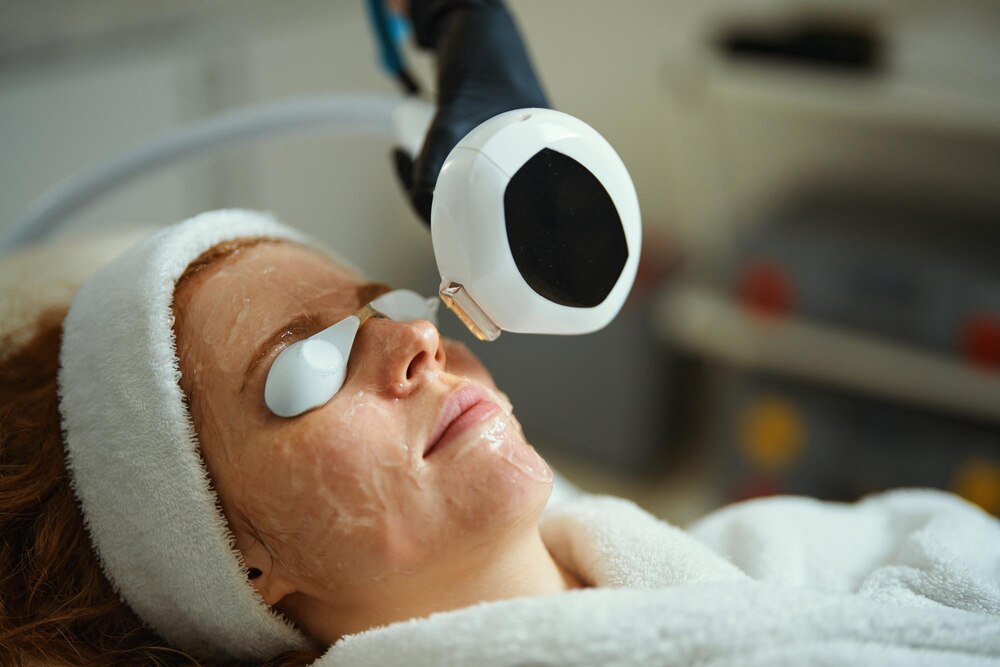
Halo laser recovery moves fast compared with traditional resurfacing. Day one looks like a mild sunburn with very little visible change, a bronzed sandpaper texture appears on days two to three, peeling runs through day four or five, and the glow most people book this treatment for arrives by the end of the first week. This article maps every stage against what is happening in the tissue, explains the bronzing that alarms patients on day three, covers how recovery shifts when the treatment level goes up, and answers how Halo compares with CO2, Fraxel, Morpheus8, and microneedling.
What Happens to Your Skin Day by Day After a Halo Laser Treatment?
Your skin moves through six stages after a Halo laser treatment, and the visible part is largely finished within a week. Warmth and redness on day one, bronzing and roughness on days two to three, peeling on days three to five, fresh glowing skin by days five to seven, pigment continuing to clear through weeks two to three, and dermal remodeling running quietly for months after that. The table below maps each stage against what is happening underneath.
| Stage | What the skin looks like | What is happening underneath | What the evidence or protocol shows |
|---|---|---|---|
| Day 0 | Red, warm, tight, similar to a mild sunburn | Coagulation and superficial ablation delivered to the same zones | Warmth typically persists about 30 minutes, longer at deeper levels |
| Day 1 | Very little visible change, skin feels rough and tight | Inflammatory phase underway, epidermis intact | Makeup is generally possible the next day |
| Days 2 to 3 | Light bronzing, sandpaper texture, dryness | MENDs migrating toward the surface | Bronzing forms on days 2 to 3 per manufacturer protocol |
| Days 3 to 5 | Fine peeling, patchy bronze flaking away | Debris shedding, new epidermis beneath | MENDs fall off by day 4 or 5 depending on depth and intensity |
| Days 5 to 7 | Fresh, smooth, noticeably brighter skin | Re-epithelialization complete | Initial results appear about 4 to 5 days after treatment |
| Weeks 2 to 3 | Tone continuing to even out, spots fading | Pigment clearing from the epidermis | Greatest pigmentary improvement occurs in the first 2 to 3 weeks |
| Months 1 to 3 | Texture refining, pores looking smaller, firmness improving | Dermal collagen remodeling | Trial follow-up ran to 3 months with 80 percent showing significant improvement |
Sources: Waibel, Pozner, Robb and Tanzi, “Hybrid Fractional Laser: A Multi-Center Trial on the Safety and Efficacy for Photorejuvenation,” Journal of Drugs in Dermatology, 2018; Sciton clinical treatment documentation; Pozner and Robb hybrid fractional laser white paper.
Two wavelengths produce that split timeline. The Halo laser delivers a 1470 nm non-ablative wavelength that coagulates tissue at tunable depths from 100 to 700 microns, alongside a 2940 nm erbium wavelength that ablates the epidermis from 20 to 110 microns, both into the same microscopic treatment zone.
What Are MENDs After a Halo Laser?
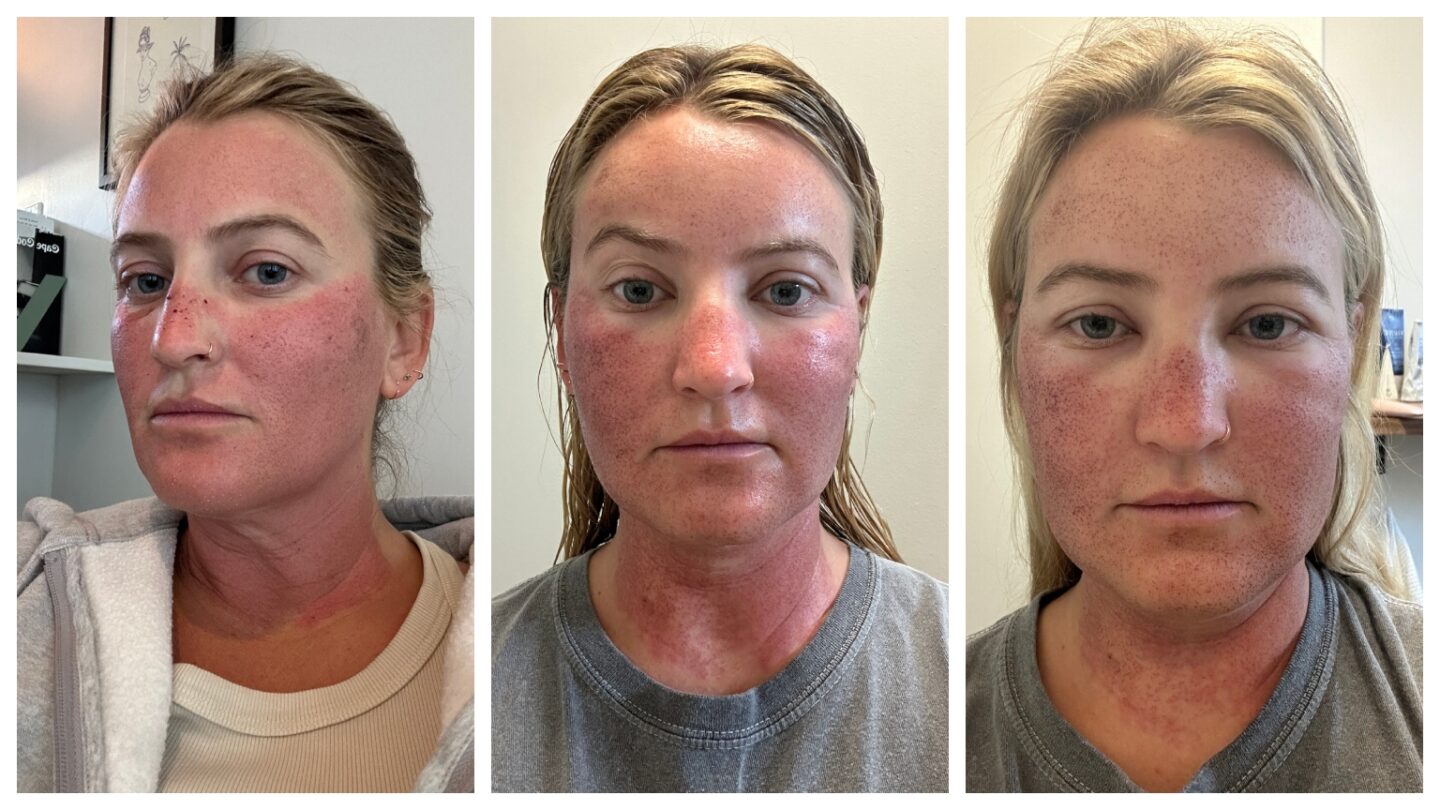
MENDs are microscopic epidermal necrotic debris, the treated skin cells your body pushes toward the surface before shedding them. The bronzed, sandpapery look on days two and three is MENDs moving upward, and the peeling on days three through five is MENDs coming off. Nothing is wrong when your face turns bronze. That is the treatment completing its cycle.
The ablative wavelength is what makes this happen quickly. Superficial ablation from the 2940 nm erbium wavelength speeds the clearance of MENDs, which is a large part of why this laser produces resurfacing-level change on a recovery schedule closer to a non-ablative treatment.
The texture is the part patients describe most. Skin feels genuinely like fine sandpaper during this window, and the sensation is more noticeable than the appearance, since the bronzing itself is usually subtle enough to cover.
What Does Day 3 of Halo Laser Recovery Look Like?
Day 3 of Halo laser recovery looks bronzed and dry, with a rough texture and the first flaking usually beginning at the edges of the treated area. This is the most visually noticeable day of the entire recovery, and it is also the day the treatment is working hardest. Bronzing typically peaks here before peeling takes over.
Where flaking starts varies by area. Around the mouth and along the jawline tends to shed first, while the cheeks and forehead follow a day behind, which produces the patchy appearance that shows up in most day 3 photos online.
Do not help it along. Pulling at partially attached MENDs removes skin that is not ready to release and risks irritation and uneven healing, so the correct approach on day 3 is a gentle cleanser, moisturizer, and patience.
How Much Swelling Should You Expect After Halo?
Expect mild swelling after Halo, mostly in the first 24 to 48 hours and mostly around the eyes. Halo produces noticeably less swelling than deeper ablative resurfacing because the ablative component reaches only the epidermis, up to 110 microns, rather than removing full surface layers. Most patients describe puffiness rather than obvious swelling.
Swelling peaks the morning after treatment rather than on the day itself. Sleeping with your head elevated for the first two nights and using cool compresses in the first 24 hours both reduce it meaningfully.
Deeper treatment levels shift this. A patient treated aggressively will see more swelling and hold it a day or two longer than someone treated at a lighter level, which is one of several reasons the same treatment name produces very different recovery experiences.
How Long Does It Take to Fully Recover From a Halo Laser?
Halo laser recovery takes about 5 to 7 days on the surface and about 3 months to finish underneath. Surface recovery means the peeling has finished and you look better than you did before treatment, while full recovery means the dermal remodeling has run its course. The first milestone is what most people mean by recovery. The second is what produces the result.
Most patients return to work and normal activity the day after treatment, keeping the skin protected and calm for the first 24 hours only. That is the practical difference between this and traditional resurfacing, where a week of visible healing is the baseline.
Sun protection extends well past the peeling. Daily sunscreen with no direct sun exposure for seven days post-treatment is the standard protocol, and continued protection after that window protects the pigment result you just paid for.
How Long After a Halo Will You See Results?
You will see initial results about four to five days after a Halo treatment, once the MENDs have shed and the new skin is exposed. Pigment improvement continues for the first two to three weeks, and dermal changes in texture and firmness build for months after that. The bright, clear look at day five is real, and it is not the finished result.
The published evidence tracks that longer arc. In a multi-center trial with follow-up at one week, two weeks, and one, two, and three months, 80 percent of subjects who completed the study showed significant skin improvement on photographic analysis reviewed by six blinded evaluators, and 100 percent reported satisfaction with their treatment and results.
Pigment is usually the first thing patients notice. Sun spots darken during the bronzing phase and then lift with the MENDs, which is why pigment concerns often respond visibly faster than texture does.
Longevity is a separate question from onset. Our breakdown of how long Halo results last covers what holds and what needs maintaining.
What Is an Aggressive Halo Treatment, and How Does Recovery Differ?
An aggressive Halo treatment uses higher energy and greater coverage at both wavelengths, and it roughly doubles the visible recovery. Where a light treatment produces subtle bronzing and finishes peeling by day three or four, an aggressive treatment produces obvious bronzing, more swelling, and peeling that can run through day six or seven. Same laser, different calendar.
The provider sets the level. Coagulation depth is tunable from 100 to 700 microns and ablation from 20 to 110 microns, and those settings are chosen based on your concern, your skin type, and how much downtime you can accommodate. Most solar damage sits within the first 200 to 400 microns of the dermis, which is the range a standard treatment targets.
This is the conversation to have before booking rather than after. At our Bingham Farms practice we set the level around your actual calendar, because a hybrid fractional laser treatment scheduled four days before an event needs different settings than one scheduled four weeks out.
How Painful Is the Halo Laser?
The Halo laser is moderately uncomfortable during treatment and largely comfortable afterward. The multi-center trial recorded an average pain score of 4 on a 0 to 10 scale during treatment, which places it in the tolerable middle rather than at either extreme. Most patients describe heat with occasional prickling.
Topical anesthetic and integrated cooling handle most of it. The handpiece includes air cooling built into the device, and numbing cream applied beforehand brings the sensation down substantially for the treatment itself.
Afterward the dominant sensation is warmth rather than pain. That warmth typically persists about 30 minutes following treatment and runs a bit longer at deeper levels, after which tightness and dryness take over as the main sensations through the peeling window.
What Not to Do After Halo Treatment, and When Can You Wear Makeup?
Do not pick, exfoliate, sweat heavily, or expose your skin to direct sun after a Halo treatment, and makeup is generally fine starting the day after. The makeup timeline is one of Halo’s genuine advantages, since traditional ablative resurfacing keeps patients bare-faced for closer to two weeks. Here is the sequence we give patients:
- First 24 hours. Keep the skin protected and calm. Gentle cleanser, moisturizer, nothing else.
- Day 1 onward. Normal activities resume. Makeup is usually acceptable at this point.
- Days 2 to 5. Cleanse gently and moisturize frequently. Do not exfoliate, scrub, or pull at flaking skin.
- Full 7 days. Sunscreen daily with no direct sun exposure. This is the protocol, not a suggestion.
- First week. Skip retinoids, alpha hydroxy acids, beta hydroxy acids, and vitamin C until the peeling has finished.
- First 48 hours. Avoid saunas, hot yoga, steam, swimming pools, and intense exercise.
- Ongoing. Continue daily sun protection well past the peeling window to protect the pigment result.
How Many Halo Treatments Do You Need?
Most patients need one to two Halo treatments to see the change they came in for. Older non-hybrid technology commonly required five to six sessions to produce comparable results, and delivering both wavelengths into the same treatment zone is what compressed that number. The published trial used two treatments spaced four to six weeks apart.
Your concern determines whether one is enough. Generalized sun damage and dullness often resolve in a single session, while established pigment, more pronounced texture irregularity, and larger pores tend to do better with two.
Maintenance is a separate conversation from the initial course. Once the result is where you want it, an annual or twice-yearly session keeps pace with new sun exposure rather than starting over.
Does Halo Tighten Skin, and Does Halo Tighten Jowls?
Halo produces mild tightening and does not tighten jowls. The 1470 nm wavelength coagulates into the dermis and stimulates collagen, which firms the skin envelope modestly, and firming an envelope is not the same as lifting descended tissue. Expecting a lift from a resurfacing laser sets up disappointment at month three.
Where Halo excels is skin quality rather than skin position. Tone, clarity, pore size, fine lines, and surface smoothness all respond well, and patients who describe their skin as dull, blotchy, or rough get the most out of it. Concerns centered on texture and pores are squarely in its lane.
Established jowling needs a different category of treatment or a surgical answer, and layering approaches serves moderate laxity better than repeating resurfacing sessions that were never going to lift anything.
Is Halo Good for Older Skin?
Halo is good for older skin, and the clinical evidence was generated on exactly that population. The multi-center trial enrolled subjects with a mean age of 52 plus or minus 14 years, meaning the 80 percent significant improvement figure came from a group centered in their fifties rather than from young skin with minimal damage. Accumulated sun damage is what this laser was designed for.
Older skin often has more to gain, since decades of pigment and texture change give the treatment more to correct. The tradeoff is that deeper wrinkles and true laxity will not resolve here regardless of age.
Skin type matters more than age for safety. The trial enrolled Fitzpatrick types I through IV, and two subjects developed post-inflammatory hyperpigmentation that resolved within 90 days, with no other adverse events reported. We assess both before recommending a Halo treatment to anyone.
Can Halo Be Done on the Neck and Chest, and What Is the Best Laser to Tighten the Neck?
Halo can be done on the neck and chest, at more conservative settings than the face, and no single laser is the definitive answer for tightening a neck. Neck and chest skin is thinner, carries fewer oil glands, and heals more slowly, so recovery in those areas typically runs two to three days longer than the facial timeline. Sun damage on the décolletage responds particularly well.
For neck tightening specifically, the honest answer is that resurfacing improves crepey texture and sun damage while doing relatively little for laxity. Energy-based tightening reaches the tissue involved in firmness, and combining approaches beats asking one device to do both jobs.
Pigment on the chest often responds better to a light-based treatment first. Pairing BBL Hero with Halo lets each device do what it does best, which is a common sequence for chest and neck concerns.
Is CO2 or Halo Laser Better?
CO2 is stronger and Halo is easier, and the better choice depends on which of those matters more for your concern. CO2 removes full layers of the epidermis and reaches deeper into the dermis, producing more change per session at the cost of roughly a week of visible healing, while Halo produces resurfacing-level improvement with peeling that finishes around day five. Here is how they actually differ:
- Ablation depth. Halo ablates the epidermis up to 110 microns. Fully ablative CO2 removes full surface layers, and even fractional CO2 goes considerably deeper.
- Visible downtime. Halo peeling finishes by day four or five. Fractional CO2 erythema averages 5.2 days and scabbing 4.1 days, with the full visible arc running one to two weeks.
- Makeup. Halo generally allows makeup the next day. CO2 usually waits until the skin has fully closed, often around two weeks.
- Deep wrinkles and scarring. CO2 wins clearly. This is what deeper ablation is for.
- Sun damage, pigment, tone, and pores. Halo handles these well with far less disruption.
- Sessions. Halo typically needs one to two. CO2 often needs only one for general resurfacing.
Both have a place, which is why we run both. Patients with significant scarring or deep static lines are better served by CO2 laser resurfacing, and we will say so rather than steer someone toward the easier recovery when it will not deliver what they want.
Which Is Stronger, Fraxel or Halo?
Halo is stronger than non-ablative Fraxel and lighter than fully ablative CO2-based Fraxel, because Fraxel is a family of devices rather than a single treatment. The meaningful comparison is not brand against brand but whether a device delivers ablation, non-ablative coagulation, or both. Halo delivers both in one pass, which is what hybrid fractional means.
Non-ablative fractional devices work entirely beneath an intact surface, which keeps downtime minimal and generally requires a longer series to reach a target. Ablative fractional devices remove tissue and produce more change per session with more recovery.
Halo sits deliberately between them. Coagulation reaching up to 700 microns handles the dermal work while ablation limited to the epidermis keeps the surface recovery short, and that combination is the entire design rationale.
Is Halo Laser Better Than Morpheus8, and Is Halo Better Than Microneedling?
Halo is better than Morpheus8 and microneedling for pigment and surface quality, and both of those are better than Halo for laxity and deeper remodeling. Halo treats from the surface down, while radiofrequency microneedling delivers energy from within the dermis outward, so they address opposite ends of the same problem. Comparing them directly misses that they are complementary.
For sun spots, uneven tone, dullness, and pore size, no needling device competes with a resurfacing laser. Pigment lives in the epidermis and the superficial dermis, and that is where Halo works.
For skin laxity, jowling, and deeper structural change, Morpheus8 reaches tissue Halo does not. Many patients end up doing both across separate appointments rather than choosing.
Traditional microneedling without radiofrequency sits lower on the intensity scale than either, with correspondingly less downtime and a longer series to reach a comparable endpoint.
What Is the Strongest Laser for Skin Resurfacing, and What’s Better Than a Halo Laser?
The strongest laser for skin resurfacing is a fully ablative CO2 laser, and strongest is rarely the same as best. Strength is a measure of how much tissue a device removes, while best is a measure of whether the result matches what you actually needed at a cost you were willing to pay in downtime. Those two questions have different answers for most patients.
What is better than Halo depends on the concern. Deep wrinkles and pronounced scarring go to CO2. Laxity goes to radiofrequency or ultrasound-based tightening. Vascular redness goes to light-based treatment. Pure pigment with no texture component often responds to something gentler.
For patients wanting even less downtime than Halo, MOXI sits a step below it on the intensity scale with a correspondingly shorter recovery.
Matching the device to the concern is the whole point of carrying a full range of laser skin treatments rather than one machine that gets recommended to everyone who walks in.
Frequently Asked Questions
Is Halo Laser Really Worth It?
Halo laser is worth it for patients whose main concerns are sun damage, uneven tone, dullness, texture, and pore size, particularly those who cannot take a week off. In the multi-center trial, 100 percent of subjects reported satisfaction with their treatment and results, and 80 percent showed significant improvement on blinded photographic analysis. Patients wanting correction of deep wrinkles or laxity will find it underdelivers.
What Is the Best Laser for a 60 Year Old Woman?
The best laser for a 60 year old woman depends on her primary concern rather than her age. Halo suits accumulated sun damage, pigment, and texture, which are the most common concerns at that stage, and the clinical trial population had a mean age in the early fifties. Where laxity is the dominant issue, energy-based tightening or a surgical consultation serves better than resurfacing alone.
Can You Exercise After Halo?
You can exercise about 48 hours after Halo, once the initial warmth and swelling have settled. Sweat irritates healing skin and elevated body temperature increases swelling during the first two days. Light walking is fine sooner, and saunas and hot yoga should wait until the peeling has finished.
Is Halo Safe for Darker Skin Tones?
Halo has been studied in Fitzpatrick skin types I through IV, with two cases of post-inflammatory hyperpigmentation across the trial population that resolved within 90 days. Because the provider sets the intensity, treatment can be adjusted conservatively for higher Fitzpatrick types. A consultation that assesses skin type before selecting settings is the safeguard that matters here.
Can Halo Be Combined With BBL?
Halo can be combined with BBL, and the pairing is common because the two treat different targets. BBL addresses vascular redness and surface pigment through light energy, while Halo resurfaces and reaches the dermis. Combining them in one appointment extends treatment time but not usually recovery time.
How Long Does It Take to Peel After Halo?
Peeling after Halo starts around day three and finishes by day four or five for most patients. Deeper treatment levels push that out to day six or seven. The peeling is fine and flaky rather than the sheet-like shedding associated with deeper ablative resurfacing.
Wrapping It Up
Halo recovery is short and predictable. Almost nothing visible on day one, bronzing and sandpaper texture on days two and three, flaking through day five, and genuinely better skin by the end of the first week. The bronze phase is MENDs surfacing, the roughness means it is working, and the day three mirror is the worst it gets. Pigment keeps clearing for two to three weeks and the dermal work runs for months after you have stopped thinking about it.
What determines your experience more than anything else is the treatment level, and that should be set around your concern and your calendar rather than a default. Our team in Bingham Farms plans that with you before booking, and when your concern would be better served by CO2, radiofrequency, or something lighter, we will tell you. If you want to know what your own recovery week would realistically look like, we would be glad to walk through it at a consultation with our team at FACE Skincare~Medical~Wellness.