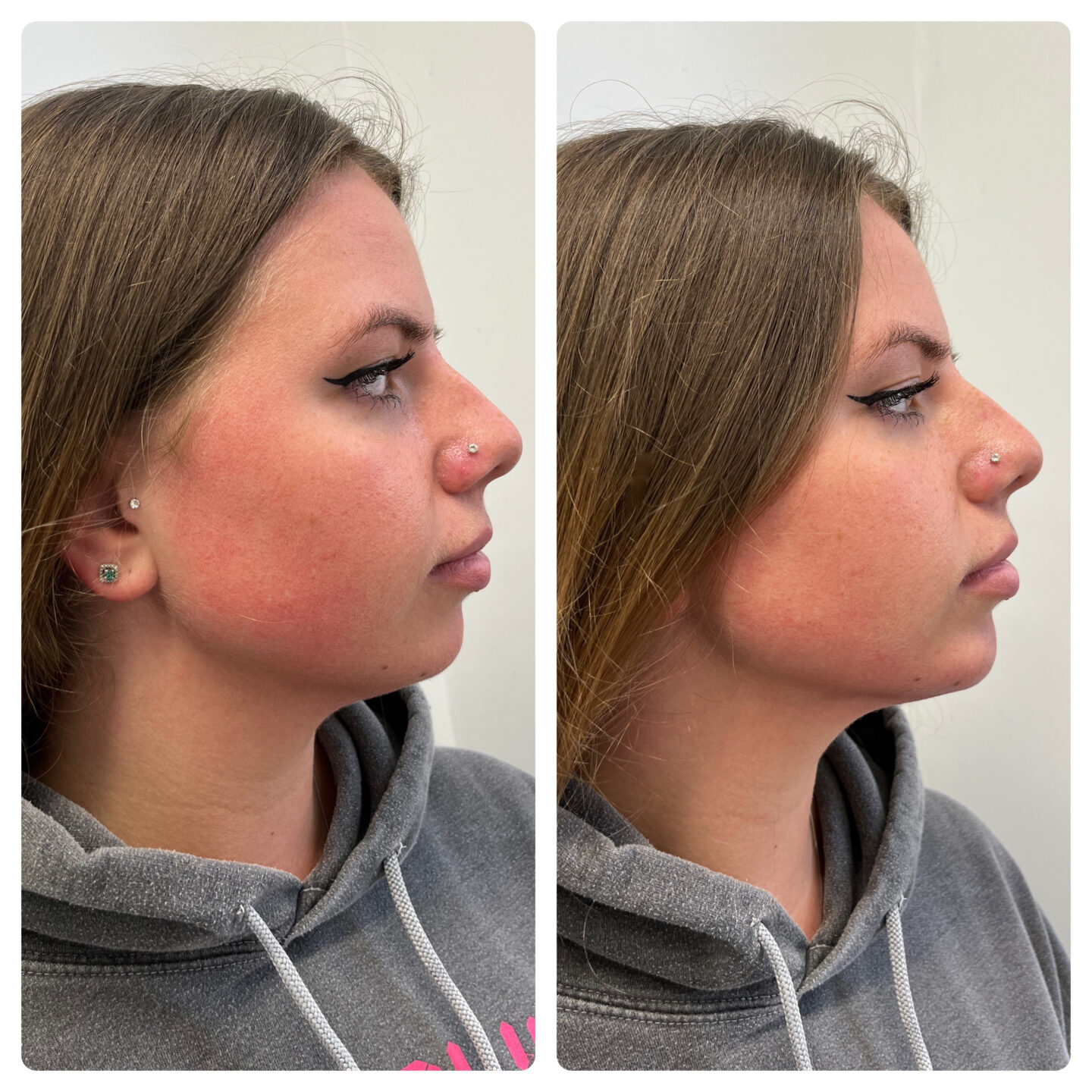
Dermal fillers for the jawline require dense, high-stiffness products that can mimic bone and hold their shape under pressure. Providers select jawline fillers based on four main criteria: G-Prime (the filler’s firmness and ability to resist compression), reversibility needs (whether the patient wants an HA filler that can be dissolved), collagen stimulation goals (whether the patient benefits from a biostimulator like Radiesse or Sculptra), and the patient’s anatomy and budget (bone structure, skin thickness, volume of product needed, and how many syringes the treatment plan requires). Juvederm Volux XC is the first and only hyaluronic acid filler FDA-approved specifically for jawline definition. Juvederm Voluma XC, Restylane Lyft, Radiesse, and Sculptra round out the top options, each with different strengths depending on the clinical goal.
This guide covers the leading jawline filler products, how providers evaluate which one fits each patient, where jawline filler is injected, how many syringes most people need, what recovery looks like day by day, and the safety and longevity differences that matter most when choosing between them.
What Is the Best Filler for Jawline Contouring?
The best filler for jawline contouring is a firm, high-viscosity product designed for deep structural placement along bone. Juvederm Volux XC holds the distinction of being the first hyaluronic acid (HA) filler to receive FDA approval specifically for jawline definition, granted in October 2023. Its dense, cohesive gel provides the structural integrity needed to sculpt and define the lower face with precision. Juvederm Voluma XC, Restylane Lyft, Radiesse, and Sculptra are the other leading options, each suited to different patient goals and anatomical needs.
The jawline is not like the lips or under-eye area. Soft, pliable fillers designed for those delicate zones would compress and spread when placed along the mandibular border, producing a rounded or puffy appearance instead of angular definition. The jawline sits directly over bone, and the filler placed there must resist the weight of overlying skin, muscle, and soft tissue. The global dermal filler market reached $4.97 billion in 2024, according to Fortune Business Insights, and jawline contouring has become one of the fastest-growing indications driving that growth. Over 4.3 million procedures using HA fillers were performed globally in 2022 alone.
The right jawline filler for any individual patient depends on the provider’s clinical assessment. A patient seeking sharp, angular definition requires a different product than a patient seeking soft volume restoration along a sagging jawline. A patient who wants the safety net of reversibility requires a different product than a patient who prioritizes maximum longevity. Understanding the decision criteria providers use helps patients ask better questions during their consultation and feel confident about the treatment plan.
How Do Providers Choose Which Jawline Filler to Use?
Providers choose jawline fillers based on four primary clinical criteria: the filler’s G-Prime (stiffness), whether reversibility matters, whether collagen stimulation is a goal, and the patient’s unique anatomy and budget. G-Prime is the most important technical property for jawline fillers because it measures how well a filler resists deformation under pressure. A high-G-Prime filler holds its shape when placed deep against the periosteum (bone surface), producing the crisp angular definition that patients and providers want from jawline contouring.
Reversibility matters because hyaluronic acid fillers can be dissolved with an enzyme called hyaluronidase, while calcium hydroxylapatite (CaHA) fillers like Radiesse and biostimulators like Sculptra cannot. For first-time patients or those who want the peace of mind of knowing their results can be adjusted or reversed, HA fillers offer a significant advantage. Patients who have experience with fillers and want longer-lasting structural support may prefer Radiesse or Sculptra for their collagen-stimulating properties.
Collagen stimulation goals influence the choice between pure volumizers and biostimulators. HA fillers add immediate volume that the body gradually absorbs over 12 to 18 months. Radiesse provides immediate volume and then stimulates the body to produce its own collagen around the CaHA microspheres, extending the structural benefit. Sculptra skips the immediate volume entirely and instead triggers gradual collagen production over several months, producing results that can last more than two years.
Anatomy and budget complete the decision. Men often require 3 to 6 syringes for comprehensive jawline contouring because the male jaw is naturally larger and the aesthetic goal typically involves wider, more angular definition, according to data referenced in the Google AI Overview for this topic. Women typically need 2 to 3 syringes for a refined, defined contour. A 2024 survey by the American Society for Dermatologic Surgery of 1,200 aesthetic providers found that the average combined chin and jawline treatment uses 2.4 syringes for first-time patients. Skin thickness, existing bone structure, and the degree of volume loss all affect how much product is needed.
Which Is Better for the Jawline, Voluma or Volux?
Volux is better for sharp, angular jawline definition, while Voluma is better for broader volume restoration that includes the jawline as part of a fuller lower-face treatment. Volux is the thickest and most cohesive filler in the entire Juvederm product line, specifically engineered with the highest G-Prime to sculpt crisp jawline angles. Voluma is slightly softer, originally designed for deep cheek volume restoration, but its firm gel also performs well along the mandibular border when the goal is natural-looking lift rather than dramatic angularity.
Volux typically lasts 12 to 24 months. Voluma can last up to 24 months in deep tissue placement, making it one of the longest-lasting HA fillers available. Both contain lidocaine for patient comfort during injection. Both are reversible with hyaluronidase. The practical difference comes down to the specific look the patient wants: Volux for a chiseled, sculpted jawline with sharp angles; Voluma for a restored, youthful contour with softer definition. Many providers use both products in the same treatment session, placing Volux at the jaw angle for angularity and Voluma along the mandibular border for smooth, natural transition.
How Does Radiesse Compare to Hyaluronic Acid Fillers for the Jawline?
Radiesse compares to hyaluronic acid fillers for the jawline as a firmer, longer-lasting product that stimulates natural collagen production but cannot be dissolved if the patient is unhappy with the result. Radiesse is made of calcium hydroxylapatite (CaHA) microspheres suspended in a water-based gel carrier, providing immediate structural volume while creating a scaffold that triggers the body to produce its own collagen over the following months.
Galderma introduced Radiesse (+) Lidocaine in February 2023, formulated specifically for deep subdermal and supraperiosteal injections to improve jawline definition, according to Persistence Market Research. The CaHA microspheres are a mineral-like compound naturally found in human bones and teeth, which gives Radiesse exceptional firmness for structural contouring. Results from Radiesse can last up to 24 months, according to clinical data, because the collagen the body produces around the microspheres provides ongoing structural support even after the gel carrier has been absorbed.
The trade-off is reversibility. HA fillers can be dissolved quickly and completely with a hyaluronidase injection. Radiesse cannot. For patients who are new to jawline filler or who want the ability to make adjustments, HA fillers offer a safer starting point. For patients who have experience with jawline contouring and want maximum longevity plus the benefit of their own collagen rebuilding the treatment area, Radiesse delivers on both fronts.
What Does Jawline Filler Actually Do?
Jawline filler adds structural volume beneath the skin along the mandibular border, the jaw angle, or the chin to create definition, improve facial proportions, and restore support that aging or genetics have diminished. The most commonly used jawline fillers are made from hyaluronic acid, a substance the body produces naturally. HA binds to water molecules at up to 1,000 times its own weight, which creates the volumizing and structural lift when injected beneath the skin at the periosteal level.
The structural effect of jawline filler depends entirely on where it is placed and how deep the injection goes. Deep periosteal placement, where the filler sits directly against the bone surface, mimics the support that bone would naturally provide. This is structural augmentation: the filler functions as a foundation, and the overlying skin, fat, and muscle drape over it to create visible definition. Superficial placement along the skin surface creates a visible ridge that can look artificial, puffy, or shelf-like within weeks. The difference between a natural-looking jawline filler result and an overdone one is almost always about depth of placement, not volume of product.
A comprehensive AI-assisted shape analysis of 280 CT scans published in Plastic and Reconstructive Surgery Global Open found that the mandible loses approximately 5mm of overall skeletal volume with aging. Women experience more bone resorption at the chin and anterior alveolar surface. Men lose definition primarily at the gonion (jaw angle). Jawline filler replaces some of that lost bone support, which is why the treatment can produce such a dramatic visual improvement with a relatively small amount of product. The filler is not adding something new; it is rebuilding something that was once there.
The table below compares the top jawline filler products across the key properties that providers evaluate when selecting the right option for each patient.
| Filler | Material | G-Prime (Firmness) | Duration | Reversible | FDA Jawline Approval | Best For |
|---|---|---|---|---|---|---|
| Juvederm Volux XC | Hyaluronic acid | Highest in Juvederm line | 12-24 months | Yes | Yes (Oct 2023) | Sharp, angular jawline definition |
| Juvederm Voluma XC | Hyaluronic acid | High | Up to 24 months | Yes | No (cheeks; off-label for jaw) | Deep volume restoration, softer contouring |
| Restylane Lyft | Hyaluronic acid | High | 12-18 months | Yes | No (cheeks/hands; off-label for jaw) | Structural lift and support, natural movement |
| Radiesse | Calcium hydroxylapatite | Very high | Up to 24 months | No | No (off-label for jaw) | Maximum firmness, collagen stimulation |
| Sculptra | Poly-L-lactic acid | N/A (biostimulator) | 2+ years | No | No (off-label for jaw) | Gradual collagen building, long-term structure |
Where Is Jawline Filler Injected?
Jawline filler is injected at three primary zones along the lower face: the mandibular angle, the prejowl sulcus, and the chin. Each zone produces a different visual effect, and experienced providers select which zones to treat based on the patient’s anatomy and aesthetic goals. The mandibular angle, the bony corner where the jaw meets the ear area, is the injection point that creates the sharp, angular definition most patients associate with a “snatched” jawline.
The prejowl sulcus is the hollow that forms on either side of the chin as skin sags and bone resorbs with age. Filling this area smooths the mandibular border and disguises mild jowling by rebuilding the shelf that descended tissue has fallen over. Patients seeking facial contouring to address early jowls often see the most dramatic improvement from filler placed in the prejowl sulcus because it restores the continuous line from chin to jaw angle that jowling interrupts.
The chin adds forward projection and vertical length to the lower face. A recessed chin makes the entire jawline appear softer and the face appear rounder. Adding 1 to 2 syringes of firm filler to the chin changes the proportions of the lower third significantly, elongating the face visually and pulling the eye toward the center of the profile. Masculine jawline contouring typically emphasizes width and angularity at the mandibular angle, while feminine contouring focuses more on a smooth, tapering line from chin to ear with controlled width.
How Many Syringes of Filler Do You Need for the Jawline?
Most patients need 2 to 4 syringes of filler for visible jawline contouring. Men often require 3 to 6 syringes depending on baseline bone structure and the desired sharpness of the result. Women typically need 2 to 3 syringes for a refined, natural-looking contour. A single syringe (1ml, roughly one-fifth of a teaspoon) provides only subtle definition when distributed across the entire mandibular border on both sides of the face.
The American Academy of Facial Plastic and Reconstructive Surgery reported in March 2026 that 95% of surveyed facial plastic surgeons treated male patients in 2025, up from 92% in 2024, with fillers among the most requested non-surgical treatments for men. The International Society of Aesthetic Plastic Surgery reported in June 2025 that women accounted for 86.1% of all HA filler procedures performed globally in 2024. Jawline contouring appeals across demographics, but the volume needed varies substantially based on the patient’s bone structure, skin thickness, and how much definition they want.
Starting conservatively with 2 syringes and adding more at a follow-up appointment 2 to 4 weeks later is a common approach, especially for first-time patients. This staged method lets the provider and patient evaluate the result after swelling has resolved before committing to additional volume. Maintenance appointments typically require less product than the initial treatment because residual filler scaffold remains, providing a foundation to build on.
What Does Swelling After Jawline Filler Look Like?
Swelling after jawline filler is mild to moderate, typically peaking at 24 to 48 hours and resolving within 5 to 7 days. The jawline may appear slightly fuller or more rounded than the final result during the first few days. Some patients also experience light bruising at the injection sites, which fades within a week. The true, settled result becomes visible approximately 2 weeks after treatment.
The recovery timeline follows a predictable pattern:
- Day 1 (treatment day): Mild tenderness and early swelling begin. The jawline looks slightly fuller than the intended final result. Ice packs help reduce swelling. Avoid touching the treated area.
- Days 2-3 (peak swelling): Swelling reaches its highest point. The jawline may look slightly asymmetric because swelling does not always develop evenly on both sides. Minor bruising may appear.
- Days 4-7 (resolving): Swelling decreases noticeably each day. Bruising fades. The jawline contour begins to look more defined as swelling subsides.
- Days 7-14 (settling): The filler integrates with surrounding tissue. The final shape and definition become visible. This is the appropriate time to evaluate whether additional volume is needed.
Aftercare during this recovery period supports the best possible result. Following these guidelines helps minimize swelling, prevent filler displacement, and protect the investment in your treatment:
- Avoid strenuous exercise and intense physical activity for 24 to 48 hours after treatment
- Skip alcohol on the treatment day, as it increases the likelihood of bruising and swelling
- Protect the treated area from extreme heat, including saunas, steam rooms, and direct intense sun exposure
- Sleep with your head slightly elevated on the first night to reduce overnight swelling
- Do not press, massage, or manipulate the filler for at least 24 hours unless your provider gives specific instructions
- Stay well-hydrated by drinking plenty of water, which supports tissue recovery and filler integration
Most patients return to normal daily activities immediately after treatment, with no visible signs of the procedure by day 5 to 7.
Does Jawline Filler Migrate?
Jawline filler does not migrate when it is placed properly at the deep periosteal level using a firm, high-G-Prime product designed for structural contouring. Filler migration is a concern associated primarily with softer, lower-viscosity fillers placed superficially in areas with significant muscle movement, not with dense structural fillers placed deep against bone.
The jawline is actually one of the safest areas for filler retention because the deep periosteal space is a relatively stable environment. The bone surface provides a solid anchor, and firm fillers like Volux, Voluma, and Radiesse resist displacement by overlying tissue movement. Migration risk increases when a provider uses a filler that is too soft for the jawline, places it too superficially (in the subcutaneous fat layer rather than against bone), or injects excessive volume in a single session. Choosing an experienced provider who uses the right product at the right depth is the most effective way to prevent any movement of the filler from its intended position.
Patients who notice their jawline filler shifting, spreading, or creating an uneven appearance should contact their provider. HA fillers can be dissolved with hyaluronidase to correct any placement issue. Injectables placed correctly at the periosteal level by a qualified injector integrate with the surrounding tissue and maintain their position throughout the full duration of the product’s lifespan.
Is Jawline Filler Safe?
Yes, jawline filler is safe when performed by a qualified, experienced provider using FDA-approved products. HA fillers have been used in cosmetic medicine for over two decades with a well-established safety profile. The U.S. recorded over 1.49 million cosmetic filler procedures in 2022 alone, according to the American Society of Plastic Surgeons, and the most common side effects, including temporary swelling, redness, and bruising, resolve within days.
The most serious rare risk associated with any facial filler is vascular occlusion, which occurs if filler is accidentally injected into or compresses a blood vessel, blocking blood flow to the surrounding tissue. This is an emergency that requires immediate treatment with hyaluronidase to dissolve the obstruction. The risk is minimized by working with a provider who has deep knowledge of facial vascular anatomy and uses aspiration techniques and cannulas where appropriate. At our practice, we evaluate each patient’s anatomy carefully before any injection and use neurotoxins and fillers within evidence-based protocols designed for maximum safety.
HA fillers carry the additional safety advantage of reversibility. Hyaluronidase dissolves hyaluronic acid filler quickly and completely, providing a safety net that non-HA products like Radiesse and Sculptra do not offer. For first-time patients or anyone who values the ability to adjust their results, HA fillers represent the safest starting point for jawline contouring.
Which Jawline Filler Has the Longest Lasting Results?
The jawline filler with the longest lasting results among commonly used products is Sculptra, which can maintain structural improvement for more than two years through gradual collagen stimulation. Among fillers that provide immediate volume, Radiesse lasts up to 24 months because its CaHA microspheres stimulate ongoing collagen production even after the gel carrier has been absorbed. Juvederm Voluma XC leads the HA filler category at up to 24 months in deep tissue placement, while Juvederm Volux XC lasts 12 to 24 months.
Longevity depends on several factors beyond the product itself. Deep periosteal placement lasts longer than superficial placement because the deep tissue environment experiences less mechanical stress and movement. Individual metabolism affects how quickly the body breaks down filler; patients with faster metabolisms may see results fade sooner. Lifestyle factors like sun exposure, hydration, smoking, and physical activity also influence filler duration. Advanced cross-linking technology in newer filler formulations maintains aesthetic outcomes up to 40 to 50% longer than earlier-generation products, according to Future Market Insights.
Global dermal filler adoption grew 8 to 10% year-over-year in 2024, according to the same source, and the volume and definition restoration category is one of the primary drivers of that growth. Patients who return for maintenance before their filler has fully dissolved typically need fewer syringes to restore their contour because residual product and the collagen framework it stimulated provide a foundation to build on.
Do Fillers Age You Over Time?
No, fillers do not age you over time when administered properly and in appropriate amounts. Dermal fillers replace lost volume, support tissue structure, and can actually slow the visible effects of aging by maintaining the scaffolding that keeps skin from sagging. The concern about fillers accelerating aging comes from cases of overfilling, where excessive product creates an unnatural, puffy appearance that distorts facial proportions.
Overfilling is an injector technique issue, not a filler safety issue. It happens incrementally, syringe by syringe over multiple appointments, when no one steps back to assess the whole face in context. A provider who treats the face as one connected architectural plan rather than filling individual areas in isolation produces results that look natural and age gracefully. HA fillers that are not replaced simply dissolve and get absorbed by the body, returning the face to its pre-treatment state. The skin does not stretch or sag more because filler was present and then dissolved.
The concern is understandable because overfilled faces are the most visible filler results online and in media. Well-done filler work is invisible by design. When someone looks refreshed and defined but you cannot tell they have had anything done, that is the sign of skilled injectable work placed by a provider who prioritizes proportion over volume.
What Kind of Filler Is Best for Jaw Jowls?
The best filler for jaw jowls is a firm HA filler like Juvederm Volux XC, Juvederm Voluma XC, or Restylane Lyft, placed in the prejowl sulcus and along the mandibular border to rebuild the structural shelf that jowls have fallen over. Jowls form when fat pads descend past the mandibular border and skin laxity allows the tissue to hang below the jawline. Filler placed in the prejowl sulcus fills the hollow that makes jowls visible, restoring a continuous, defined line from chin to jaw angle.
Filler alone is most effective for mild to moderate jowling where the primary issue is volume loss along the mandibular border. For significant jowling with loose, sagging skin, filler addresses the volume component but does not physically lift the descended tissue. Skin tightening devices like Ultherapy contract and rebuild collagen in the deep tissue layer. Threadlifts physically reposition the descended fat pads by anchoring them higher. Combining jawline filler with one of these lifting modalities produces the most complete result for patients with moderate to advanced jowling.
Some patients with jowling also benefit from Botox in the platysmal bands of the neck, a technique called the Nefertiti neck lift. The platysmal muscles pull the lower face downward, contributing to the appearance of jowling. Relaxing that downward pull with neurotoxin creates a subtle lifting effect that complements jawline filler placed along the border above.
Frequently Asked Questions
Does Jawline Filler Hurt?
Jawline filler causes mild discomfort, not significant pain. Most providers apply topical numbing cream before the procedure, and the majority of modern jawline fillers (including Volux, Voluma, Restylane Lyft, and Radiesse with Lidocaine) contain built-in anesthetic that numbs the tissue as the product is deposited. Patients typically describe the sensation as pressure or a brief pinch at each injection point. The jawline is less sensitive than the lips, under-eye area, or nasolabial folds.
Does Jaw Filler Slim Your Face?
Jawline filler does not slim your face; it adds volume and structure. Filler placed along the mandibular border creates sharper definition that can make the face appear more sculpted, but it does not remove width or reduce fullness. Patients who want actual slimming of a wide or square lower face typically benefit from masseter Botox, which relaxes and shrinks the large chewing muscle at the jaw angle over 4 to 8 weeks. Many patients combine masseter Botox for slimming with jawline filler for definition.
What Is Jawline Filler Aftercare?
Jawline filler aftercare involves avoiding strenuous exercise for 24 to 48 hours, skipping alcohol on the treatment day, protecting the area from extreme heat (saunas, steam rooms), sleeping with the head slightly elevated on the first night, and not pressing or massaging the treated area for at least 24 hours. Staying well-hydrated and applying gentle cold compresses can help reduce swelling. Most patients resume all normal activities within 1 to 2 days.
Can Jawline Filler Be Dissolved?
Yes, hyaluronic acid jawline fillers (Volux, Voluma, Restylane Lyft, Restylane Defyne) can be dissolved quickly and completely with an injection of hyaluronidase. This enzyme breaks down the HA gel, returning the treated area to its pre-treatment state. Radiesse and Sculptra cannot be dissolved because they are not made of hyaluronic acid. The reversibility of HA fillers provides a valuable safety net, especially for first-time patients.
What Is the Best Treatment to Lift Sagging Jowls?
The best treatment to lift sagging jowls depends on the severity. Mild jowling responds well to jawline filler placed in the prejowl sulcus combined with skin tightening. Moderate jowling benefits from PDO threadlifts that physically reposition descended tissue. Severe jowling with significant skin laxity may require a surgical facelift for the most dramatic improvement. Many patients achieve excellent results by combining two non-surgical approaches: filler for volume and definition plus threads or tightening for actual tissue repositioning.
How Long Until Jawline Filler Settles?
Jawline filler takes approximately 2 weeks to fully settle. Swelling peaks at 24 to 48 hours after treatment and resolves progressively over the following 5 to 7 days. The filler softens slightly and integrates with the surrounding tissue during this period. The final shape, symmetry, and definition become visible once all swelling has subsided. Patients should wait the full 2 weeks before evaluating whether they want additional volume at a follow-up appointment.
The Takeaway
The best jawline filler is not a single product but the right product for the right patient, selected by a provider who understands facial anatomy, filler properties, and the specific goal the treatment needs to achieve. Volux delivers the sharpest angular definition. Voluma provides versatile deep volume. Restylane Lyft offers firm structural support with natural movement. Radiesse adds immediate contour plus long-term collagen stimulation. Sculptra builds gradual, lasting structure through biostimulation. The provider’s skill in selecting, placing, and layering these products is what separates an excellent jawline filler result from a mediocre one.
If you are considering jawline contouring, we encourage you to schedule a consultation so we can evaluate your bone structure, skin quality, and goals in person. Our team at FACE Skincare ~ Medical ~ Wellness in Bingham Farms, Michigan builds every treatment plan around the individual patient, not a trend or a single product.