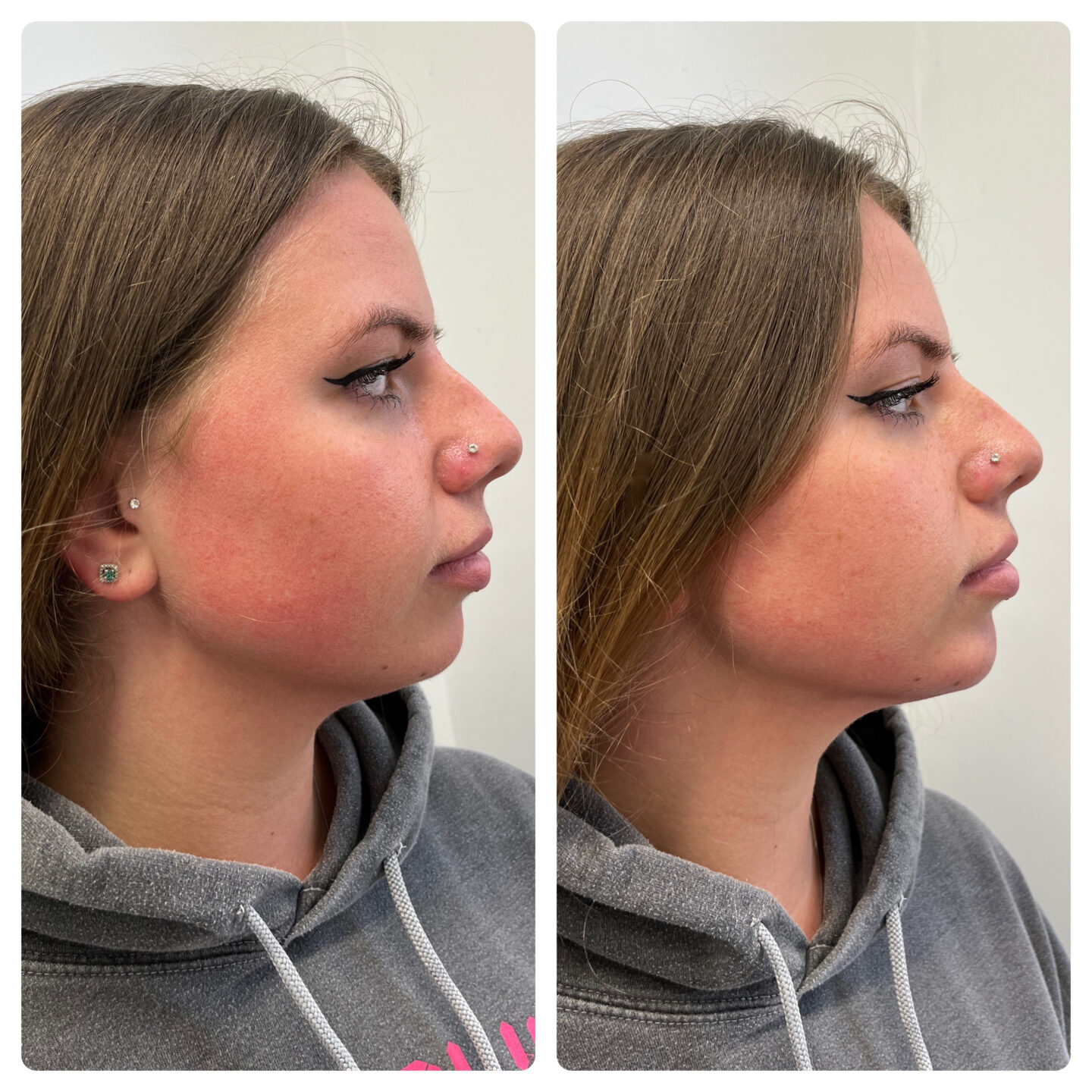
A single syringe (1ml) of jawline filler provides very subtle, localized definition rather than a dramatic reshaping or slimming effect for a round face. That 1ml is roughly one-fifth of a teaspoon. Split between both sides (0.5ml per side), it can add a tiny touch of crispness to the jaw angle or smooth a small transition gap. The limitation is real: most comprehensive jawline contouring treatments require 2 to 4 syringes to build visible structure along the entire mandibular border. For a rounder face specifically, the approach matters even more than the volume, because adding filler in the wrong spot can make a round face look wider or puffy instead of sculpted. Providers often look at neuromodulators like Botox to slim the lower face first, then use filler strategically to define, not expand.
This guide explains exactly what 1ml of jawline filler can and cannot do, how many syringes most patients actually need, which filler types work best for jawline structure, and the specific considerations that matter when the goal is contouring a rounder or chubby face rather than simply adding volume.
What Can 1ml of Jawline Filler Achieve on a Round Face?
One milliliter of jawline filler can achieve a subtle improvement in definition, a gentle sharpening of the jaw angle, or a slight smoothing of the transition between the jaw and neck. That 1ml is best for a gentle, natural preview of what jawline filler looks like, not for structural transformation. A 2024 survey by the American Society for Dermatologic Surgery of 1,200 aesthetic providers found that the average chin treatment uses 1.7 syringes for first-time patients, with that number rising to 2.4 syringes for combined chin and jawline work.
To put that volume in perspective, picture a small blueberry. That is 1ml. Now picture the full length of your jawline from chin to ear on both sides. The gap between those two images explains why a single syringe rarely produces dramatic jawline contouring on its own. When that 1ml gets distributed across the jaw angle and mandibular border on both sides of the face, it goes faster than most patients expect.
For someone with a naturally round or chubby face, 1ml delivers a first-time soft enhancement, a small improvement in how light catches along the jaw, and a slightly cleaner profile from the side. People around you probably will not notice a specific change; they might just think you look a bit more rested or defined. That subtlety is actually one of the strengths of starting with 1ml, because it lets you see how your face responds to filler before committing to a larger volume.
How Many Syringes of Filler Do You Need for Your Jawline?
Most patients need 2 to 4 syringes of filler for visible jawline contouring, depending on how much structural change they want and how much natural bone support they already have. Two syringes create noticeable sharpness; 3 to 4 syringes produce the kind of defined, sculpted result that most patients looking for real contouring are after.
The jawline is a large treatment area. It spans from the chin to the angle of the jaw on each side of the face. Placing enough product to create visible definition along this entire border, on both sides, while maintaining natural proportions, requires multiple syringes working together. The global dermal filler market reached $4.97 billion in 2024, according to Fortune Business Insights, and jawline contouring has become one of the fastest-growing indications driving that growth, particularly among patients in their late twenties through forties seeking non-surgical definition.
The right number of syringes depends on the starting point. Younger patients with mild softness through the jawline and decent bone structure underneath may see meaningful improvement with 2 syringes. Older patients who have lost mandibular bone volume through natural aging, a process a 2024 study in Plastic and Reconstructive Surgery Global Open documented at approximately 5mm of skeletal change over time, typically need 3 to 4 syringes of a firm structural filler to rebuild the foundation that bone loss has taken away.
What Does Jawline Filler Actually Do?
Jawline filler adds structural volume beneath the skin along the mandibular border, the jaw angle, or the chin to create definition, improve facial proportions, and restore support that aging or genetics have diminished. The most commonly used jawline fillers are made from hyaluronic acid (HA), a substance the body produces naturally. HA binds to water molecules at up to 1,000 times its own weight, which is what creates the volumizing and structural lift when injected beneath the skin.
The procedure itself is straightforward. After numbing the treatment area with topical anesthetic or lidocaine, the injector places filler at strategic points along the jawline using a needle or cannula. The entire appointment typically takes 15 to 30 minutes. A typical treatment session follows this sequence:
- Assessment and mapping: The injector evaluates your bone structure, fat distribution, skin thickness, and symmetry to create a placement plan customized to your specific anatomy.
- Numbing: Topical anesthetic cream or local lidocaine injections numb the treatment area. Most modern fillers also contain built-in lidocaine for additional comfort.
- Injection: Filler is placed at the jaw angle, along the mandibular border, and sometimes at the chin. Deep periosteal placement (against the bone surface) produces the most natural-looking structural definition.
- Molding and symmetry check: The injector presses and shapes the filler to distribute it evenly, checking both sides for balance.
- Aftercare: Mild swelling and tenderness are normal for 1 to 3 days. Most patients return to normal activities immediately.
The distinction between structural augmentation and cosmetic outlining matters enormously for the final result. Structural placement means filler deposited deep, against the periosteum, to mimic the support that bone would naturally provide. This produces definition that looks natural from every angle. Cosmetic outlining means filler placed superficially along the jawline to create a visible edge, which can look sharp in a selfie but puffy or shelf-like in person. The difference between a good jawline filler result and a bad one is rarely about how much filler was used; it is about where it went.
What Filler Gives You a Sharper Jawline?
The fillers that give you a sharper jawline are firm, high-viscosity products designed for deep structural placement along bone. Juvederm Volux XC became the first hyaluronic acid filler to receive FDA approval specifically for jawline contouring in October 2023, making it the gold standard for this indication. Radiesse, a calcium hydroxylapatite filler, provides even firmer structural support and also stimulates collagen production over time. Restylane Defyne offers controlled flexibility with strong structural properties.
The reason firmer fillers produce sharper results comes down to physics. The jawline sits over bone, and the filler needs to hold its shape under the weight of overlying skin and soft tissue. A soft filler designed for lips would compress and spread when placed along the jaw, producing a rounded or puffy look instead of angular definition. Firm fillers resist that compression and maintain the crisp, linear shape that reads as a defined jawline. Sculptra, a poly-L-lactic acid biostimulator, works differently by triggering the body to produce its own collagen over several months, building gradual structural support rather than immediate volume.
Product selection also affects longevity. Softer HA fillers in the jawline may last 9 to 12 months. Firmer products like Volux and Radiesse, placed deep against the periosteum, can maintain their structure for 12 to 18 months or longer. According to Galderma, the manufacturer behind the Restylane family, injectable implants formulated specifically for deep subdermal and supraperiosteal placement in the jawline are designed to last longer precisely because the deep tissue environment experiences less movement and mechanical stress than superficial layers.
Can Jaw Fillers Fix a Chubby Face?
Jaw fillers can make a chubby face look more defined, but they cannot make a round face thinner. Filler adds volume; it does not remove it. If a round face is caused by a heavy or square masseter muscle (the large chewing muscle at the jaw angle), providers often look at neurotoxins like Botox to slim the lower face rather than adding more volume with filler.
This distinction is the single most important consideration for anyone with a rounder face thinking about jawline filler. Adding filler to the jaw angle on a face that already appears wide through the lower third can make the face look wider, heavier, or puffy, the opposite of the slimming effect most round-faced patients want. The correct approach depends entirely on what is causing the roundness.
Masseter hypertrophy, an overdevelopment of the chewing muscle from genetics, stress clenching, or teeth grinding (bruxism), creates width at the jaw angle. Botox injected into the masseter gradually relaxes and shrinks the muscle over 4 to 8 weeks, producing a slimmer, more oval or V-shaped lower face. Subcutaneous fat fullness in the cheeks creates a round facial shape that filler cannot reduce; targeted treatments or time may address this. Lack of jawline definition on a face that is not necessarily wide but simply has soft, undefined contours, this is where filler excels, adding structural angles that create the appearance of a leaner lower face.
Many patients benefit from combining both treatments. Masseter Botox slims the sides of the lower face. Jawline filler adds definition along the mandibular border. Chin filler adds forward projection. Together, these three create a more sculpted, balanced result than any single treatment produces alone. Jawline contouring with neurotoxins and dermal fillers is one of the most requested combination protocols we perform.
Which Is Better for Jowls, Botox or Fillers?
For jowls, fillers are generally better than Botox because jowls are caused by descended fat pads and skin laxity, not by overactive muscles. Jawline filler placed in the pre-jowl sulcus (the hollow that forms just in front of the jowl) rebuilds the mandibular border and disguises the jowl by restoring the shelf beneath it. Botox does not address jowling directly because jowls are a gravity and tissue descent issue, not a muscle contraction issue.
The exception is the platysmal bands in the neck. These vertical muscle bands can pull the lower face downward and contribute to the appearance of jowling. A Nefertiti lift, where neurotoxin is injected along the platysmal bands in the neck, relaxes that downward pull and can create a subtle lifting effect that complements jawline filler.
For significant jowling with loose, sagging skin, filler alone may not be sufficient. Threadlifts physically reposition descended tissue by anchoring it higher along the cheek and jawline. Skin tightening devices like Ultherapy or radiofrequency treatments contract and rebuild collagen in the deep tissue layer, producing gradual firmness over months. Filler, threads, and tightening devices each address jowling from a different angle, and a layered approach using two or three of these modalities typically produces the most complete result.
Can Jawline Fillers Lift Jowls?
Jawline fillers can camouflage mild to moderate jowling but do not physically lift sagging tissue. Filler rebuilds the mandibular border, the structural shelf that jowls have fallen over, so the jowl becomes less visible by comparison. The jawline looks cleaner and more defined, and the transition between the jaw and neck sharpens, which creates the visual impression of lift without actual tissue repositioning.
The mechanism is similar to rebuilding a retaining wall. Jowling happens when fat pads descend past the mandibular border. Filler placed along and just below that border restores the wall, so the descended tissue sits against a defined edge rather than hanging over a receded one. According to a review published by the National Library of Medicine, nonsurgical jawline rejuvenation with HA, calcium hydroxylapatite, poly-L-lactic acid, and polymethyl methacrylate fillers has become increasingly popular due to their temporary, noninvasive, yet effective methods for addressing facial volume loss and jawline contour deterioration.
The limitation is important to understand. If the jowling is primarily caused by skin laxity rather than volume loss, adding filler creates bulk without definition. The jaw gets heavier, not sharper. A qualified injector assesses whether the concern is volume loss (filler helps), skin laxity (tightening helps), or fat descent (threads help), and recommends the right tool accordingly.
The table below compares what different volumes of jawline filler can achieve, so you can see how 1ml stacks up against a more comprehensive treatment plan.
| Volume | Best For | Expected Result | Typical Duration | Ideal Candidate |
|---|---|---|---|---|
| 1ml (1 syringe) | Light contouring, first-time preview | Subtle definition at the jaw angle or chin; gentle improvement, not dramatic | 9-12 months | Younger patients with mild softness; those wanting to test the look first |
| 2ml (2 syringes) | Noticeable definition | Sharper jaw-to-neck transition; visible contour improvement from the front and side | 12-15 months | Patients with moderate softness and decent underlying bone structure |
| 3-4ml (3-4 syringes) | Full jawline sculpting | Comprehensive contouring from chin to jaw angle; dramatic structural change | 12-18 months | Patients with significant volume loss, bone resorption, or desire for strong definition |
Where Should Jawline Filler Be Placed on a Round Face?
Jawline filler on a round face should be placed primarily at the chin and along the mandibular border, with cautious, minimal volume at the jaw angle. Strategic placement is what separates a result that looks sculpted from a result that looks wider. The three main injection zones along the jawline each produce a different visual effect, and understanding those effects is critical for a rounder face shape.
The chin adds forward projection and vertical length to the lower face. A chin that sits too far back makes the entire jawline appear softer and the face appear rounder. Adding 1 to 2 syringes of firm filler to the chin can change the proportions of the lower third significantly, elongating the face visually and pulling the eye toward the center rather than the width. The mandibular border, the line running from the chin toward the ear, is where definition lives. Filler placed along this border creates a clean transition between the face and the neck. For a round face, this linear definition along the mandibular border is where filler produces the most slimming visual effect.
The jaw angle, the bony corner where the jaw meets the ear area, adds width and angularity. This is where caution matters for a round face. A patient with a naturally wide lower face who receives filler at both jaw angles may end up looking squarer rather than more defined. For round-faced patients, we often recommend focusing volume on the chin and mandibular border first, adding jaw angle filler only if width is not the concern.
Placement depth matters as much as placement location. Deep, periosteal placement (against the bone surface) produces structural definition that integrates with natural anatomy. Superficial placement creates a visible ridge or shelf that looks artificial. A 2024 AI-assisted shape analysis of 280 CT scans published in Plastic and Reconstructive Surgery Global Open found that mandibular aging produces distinct patterns across sexes, with women experiencing more resorption at the chin and men losing definition at the gonion (jaw angle). Understanding these patterns helps an experienced injector customize placement for each patient.
What Should You Consider Before Getting Jawline Filler?
Before getting jawline filler, patients should consider their facial anatomy, the cause of their concern, and the experience level of their injector. Not every face that looks round or undefined benefits from filler. Some faces need slimming (masseter Botox), some need lifting (threads or tightening devices), and some need structural volume (filler). Putting filler on a face that needs slimming creates bulk, not definition. Jawline filler works best for patients who fit one or more of these profiles:
- A naturally soft or undefined jawline that lacks angularity, even without excess weight or muscle bulk
- Age-related bone resorption along the mandible that has blurred the jaw-to-neck transition
- Mild pre-jowl hollowing that creates a break in the mandibular border
- A recessed chin that makes the lower face appear shorter and rounder than it is
- Patients who want a non-surgical alternative to chin or jawline implants
- Men seeking a wider, more angular jaw angle for a more masculine lower face
The U.S. recorded over 1.49 million cosmetic filler procedures in 2022 alone, according to the American Society of Plastic Surgeons, and jawline contouring has become one of the fastest-growing filler indications. The International Society of Aesthetic Plastic Surgery reported in June 2025 that women accounted for 86.1% of all HA filler procedures performed globally in 2024, though the American Academy of Facial Plastic and Reconstructive Surgery noted in March 2026 that 95% of surveyed facial plastic surgeons treated male patients in 2025, up from 92% in 2024, with fillers among the most requested non-surgical treatments. Volume and definition restoration appeals across all demographics.
Patients considering jawline filler should think about their primary goal (sharper angles vs a more oval shape), whether they have had injectables before, and what realistic improvement looks like for their specific face. During a consultation at our Bingham Farms, Michigan practice, we evaluate bone structure, fat distribution, skin quality, and masseter muscle size before recommending any treatment plan. The assessment determines the outcome; skip it, and the result becomes a guess.
How Long Does Jawline Filler Last?
Jawline filler lasts 12 to 18 months, depending on the filler product, how deep it was placed, the patient’s metabolism, and lifestyle factors like sun exposure, hydration, and physical activity. Firmer fillers placed deep against the periosteum tend to last longer because the deep tissue environment experiences less mechanical stress and movement than superficial layers.
Radiesse and Juvederm Volux XC, the two most commonly used structural jawline fillers, generally maintain visible definition for 12 to 18 months. Softer HA fillers may begin to fade closer to the 9 to 12 month mark. Maintenance appointments typically require less product than the initial treatment because some residual filler scaffold remains, providing a foundation to build on. Patients who return for touch-ups before the filler has fully dissolved often need only 1 to 2 syringes to restore definition that originally required 3 to 4.
Is 70 Too Old for Facial Fillers?
No, 70 is not too old for facial fillers. Age alone does not disqualify someone from dermal filler treatment. The mandibular aging study published in Plastic and Reconstructive Surgery Global Open analyzed CT scans across three age groups (20-36, 41-64, and 65+) and confirmed that the jaw loses bone volume progressively with age, with approximately 5mm of overall skeletal change. Jawline filler can restore some of that lost structural support at any age.
The relevant factors are skin quality, realistic expectations, and overall health, not a birthday number. Older patients with good skin elasticity and moderate volume loss can see excellent results from jawline filler. Patients with significant skin laxity may need filler combined with a tightening treatment to achieve meaningful improvement, because adding volume beneath skin that has lost its ability to snap back can create heaviness instead of definition. An honest consultation addresses these factors directly.
Frequently Asked Questions
Is 1ml of Filler Enough for Marionette Lines?
One milliliter of filler is often enough to soften mild to moderate marionette lines, the creases that run from the corners of the mouth down toward the chin. Deeper marionette lines may require 1.5 to 2ml for full correction. In many cases, addressing cheek volume loss higher in the face also reduces marionette line depth by lifting the tissue above them, meaning the marionette lines themselves may need less direct filler.
What Is the Most Effective Treatment for Sagging Jowls?
The most effective treatment for sagging jowls depends on the severity. Mild jowling responds well to jawline filler placed in the pre-jowl sulcus combined with skin tightening. Moderate jowling benefits from PDO threadlifts that physically reposition the descended tissue. Severe jowling with significant skin laxity may require a surgical facelift for the most dramatic improvement. Many patients achieve excellent results with a combination of two non-surgical approaches.
How Much Does Jawline Filler Hurt?
Jawline filler causes mild discomfort, not significant pain. Most injectors apply topical numbing cream before the procedure, and the majority of modern fillers contain built-in lidocaine that numbs the tissue as filler is deposited. Patients typically describe the sensation as pressure or a brief pinch at each injection point. The jawline area is less sensitive than the lips or under-eye area.
Can Men Get Jawline Filler?
Yes, men get jawline filler frequently, and the demand is growing rapidly. The American Academy of Facial Plastic and Reconstructive Surgery reported in March 2026 that 95% of surveyed surgeons treated male patients in 2025. Jawline filler for men typically focuses on widening the jaw angle and adding structural projection to create a more angular, masculine lower face, which requires a fundamentally different placement strategy than feminine jawline contouring.
What Does Jawline Filler Look Like the Next Day?
Jawline filler the next day typically shows mild swelling and possibly light bruising at the injection sites. The jawline may appear slightly fuller or more rounded than the final result. Swelling usually peaks at 24 to 48 hours and resolves within 3 to 5 days. The true result settles over 2 weeks as swelling subsides and the filler integrates with the surrounding tissue.
How Long Until Jawline Filler Settles?
Jawline filler takes approximately 2 weeks to fully settle. During this time, mild swelling gradually resolves, and the filler softens and integrates with the tissue around it. The final shape and definition become visible once all swelling has subsided. Patients should wait the full 2 weeks before evaluating whether they want additional volume at a follow-up appointment.
The Takeaway
Jawline filler can sharpen a soft jawline, restore definition lost to aging, and improve facial balance for both round and angular face shapes. One milliliter provides a gentle starting point, but comprehensive jawline contouring requires 2 to 4 syringes placed strategically along the mandibular border, chin, and jaw angle. For a rounder face specifically, the approach matters more than the volume; placement at the chin and mandibular border creates a slimming visual effect, while placement at the jaw angle adds width that a round face may not need. Combining jawline filler with masseter Botox offers the most complete contouring result for patients whose lower face is both wide and undefined.
The single most important factor in any jawline filler result is the injector’s understanding of facial anatomy and their ability to match the treatment plan to the specific face sitting in front of them. If you are considering facial contouring, we encourage you to schedule a consultation so we can evaluate your bone structure, skin quality, and goals in person. Our team at FACE Skincare ~ Medical ~ Wellness builds every treatment plan around the individual, not a trend.