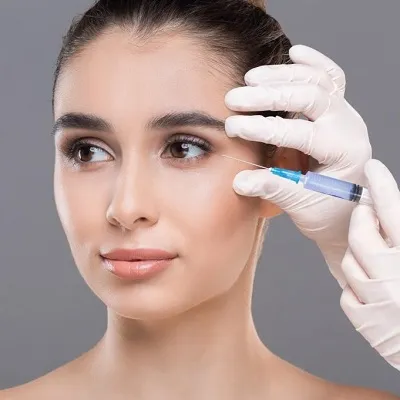
Hyaluronic acid (HA) fillers, specifically Restylane Eyelight, Juvederm Volbella XC, and Belotero Balance, are the top choices for under eye wrinkles and shadowing that cause tired-looking eyes. Each filler uses a different manufacturing technology that determines how the gel behaves beneath extremely thin periorbital skin. Providers choose between them based on four factors: tissue thickness, hollow depth, water retention profile, and whether the patient’s concern is driven by anatomy or aging. A 2023 meta-analysis published in Aesthetic Plastic Surgery involving 2,556 patients found a 91% overall satisfaction rate with tear trough HA filler, confirming that the right product in the right hands produces results most patients are happy with.
Top under eye fillers:
Restylane Eyelight: Firm enough to provide structural support under the eye while resisting excessive fluid attraction. NASHA technology produces a particulate gel with low to moderate water absorption, which means less post-injection swelling in the periorbital area. Clinical trials showed 87% of patients had reduced hollowness at 3 months, with results lasting up to 18 months.
Juvederm Volbella XC: A very thin, smooth formula that integrates seamlessly into delicate, thin skin with minimal swelling. Vycross technology creates a cohesive gel ideal for fine lines and subtle volume restoration. Volbella is the first HA filler FDA-approved specifically for infraorbital hollows.
Belotero Balance: A lightweight gel that sits close to the skin surface with a low risk of bluish discoloration (the Tyndall effect). Cohesive polydensified matrix (CPM) technology allows superficial placement that other fillers cannot achieve safely.
How providers choose: Providers select thinner products (like Volbella or Belotero) for very thin skin to prevent visible lumps or a bluish tint. Deeper tear trough deficits require slightly firmer options (like Restylane Eyelight) to rebuild structural support. Providers avoid heavy, high-water-attracting gels in the under-eye area to prevent puffy morning swelling. Patients with severe skin laxity or bulging fat pads (eye bags) are often redirected to surgical options instead.
How Do Under Eye Wrinkles Form?
Under eye wrinkles form through a combination of collagen loss, volume depletion, repetitive muscle movement, and sun damage in the thinnest skin on the human body. The periorbital skin measures approximately 0.5mm thick and contains fewer oil glands and less subcutaneous fat than skin elsewhere on the face. These characteristics make the under-eye area the first region to show visible signs of aging.
Collagen production in human skin declines approximately 1% per year after age 20, according to dermatology research. Under-eye skin loses collagen and elastin faster than thicker facial skin because it starts with less structural support. As collagen diminishes, the skin loses its ability to snap back after movement. Fine lines that initially appear only during expression (dynamic wrinkles) eventually become visible at rest (static wrinkles). The orbicularis oculi muscle, which controls blinking and squinting, creates repetitive folding that deepens these lines over time.
Volume loss beneath the skin amplifies wrinkling. When the fat pads and bone structure supporting the lower eyelid diminish, the overlying skin loses its scaffold. Skin without underlying support bunches, creases, and appears crepey. This is why under-eye wrinkles and under-eye hollows frequently appear together; both result from the same structural decline. UV exposure accelerates the process by degrading collagen fibers directly, which is why consistent sunscreen use is one of the most effective preventive measures for periorbital aging.
Does Under Eye Filler Help With Wrinkles?
Yes, under eye filler helps with wrinkles by restoring the volume that supports the overlying skin, smoothing the surface and reducing the visible depth of fine lines and creases. When dermal filler is placed beneath wrinkled under-eye skin, the gel acts as a scaffold that lifts the skin from underneath. The wrinkled surface stretches slightly over the added volume, and the creases become less visible because the skin is no longer bunching over a hollow.
Filler addresses static wrinkles (lines visible at rest) more effectively than dynamic wrinkles (lines that appear only during expression). Static wrinkles result from structural collapse, and filler directly corrects that collapse by replacing lost volume. Dynamic wrinkles result from muscle contraction, and filler does not relax muscles. For crow’s feet and expression-driven lines around the eyes, neurotoxins like Botox are the more effective treatment because they temporarily relax the orbicularis oculi muscle that creates the folding.
Many patients benefit from combining filler and Botox. Filler restores the volume beneath static lines, and Botox relaxes the muscle responsible for dynamic lines. The combination addresses both components of under-eye aging simultaneously. A 2025 real-world evidence study published in Aesthetic Plastic Surgery confirmed that HA filler achieved more than 70% improvement on the Global Aesthetic Improvement Scale for tear trough treatment, with 84.3% of subjects reporting satisfaction.
How Do Providers Choose the Right Under Eye Filler?
Providers choose the right under eye filler by evaluating four factors: the patient’s tissue thickness, the depth of the hollow or wrinkle, the filler’s water retention profile, and whether the concern stems from anatomical structure or age-related changes. No single filler is “the best” for every patient. The best filler for under eye wrinkles is the one that matches the individual’s anatomy, skin quality, and treatment goals.
- Tissue thickness: Providers select thinner, softer products (like Volbella or Belotero) for patients with very thin, translucent periorbital skin. Thicker or firmer fillers placed beneath skin this thin can create visible lumps, ridges, or a bluish tint known as the Tyndall effect. The Tyndall effect occurs in about 0.9% of tear trough treatments based on pooled clinical data, and it is almost always caused by superficial placement of a product that should have been placed deeper or by using a product that is too viscous for the tissue thickness.
- Hollow depth: Deeper tear trough deficits require slightly firmer fillers (like Restylane Eyelight) that provide enough structural lift to fill the depression and support the overlying skin. Soft, thin fillers lack the G-prime (gel firmness) to hold their shape in a deep hollow and may spread laterally instead of lifting vertically. Moderate hollows with fine lines respond well to mid-viscosity products like Volbella.
- Water retention: Providers avoid heavy, high-water-attracting gels in the under-eye area because hyaluronic acid pulls surrounding fluid into the injection site. HA can attract up to 1,000 times its weight in water. Fillers with high hydrophilicity (water-attracting capacity) cause more post-injection swelling and can produce persistent puffiness, especially in the morning when fluid pools in the periorbital tissue overnight. NASHA-based fillers like Restylane attract less water than Vycross-based fillers, which is why Restylane products are frequently chosen for the tear trough.
- Anatomy vs. aging: Providers determine whether the patient’s under-eye wrinkles come from inherited bone structure (anatomical hollowing present since youth) or from age-related volume loss. Younger patients with genetic hollowing often need only a small amount of filler to fill a naturally deep tear trough. Older patients with age-related volume loss frequently need midface volume restoration alongside tear trough filler, because the cheek support that holds the under-eye tissue in place has diminished. Treating the tear trough without restoring cheek support often produces an incomplete or short-lived result.
At our Bingham Farms office, we assess all four of these factors during the initial consultation before recommending a specific product. The evaluation includes examining the skin in multiple lighting conditions, assessing fat pad position, checking ligament tightness, and discussing the patient’s primary concern (hollowing, wrinkles, darkness, or a combination).
Which Is Better for Under Eye Fillers, Restylane or Juvederm?
Neither Restylane nor Juvederm is universally better for under eye fillers; each excels for different types of under-eye concerns based on its manufacturing technology. Restylane products use NASHA technology (non-animal stabilized hyaluronic acid), which produces a firmer, particulate gel with lower water absorption. Juvederm products use Vycross technology, which produces a smoother, more cohesive gel with higher water-binding capacity.
| Filler | Technology | Best For | Water Absorption | Duration | Tyndall Risk |
|---|---|---|---|---|---|
| Restylane Eyelight | NASHA | Moderate to deep hollows, structural lift | Low to moderate | Up to 18 months | Low (deep placement) |
| Juvederm Volbella XC | Vycross | Fine lines, subtle hollows, thin skin | Moderate | 6 to 12 months | Low to moderate |
| Belotero Balance | CPM | Very superficial lines, extremely thin skin | Low | 6 to 12 months | Very low |
| RHA Redensity | Preserved-network HA | Dynamic areas, natural movement, tear trough | Low | 9 to 15 months | Low |
Restylane Eyelight is frequently the first choice for patients with moderate to deep tear trough hollowing because its firmer structure provides meaningful lift without excessive swelling. Clinical trials demonstrated 87% of patients achieved reduced hollowness at 3 months, and results lasted up to 18 months. Juvederm Volbella XC works better for patients with fine lines and very subtle hollowing because its thinner consistency spreads smoothly without creating visible edges beneath extremely thin skin. Volbella holds the distinction of being the first and only HA filler FDA-approved specifically for infraorbital hollows.
RHA Redensity represents a newer generation of filler technology designed specifically for areas of the face that move constantly during expression. The preserved-network manufacturing process produces a gel that flexes with the orbicularis oculi muscle during blinking and smiling, reducing the visible ridging that can occur with stiffer products in dynamic zones. We offer all four products at our practice and select the one that best matches each patient’s specific anatomy.
Does Cheek Filler Help Under Eye Wrinkles?
Yes, cheek filler helps under eye wrinkles by restoring the midface structural support that holds the lower eyelid tissue in place. Volume loss in the cheekbone and midface is one of the primary drivers of under-eye aging. When the fat pads and bone structure beneath the cheek diminish, the tissue above the cheek sinks downward. The lower eyelid skin stretches, folds, and creases because it no longer has a firm foundation supporting it from below.
Restoring cheek volume with a firmer filler like Juvederm Voluma or Restylane Lyft creates a scaffold that lifts the entire midface. The under-eye area benefits from this lift because the skin is pulled taut over restored structure rather than bunching over a hollow. In many patients, cheek filler alone reduces under-eye wrinkles and shadows significantly before any tear trough filler is even placed. This midface-first approach uses less product directly under the eyes, which lowers the risk of complications in the delicate periorbital zone.
We frequently recommend a staged approach: cheek and midface support at the first appointment, followed by targeted tear trough refinement 2 to 4 weeks later. Patients across Oakland County who follow this protocol consistently report more natural, longer-lasting improvement than those who receive tear trough filler alone.
Is Filler or Botox Better for Under Eye Wrinkles?
Filler is better for under eye wrinkles caused by volume loss and hollowing, while Botox is better for under eye wrinkles caused by repetitive muscle movement. The two treatments target different mechanisms of wrinkle formation, and the “right” choice depends on which mechanism is driving the patient’s specific wrinkles.
Static wrinkles, the lines visible when the face is completely at rest, result from structural collapse beneath the skin. Filler addresses static wrinkles by replacing the lost volume that caused the skin to fold inward. Dynamic wrinkles, the lines that appear during squinting, smiling, or laughing, result from the orbicularis oculi muscle contracting and creasing the overlying skin. Botox addresses dynamic wrinkles by temporarily relaxing the muscle so it produces less folding.
Most patients over 35 have both types of wrinkles around the eyes. Static hollowing creates a sunken, shadowed appearance at rest, while dynamic crow’s feet and lower lid lines appear during expression. Combining filler for the static component and Botox for the dynamic component produces the most comprehensive result. A small dose of Botox placed in the orbicularis oculi muscle beneath the lower lash line smooths fine expression lines, while filler placed in the tear trough eliminates the hollow and lifts the creased skin. Neither treatment alone addresses the complete picture of under-eye aging for most patients.
What Is the Longest Lasting Filler for Under Eyes?
The longest lasting filler for under eyes is Restylane Eyelight, which can maintain results for up to 18 months. A 2025 retrospective study published in the Journal of Clinical and Aesthetic Dermatology analyzed 155 patients treated over a 16-year period and found tear trough HA filler results lasting up to 18 months, with clinical evidence suggesting some patients retain improvement at 24 months. The tear trough is a low-movement area compared to the lips or nasolabial folds, which contributes to longer filler retention.
Standard Restylane and Restylane-L typically last 9 to 15 months in the tear trough. Juvederm Volbella XC lasts 6 to 12 months. Belotero Balance falls in the 6 to 12 month range. RHA Redensity lasts approximately 9 to 15 months based on clinical observation. The specific duration depends on the patient’s metabolism, the volume injected, sun exposure habits, and whether the filler was placed at the correct depth for optimal retention.
Touch-up appointments at 10 to 12 month intervals maintain results with less product than the initial session because residual filler from the previous treatment provides a foundation. Our injectables guide covers how each product fits into a long-term maintenance plan.
What Fillers Should Be Avoided Under the Eyes?
Fillers that should be avoided under the eyes include calcium hydroxylapatite (Radiesse), poly-L-lactic acid (Sculptra), permanent silicone-based fillers, and any HA filler with excessive viscosity or high water-attracting properties not designed for the periorbital area.
- Radiesse (calcium hydroxylapatite): Too thick and opaque for the thin periorbital skin. Radiesse cannot be dissolved with hyaluronidase, so complications like lumps or whitish discoloration require surgical correction or months of waiting for natural absorption.
- Sculptra (poly-L-lactic acid): A collagen stimulator, not a traditional filler. Sculptra carries a risk of nodule formation in thin skin and cannot be reversed. It is excellent for cheek and midface volume but is not appropriate for the tear trough.
- Permanent fillers (silicone, Bellafill): Non-reversible products create permanent complications when issues arise. The FDA has specifically warned against injectable silicone for cosmetic body contouring. The under-eye area changes with aging, and a permanent filler placed at age 35 may look wrong at age 45 as the surrounding structures shift.
- High-viscosity HA fillers (Juvederm Ultra, Voluma): These firmer, thicker products are designed for cheeks and jawlines. Placing them directly under the eye creates excessive swelling, visible ridges, and a higher risk of the Tyndall effect because the gel is too dense for tissue this thin.
Only soft, low-viscosity hyaluronic acid fillers with proven safety profiles in the periorbital area belong under the eyes. The reversibility of HA fillers with hyaluronidase is a critical safety advantage, because any complication can be corrected within 24 to 48 hours by dissolving the product entirely. We use only HA-based products for under-eye treatment at our practice for this reason.
Frequently Asked Questions
Is Getting Under Eye Fillers Worth It?
Getting under eye fillers is worth it for patients whose primary concern is hollowing, shadowing, or static wrinkles caused by volume loss. Clinical data consistently shows satisfaction rates above 80%, with the 2023 meta-analysis reporting 91% across 2,556 patients. Results are visible immediately, recovery takes 3 to 7 days, and HA fillers are fully reversible. The value depends on accurate diagnosis of the cause, correct product selection, and an experienced injector who understands periorbital anatomy.
Which Filler Looks Most Natural?
The filler that looks most natural under the eyes depends on the patient’s skin thickness and hollow depth. For very thin, translucent skin, Belotero Balance integrates closest to the surface without visible edges or discoloration. For moderate hollows, Juvederm Volbella XC produces a smooth, subtle improvement. RHA Redensity moves with facial expression, which prevents the “frozen” or rigid appearance that stiffer fillers can produce during animation. The most natural result comes from conservative volume placement by an experienced provider, not from any single product alone.
What Is the Newest Under Eye Filler Available?
Restylane Eyelight is one of the newest FDA-approved fillers specifically indicated for the infraorbital area. Its NASHA technology produces a firm gel with controlled water absorption, which addresses two of the most common tear trough treatment challenges: post-injection swelling and product migration. Clinical trials showed 83% patient satisfaction at both 4 weeks and 6 months. RHA Redensity, designed for dynamic facial zones, is another recent addition to the tear trough filler toolkit, offering flexibility that adapts to natural expression patterns.
What Are the Downsides of Restylane?
The downsides of Restylane for under-eye treatment include temporary swelling and bruising during the first 3 to 7 days, the possibility of contour irregularities with improper placement (5.3% in pooled data), and the need for repeat treatments every 9 to 18 months because the product metabolizes over time. Restylane’s firmer consistency means it must be placed deep in the supraperiosteal plane; superficial placement can create palpable lumps. These downsides are manageable with experienced injection technique and proper patient selection.
Do Fillers Age You Over Time?
Fillers do not age you over time. When HA filler metabolizes, the treated area returns to its pre-treatment baseline. The concern about accelerated aging stems from overfilling, which stretches tissue beyond its natural capacity and can create an unnatural appearance. Conservative, anatomy-appropriate volumes do not stretch skin. Many long-term filler patients report that years of collagen-stimulating effects from repeated HA treatments actually improve baseline skin quality over time, though this observation has limited clinical data behind it.
What Is Forbidden After Fillers?
After under eye fillers, avoid vigorous exercise, alcohol, hot saunas, heavy eye makeup, and direct pressure on the treated area for 24 to 48 hours. Avoid blood-thinning supplements (fish oil, vitamin E, aspirin) for 5 to 7 days before and after treatment to minimize bruising. Do not massage or press on the under-eye area during the first week while the filler stabilizes. Sleep with your head elevated on two pillows for the first 2 to 3 nights to reduce morning swelling. Our under-eye treatments guide covers the complete aftercare protocol.
The Takeaway
The best filler for under eye wrinkles is not a single product. It is the product that matches your tissue thickness, hollow depth, and the specific cause of your wrinkles. Restylane Eyelight provides the longest-lasting structural correction for moderate to deep hollows. Juvederm Volbella XC delivers smooth, subtle improvement for fine lines and shallow hollowing. Belotero Balance sits closest to the surface without visible artifacts. RHA Redensity moves with expression for the most dynamic, natural result. What separates a great outcome from a mediocre one is not which product is used but whether the provider matched the right product to the right anatomy.
For patients with both static wrinkles (volume loss) and dynamic wrinkles (expression lines), combining filler with Botox addresses the complete picture of under-eye aging. Restoring cheek support before or alongside tear trough treatment frequently produces the most natural, balanced improvement with less product placed directly under the eye.
If under-eye wrinkles and hollowing have been affecting how rested you look, a consultation is the most useful first step. At FACE Skincare ~ Medical ~ Wellness, we evaluate your specific anatomy, identify the cause of your wrinkles, and recommend the filler and technique combination that will produce the most natural result for your face.