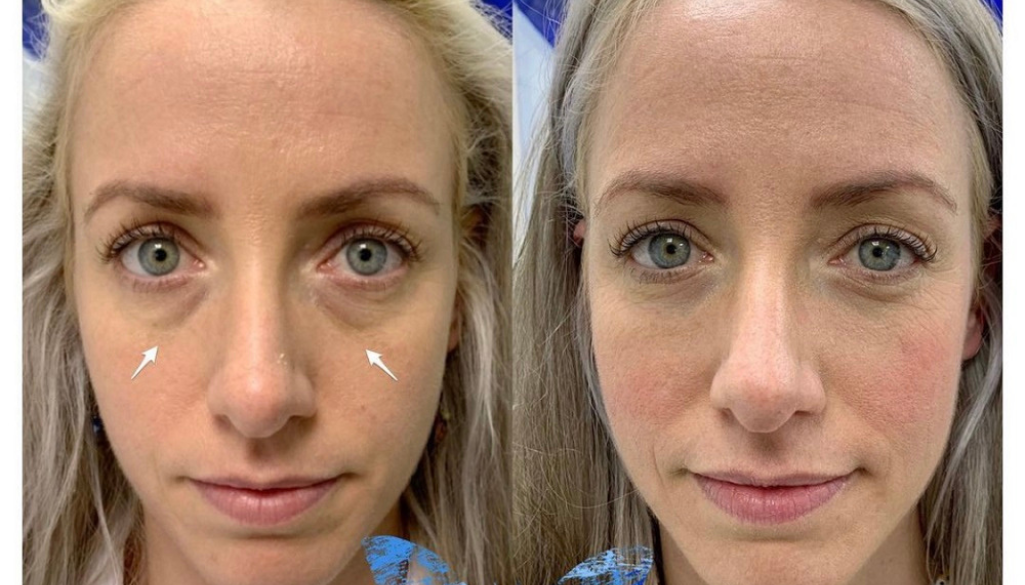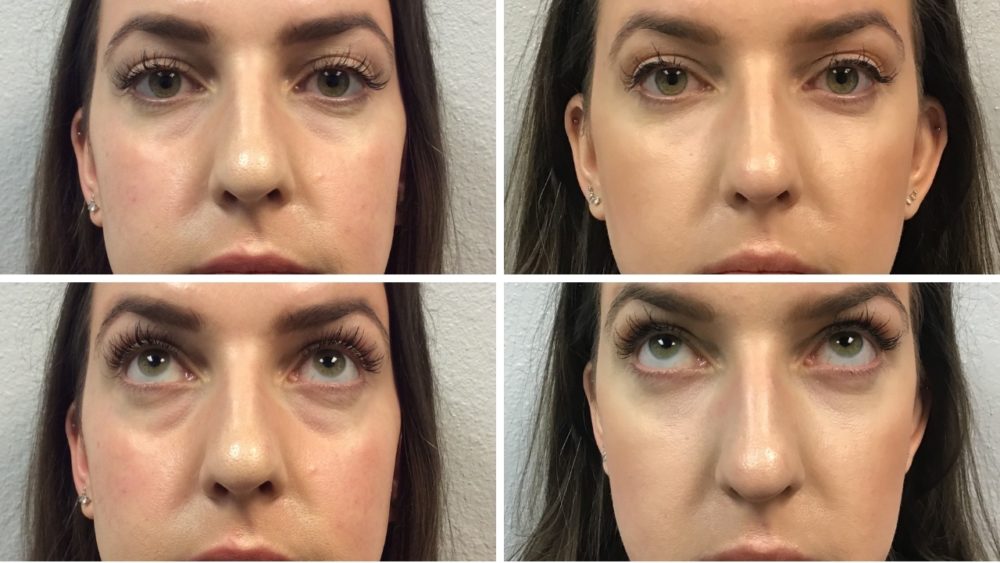
Under eye tear trough filler is a soft hyaluronic acid (HA) gel injected beneath the eyes to restore lost volume, smooth the deep groove between the lower eyelid and cheek, and reduce shadow-based dark circles. This treatment matters for your skin because it replaces lost structural support, draws moisture into thin under eye tissue, and removes the shadows that make a rested face look tired.
Hyaluronic acid fillers rank as the second most popular minimally invasive cosmetic treatment in the United States, with 5,331,426 HA filler procedures performed in 2024, according to the American Society of Plastic Surgeons (ASPS). The under eye area is one of the most delicate places those fillers go. Below, we explain what a tear trough is, why it deepens, how filler changes the skin, which dark circles it fixes, who it suits, how long it lasts, and what to choose when filler is not the right tool.
What Is Under Eye Tear Trough Filler?
Under eye tear trough filler is a cosmetic injection of hyaluronic acid gel placed along the tear trough to fill the hollow between the lower eyelid and the upper cheek. The hollow casts a shadow. The shadow reads as a dark circle, even after a full night of sleep. Filling the hollow lifts the skin back to the level of the cheek, so light hits the under eye area evenly again.
Tear trough filler belongs to the larger family of dermal fillers, the injectable gels that restore lost volume in the face. Fillers made for the under eye area are softer and thinner than fillers used in the cheeks or jawline, because under eye tissue is thin and moves with every blink.
Soft under eye fillers now carry FDA approval for this exact area. The U.S. Food and Drug Administration (FDA) approved Juvéderm Volbella XC for improving under eye hollows in adults over 21 in February 2022, according to Allergan Aesthetics, and approved a second HA filler, Restylane Eyelight, for the same use in June 2023, according to Galderma. Two approvals in two years show how tear trough treatment has grown into a studied, regulated procedure.
What Is a Tear Trough?
A tear trough is the natural groove that runs from the inner corner of the eye down and outward along the top of the cheek. Doctors also call this groove the nasojugal groove or the infraorbital hollow (IOH). The infraorbital hollow sits where the thin skin of the lower eyelid meets the thicker skin of the cheek. That meeting point is anchored to the bone by a ligament, so the groove shows more as the tissue around it loses volume.
What Is Tear Trough Filler Made Of?
Tear trough filler is made of hyaluronic acid, a sugar molecule your body already produces in the skin, joints, and eyes. Manufacturers cross-link the hyaluronic acid so the gel holds its shape for months instead of breaking down in days. Most under eye formulas also contain lidocaine, a numbing agent that makes each injection more comfortable.
Hyaluronic acid dominates the filler category. ASPS data shows HA fillers outnumbered non-HA fillers by more than five to one in 2024, with 5,331,426 HA procedures compared with 932,861 non-HA procedures. Hyaluronic acid is also reversible, which makes it the preferred material for the thin skin under the eyes.
What Causes Tear Troughs to Deepen?
Tear troughs deepen because of fat pad loss, bone changes around the eye socket, thinning skin, and genetics. Volume loss is the root cause in most adults, and genetics decide how early the groove appears. Some people inherit a deep tear trough and notice it in their 20s. Other people see the groove form slowly through their 30s and 40s as the face changes shape.
Fat pad loss comes first for many people. The fat pads under the eyes and in the mid-cheek shrink and slide downward with age. Shrinking cheek fat leaves the lower eyelid without support, and the groove between the eyelid and cheek grows deeper.
Bone changes add to that groove. The eye socket slowly widens with age, and the bone beneath the cheek recedes. A receding cheekbone gives the soft tissue less to rest on, so the tear trough sinks further.
Thin skin makes every change easier to see. The skin on the lower eyelid measures about 0.5 millimeters thick, compared with about 2 millimeters for most facial skin, according to Dermascope, a professional skin care journal. Skin this thin is slightly see-through. See-through skin reveals the shadow of the hollow, the color of the blood vessels, and the outline of the fat pads beneath it.
Why Does Tear Trough Filler Matter for Your Skin?
Tear trough filler matters for your skin because it restores structural volume, improves hydration in thin under eye tissue, and reduces the shadows that make dark circles look worse. Volume lifts the skin, moisture softens the skin, and a smooth surface stops shadows from forming. These three effects work together, and each one builds on the one before it.
Volume and Structural Support
Volume is the first thing filler gives back. Hyaluronic acid gel placed deep along the orbital rim acts like scaffolding for the lower eyelid. Scaffolding under the eyelid holds the skin level with the cheek, so the step between the two areas disappears. A level surface makes the face look rested instead of sunken.
Moisture Retention and Hydration
Hydration is the second benefit, and hydration comes from the nature of hyaluronic acid itself. Hyaluronic acid attracts and binds water in the skin. Water bound around the filler plumps thin under eye tissue, softens fine crepey lines, and gives the skin a smoother texture. Under eye skin loses natural hyaluronic acid with age, so filler replaces some of the moisture-holding power the area has lost.
Shadow Reduction
Shadow reduction is the benefit most people notice first. A hollow under the eye blocks overhead light and casts a dark band across the upper cheek. Filling the hollow removes the edge that creates the shadow. In a 333-patient trial published in the Aesthetic Surgery Journal in 2024, at least 76% of patients treated with an under eye HA filler reported reduced under eye shadows, and at least 79% reported looking less tired.
Shadow reduction works best on skin that is strong and healthy. Many patients pair filler with collagen-building under eye treatments like lasers, peels, and microneedling for firmer, smoother skin over the newly supported area.
Does Under Eye Filler Help Dark Circles?
Yes, under eye filler helps dark circles caused by hollowing and shadow, but it does not change brown pigment, visible blue veins, or puffy fat bags. Under eye filler fixes volume-based dark circles, while color-based and puffiness-based dark circles need a different treatment. Identifying the type of dark circle you have is the most important step before choosing filler.
Dark circle type depends on what sits beneath that 0.5-millimeter layer of skin. The table below matches each type with its cause and the treatment that works best.
| Dark Circle Type | What Causes It | Does Filler Help? | Best Treatment or Partner Treatment |
|---|---|---|---|
| Hollow or shadow | Volume loss creates a groove that casts a shadow | Yes, filler is the main treatment | Hyaluronic acid filler |
| Vascular (blue or purple) | Blood vessels show through thin, see-through skin | Partly, filler adds a cushion over the vessels | Platelet-rich plasma (PRP) or lasers to thicken skin |
| Pigmented (brown) | Extra melanin in the skin | No | Chemical peels and lasers |
| Puffy bags | Fat pads bulge forward under the eye | No, added volume makes bulging look larger | Radiofrequency (RF) microneedling or polydioxanone (PDO) thread lifts, with surgery for large bags |
| Crepey, loose skin | Collagen and elastin loss | Mildly, through added hydration | RF microneedling, lasers, or plasma treatments |
Many people have more than one type at the same time. A shadow-type hollow often sits next to a band of brown pigment, and both need care for the eye area to look bright. We treat mixed dark circles with a combined plan, using filler for the hollow and skin treatments for the color.
Pigment responds best to light-based care. Laser treatments break up excess melanin and build collagen, which thickens the skin so blood vessels show less. Thicker skin also supports filler, so the two treatments deliver more together than either one delivers alone.
Is Filler in the Tear Trough Worth It?
Yes, filler in the tear trough is worth it for people whose tired look comes from volume loss, and the satisfaction data backs that up. Most tear trough patients in clinical studies report looking less tired and stay satisfied with their results a year later.
Satisfaction holds over time. A systematic review highlighted by the American Academy of Ophthalmology (AAO) found an overall satisfaction rate of 84.4% for tear trough filler, with 76.7% of patients still satisfied 6 months or more after treatment. Long-term satisfaction signals results that last and look natural as the months pass.
Product trials show the same pattern. In the Juvéderm Volbella XC clinical study, 90% of subjects reported satisfaction through one year after treatment, according to Allergan Aesthetics. Before treatment, only 15% of those subjects said they were a little or not at all bothered by how tired their under eyes looked; at 3 months, that number rose to 80%.
Controlled trials confirm the change is measurable. In the 2024 Aesthetic Surgery Journal trial, 87.4% of treated patients showed real improvement in their hollows at 3 months, compared with 17.7% of untreated patients in the control group. Results like these explain why hyaluronic acid fillers remain the first choice for under eye hollows.
Who Is a Good Candidate for Under Eye Filler?
A good candidate for under eye filler is a healthy adult with mild to moderate hollowing, reasonably thick skin, minimal fat bulging, and realistic expectations. The best candidates have a hollow, not a bulge. The FDA approvals for under eye HA fillers cover adults over 21, which sets a clear starting age for treatment.
Strong candidates for tear trough filler share several traits:
- A visible groove or hollow between the lower eyelid and cheek
- Dark circles that look darker under overhead light and lighter when the face tilts up toward a lamp
- Skin thick enough to cover the filler smoothly
- Little or no puffy fat bulging beneath the eyes
- Good general health and no active skin infection near the eyes
- Acceptance that results are temporary and need upkeep
Some people do better with a different treatment first. Large, puffy eye bags respond poorly to filler, because filler adds volume to an area that already bulges. Very thin, loose, or crepey skin needs collagen-building care before filler can sit smoothly. People who are pregnant or breastfeeding, or who are allergic to hyaluronic acid or lidocaine, should wait or choose another option.
At our medspa in Bingham Farms, every under eye consultation starts with a close look at skin thickness, fat position, and cheek volume. Cheek volume matters as much as the tear trough itself, because a flat midface pulls the lower eyelid down and makes the groove look deeper. Restoring a little cheek support first often lets a smaller amount of filler do more under the eye.
What Happens During a Tear Trough Filler Appointment?
A tear trough filler appointment follows a short, simple sequence, and the injection itself takes about 15 minutes. Most patients walk in, get treated, and return to normal activities the same day. The appointment moves through six steps:
- Assessment, where your injector studies the hollow, skin thickness, fat pads, and cheek volume from several angles and under different light.
- Cleansing, where the skin is disinfected to lower the risk of infection.
- Numbing, where a topical numbing cream or ice calms the area before lidocaine in the filler adds more comfort.
- Injection, where your injector places small amounts of filler deep along the bone with a blunt cannula or a fine needle.
- Molding, where your injector gently smooths the gel so it blends evenly into the cheek.
- Review, where you check the result in a mirror and receive aftercare instructions.
Small amounts are the key to a natural result. A 2025 retrospective study in the Journal of Clinical and Aesthetic Dermatology found injectors used an average of 0.45 milliliters (mL) of filler per side across 155 patients. A 2020 study in Plastic and Reconstructive Surgery Global Open reported no major complications when injectors used a cannula and no more than 1 mL for both eyes in one sitting.
Does Under Eye Filler Hurt?
No, under eye filler does not hurt much, and most people feel pressure and a brief sting rather than real pain. Numbing cream and lidocaine keep discomfort low, and the 2020 Plastic and Reconstructive Surgery Global Open study rated cannula tear trough treatment as very low in pain. The pressure feels unusual because it sits close to the eye, but the pressure fades the moment the injection ends.
A blunt cannula also limits bruising. A 2023 study in Plastic and Reconstructive Surgery Global Open compared needles and cannulas side by side and found cannulas caused slightly fewer bruises. We often recommend a cannula for this reason, especially for patients with busy social calendars.
Recovery after the cannula technique is short. Patients in the 2024 Aesthetic Surgery Journal trial reported recovering within 3 to 5 hours of treatment. Most swelling fades in 2 to 3 days, and the filler fully settles over 2 to 4 weeks. Light bruising, mild puffiness, and small bumps are normal parts of filler recovery and fade as the gel softens.
How Long Will My Under Eye Filler Last?
Your under eye filler will last 6 months to 2 years, and many patients keep visible results for 12 to 18 months. Under eye filler outlasts filler in most other areas of the face because the tear trough moves less and holds a smaller amount of product.
Low movement slows breakdown. Lips and smile lines move all day, and that motion speeds up how fast the body clears hyaluronic acid. The tear trough sits over bone with little muscle action, so filler in the tear trough breaks down slowly. The 2025 Journal of Clinical and Aesthetic Dermatology study of 155 patients found significant improvement in under eye hollowing up to 18 months after treatment.
Product choice, metabolism, and lifestyle shape the exact timeline. Softer gels made for the under eye area, a slower metabolism, and daily sun protection all help results last longer. Choosing the right under eye filler for your skin plays a large role in how long the result holds.
How Often Do You Need to Get Tear Trough Filler?
You need to get tear trough filler every 9 to 18 months on average, and most visits after the first are small touch-ups. Touch-ups use less product than the first session, because some filler from the first treatment stays in place. Spacing treatments out protects the natural look and prevents a slow buildup of extra product.
Does Filler Age You Over Time?
No, filler does not age you over time when injectors place it in small, well-spaced amounts. Filler only creates a heavy, puffy look when too much product builds up from frequent top-ups. Conservative filler keeps you looking like a rested version of yourself.
Imaging research explains why buildup happens. A 2024 review of 33 magnetic resonance imaging (MRI) studies in Plastic and Reconstructive Surgery Global Open found hyaluronic acid filler still present in the midface of all 33 patients at least 2 years after injection, and in one patient up to 15 years later. The 2023 needle-versus-cannula study also found product remaining in most patients at day 365. Filler that lingers longer than expected is good news for results, and lingering filler is also why we add product slowly and only when the hollow returns.
How Do Injectors Keep Under Eye Filler Safe and Natural?
Injectors keep under eye filler safe and natural by choosing soft hyaluronic acid gels, using small volumes, placing filler deep along the bone, using a blunt cannula, and screening candidates carefully. Careful technique and the right product prevent the most common under eye filler problems before they start.
Common side effects are mild and short-lived. Tenderness, bruising, swelling, small lumps, redness, and firmness are the most common reactions. In the Juvéderm Volbella XC clinical trial, all of these side effects resolved within 45 days. Cold compresses, sleeping with the head raised, and skipping hard workouts for 24 to 48 hours help those reactions fade faster.
Placement depth prevents the Tyndall effect. The Tyndall effect is a bluish tint that appears when hyaluronic acid sits too close to the surface of thin skin. Deep placement against the bone keeps the gel hidden. No cases of the Tyndall effect appeared in the Restylane Eyelight trial, according to Galderma.
Anatomy knowledge keeps serious events rare. Vascular complications, where filler blocks a blood vessel, are the most serious risk of any facial filler. A 2025 report by the American Academy of Ophthalmology reviewed 198 cases of filler-related vision loss and found the nose accounted for 40% of the 226 injection sites listed, while the area around the eyes accounted for only 2 sites. Experienced injectors rely on blunt cannulas, slow injection, and small amounts to keep that risk as low as possible.
Can Under Eye Filler Be Dissolved?
Yes, under eye filler can be dissolved with hyaluronidase, an enzyme that breaks down hyaluronic acid. Hyaluronidase gives tear trough filler a built-in safety net that non-HA fillers do not have. Injectors use hyaluronidase to correct lumps, a bluish tint, or extra puffiness, and to clear filler quickly in an emergency. Reversibility is the main reason hyaluronic acid is the standard material for the under eye area.
What Can You Do Instead of Under Eye Fillers?
Instead of under eye fillers, you can choose PRP, RF microneedling, laser resurfacing, chemical peels, PDO thread lifts, or lower eyelid surgery. The right alternative depends on the cause, with skin quality concerns needing collagen-building treatments and large fat bags needing tightening or surgery.
PRP uses growth factors from your own blood to thicken thin under eye skin. PRP injections work gradually, building collagen over several sessions, and suit people with vascular dark circles or people who want a slow, subtle change.
RF microneedling tightens loose under eye skin by combining tiny needles with heat. Heat in the deeper skin layers triggers new collagen and elastin, which firms crepey skin and softens mild bags. Morpheus8 and Secret RF are two forms of RF microneedling that treat the delicate under eye area with little downtime.
Lower eyelid surgery, called blepharoplasty, removes or repositions fat for large, permanent bags. ASPS reported 120,755 eyelid surgeries in the United States in 2024, making blepharoplasty one of the five most common cosmetic surgeries. Surgery fits people whose bags are too large for nonsurgical care, while filler and skin treatments fit most other under eye concerns.
What Tightens Skin Under the Eyes?
RF microneedling, laser resurfacing, plasma treatments, and PDO thread lifts tighten skin under the eyes by triggering new collagen and elastin. Collagen gives skin firmness, and elastin gives skin its snap-back. Collagen and elastin both drop with age and sun exposure, which is why under eye skin turns crepey and loose.
Thread lifts use dissolvable PDO threads to lift and tighten skin around the eyes. PDO threads dissolve within a few months, and the collagen they trigger keeps the skin firmer for up to a year. Pairing tightening care with filler gives the best of both, a smooth surface over a supported base.
Frequently Asked Questions
Why Are People Against Under-Eye Fillers?
People are against under-eye fillers mostly because of overfilled, puffy results shared online, not because the treatment fails when done well. Overfilling happens when too much product is added too often. Conservative dosing, like the 0.45 mL per side average seen in a 155-patient study, avoids the puffy look behind most of the criticism.
Is Under Eye Filler Safe?
Yes, under eye filler is safe when a trained injector uses an FDA-approved hyaluronic acid gel and careful technique. The FDA approved Juvéderm Volbella XC for under eye hollows in 2022 and Restylane Eyelight in 2023. A 2020 study in Plastic and Reconstructive Surgery Global Open reported no major complications with the cannula technique.
How Much Filler Is Needed for Tear Troughs?
The amount of filler needed for tear troughs is small, usually about half a syringe per side or less. A 2025 study in the Journal of Clinical and Aesthetic Dermatology found an average of 0.45 mL per side, and a 2020 study capped treatment at 1 mL for both eyes in one sitting.
Is Under Eye Filler Better Than PRP?
Yes, under eye filler is better than PRP for restoring lost volume quickly, while PRP is better for thickening thin, crepey skin over time. Filler shows results the same day, and PRP builds results over several sessions. Many patients combine the two for volume and skin quality at once.
How Long Does Under Eye Filler Take to Settle?
Under eye filler takes 2 to 4 weeks to settle fully. Most swelling fades in the first 2 to 3 days, and the final shape appears once the gel softens and blends with the surrounding tissue.
Why Do Some Injectors Avoid Tear Trough Filler for Certain Patients?
Some injectors avoid tear trough filler for certain patients because filler cannot fix puffy fat bags, heavy pigment, or very loose skin. Adding volume to a bulging area makes the bulge look larger. Patients with these concerns get better results from RF microneedling, lasers, thread lifts, or surgery first.
The Takeaway
Under eye tear trough filler restores the volume the under eye area loses with age, hydrates thin skin, and erases the shadows behind a tired look. The best results come from the right candidate, a soft hyaluronic acid gel, small amounts placed deep, and patience between touch-ups. Clinical trials show most patients look less tired and stay satisfied a year later.
Every face loses volume in its own way, so the first step is finding out what causes your dark circles. Our team serving Oakland County is happy to help you sort that out with a careful, honest look at your skin.
FACE Medspa blends medical aesthetics and wellness to help patients look rested and refreshed, never overdone.
Book a consultation whenever you feel ready, and we will build an under eye plan around your skin.