Moxi laser vs BBL comes down to one split: BBL targets color, and Moxi targets texture. BBL is broadband light aimed at brown spots and red vessels. Moxi is a 1927 nm fractional laser that smooths rough skin, fine lines, and early signs of aging. Providers can pair the two in one visit, and the FDA cleared the 1927 nm laser for sun spots and freckles.
Key Takeaways
- BBL treats brown spots and red vessels with broadband light, while Moxi treats texture and fine lines with a 1927 nm laser.
- Clinic guidance plans Moxi as a series of three to four sessions and BBL as one to three starter sessions.
- One 23-patient study of a 1927 nm laser cut actinic keratosis counts by 61% after four monthly sessions.
- Halo is a hybrid laser, and CO2 resurfacing is the strongest option, with the longest recovery.
- Your provider matches the treatment to your skin tone, concern, and calendar at a consultation.
What Is the Difference in Moxi Laser vs BBL?
The difference in Moxi laser vs BBL is the target: BBL treats color, and Moxi treats texture. BBL sends filtered light into the skin, where brown pigment and red vessels absorb it. Moxi sends laser energy in tiny columns that trigger skin renewal. Our Moxi treatment follows that texture-first approach.
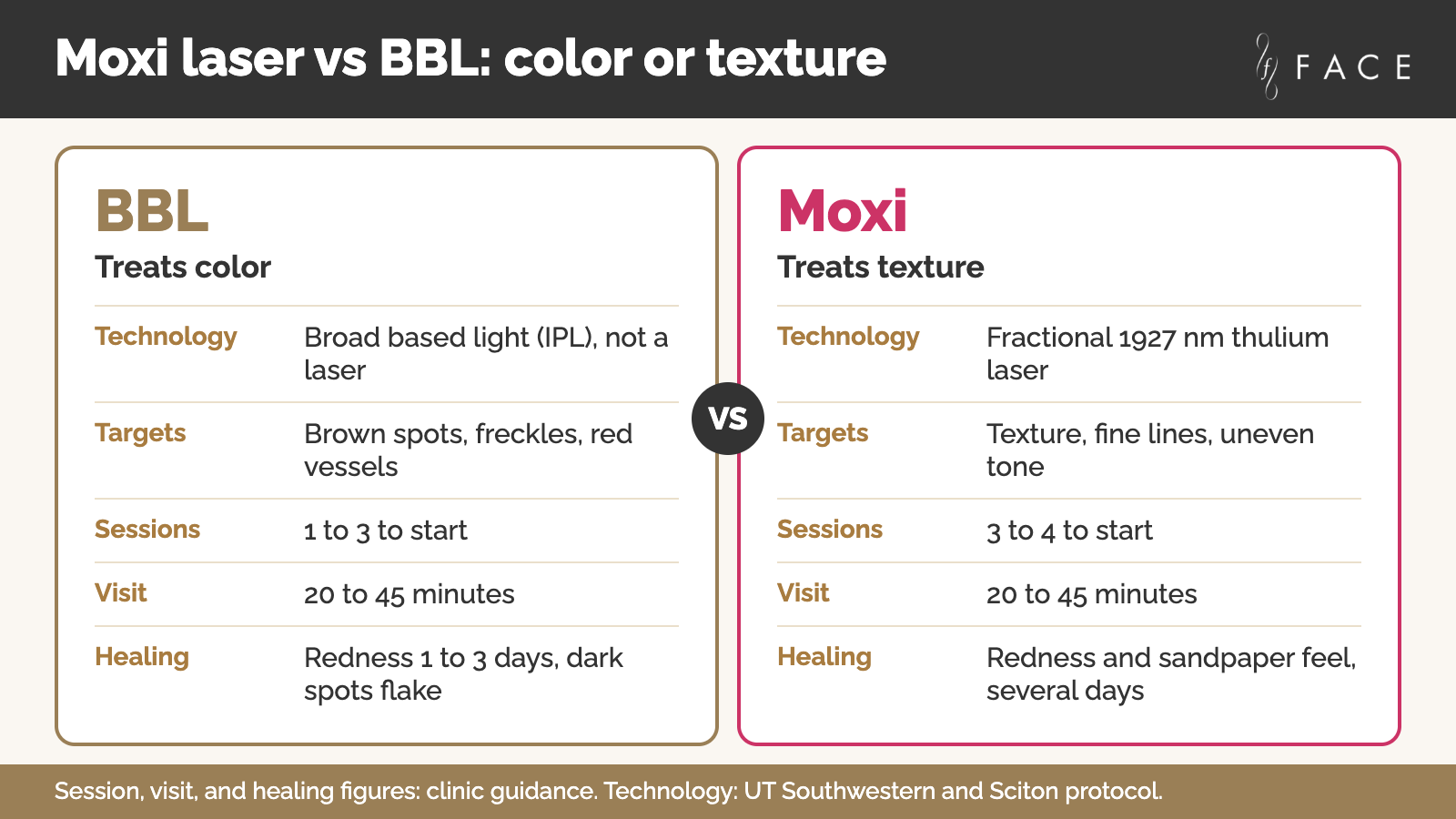
A research protocol from UT Southwestern Medical Center, sponsored by Sciton, lists BBL as nonablative intense pulsed light (IPL). The same protocol lists Moxi as a fractionated nonablative thulium laser at 1927 nm. Nonablative means the surface of the skin stays in place. The table below sets the two treatments side by side.
The session and healing rows come from clinic guidance, not controlled trials. The next two sections explain how each treatment works.
What Is a Moxi Laser Facial?
A Moxi laser facial is a fractional laser treatment that uses 1927 nm light to renew the top layers of skin. The laser heats thousands of tiny columns and leaves the skin between them untouched. The body replaces the treated columns with fresh cells and new collagen.
The FDA cleared Sciton’s JOULE 1927nm Laser System under 510(k) number K182173 on March 6, 2019. The labeling covers actinic keratosis (AK), plus benign pigmented lesions such as age spots, sun spots, and freckles. Clinic guidance calls the approach prejuvenation, because it suits early signs of aging.
Moxi works on texture and tone. BBL works on color, which the next section covers.
What Does BBL Do for Your Skin?
BBL clears color by sending broadband light that brown pigment and red vessels absorb. IPL light is noncoherent and broad-spectrum, and it comes from a xenon lamp. Filters narrow the spectrum to match the target in the skin.
A split-face study of 28 women found IPL effective for lentigines, telangiectasia, and generalized erythema. The same paper reports IPL is less effective for wrinkles. Our BBL photofacial option runs on Sciton’s BBL Hero platform.
Wrinkle and texture goals point toward a fractional laser instead. The next section matches each treatment to a skin concern.
Which Treatment Fits Your Skin Concerns and Skin Tone?
The treatment that fits your skin follows your main concern: color points to BBL, and texture points to Moxi. The Sciton protocol lists BBL for freckles, age spots, cherry angiomas, and rosacea. The same protocol lists Moxi for pigmentation, sun damage, and signs of aging. The list below turns that into a quick guide.
- Sun spots, freckles, and age spots point to BBL.
- Red vessels and rosacea-related redness point to BBL.
- Fine lines, rough texture, and enlarged pores point to Moxi.
- Early aging and skin maintenance point to Moxi.
- A mix of color and texture points to both treatments.
The graphic below shows the same split, with the typical session counts from clinic guidance.
Pigment has several causes, and a provider confirms which one you have. Our dark spot treatment page covers the wider set of pigment options.
Skin tone shapes the choice as well. Nebraska Medicine states that darker skin carries a higher risk of discoloration or scarring from aggressive lasers. Providers adjust the settings to your tone.
The evidence for deeper skin tones is thin. A pilot study used a nonablative 1927 nm laser plus hydroquinone 4% cream in patients with Fitzpatrick type IV skin. Of 8 evaluated patients, 3 had an excellent response and 4 had a satisfactory response. None developed paradoxical pigmentation. The sample was tiny, and the study had no control group. Our sun-safe laser options guide covers how providers set energy for different tones.
Can Moxi Laser and BBL Be Combined in One Visit?
Moxi laser and BBL can be combined in one visit, because the two treatments reach different concerns. The UT Southwestern protocol gives up to 15 subjects one or two combined BBL, Moxi, and Halo treatments. The second visit falls 4 to 8 weeks after the first.
That protocol is non-randomized and has no control group, so it shows a method, not proof of better results. Clinic guidance describes BBL as the pass for color and Moxi as the pass for texture. Your provider sets the number of Moxi sessions after a skin review.
Once a plan is set, the next question is what the results look like.
What Are Realistic Moxi Laser Results?
Moxi laser results build over a monthly series, with smoother texture and a more even tone as skin renews. The strongest published data comes from a 1927 nm thulium fractional laser study in Lasers in Surgery and Medicine. The study treated 23 patients with four monthly sessions.
Actinic keratosis counts fell from 15.8 to 6.2 three months after the last session, a 61% reduction. Mottled pigmentation scores moved from 2.3 to 1.5. Tactile roughness moved from 2.4 to 1.1. The graphic below shows the AK count at each check.
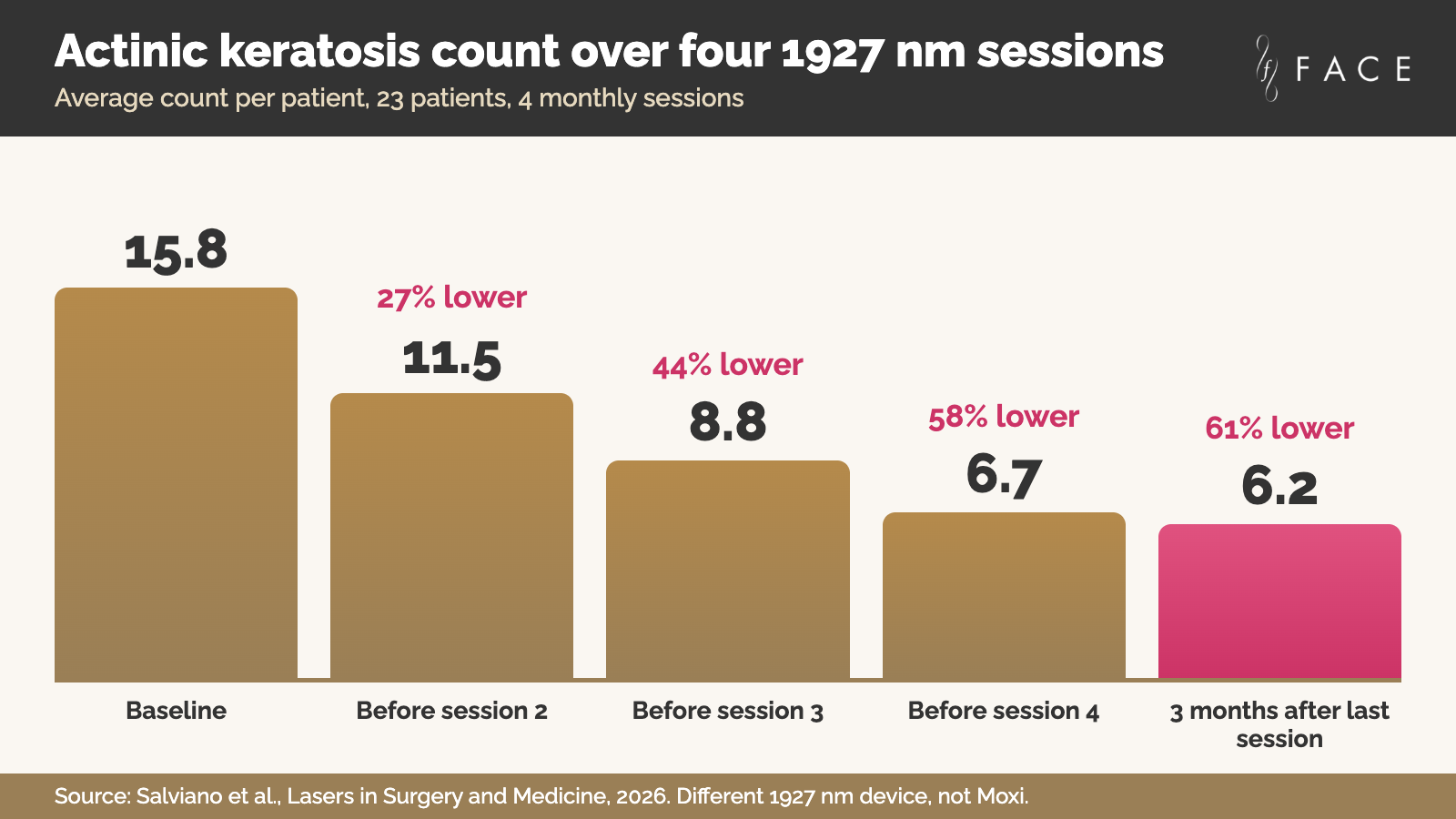
The study used a different 1927 nm device, not Moxi. Patients averaged 61 years old and had Fitzpatrick type I to III skin. No patient with type V or VI skin took part.
The ASLMS release on the study adds one caution. Proliferation markers p53 and Ki-67 stayed stable despite visible improvement, so the authors call for continued skin checks. Improved skin does not replace regular skin exams.
What Can Moxi Laser Before and After Photos Show?
Moxi laser before and after photos show changes in texture and tone, but providers choose which photos to display. Lighting, angle, and makeup also shift how skin looks. Photos are an illustration, not a forecast.
Look for photos that use the same light and angle in both frames. Look for patients with your skin tone and your starting concern. Look for the number of sessions and the weeks between the last session and the photo.
Photos set expectations, and cost shapes the decision to start.
Is Moxi Laser Worth the Money?
Moxi laser is worth the money when its target matches your goal, which means texture, fine lines, or early aging. Moxi is planned as a series of three to four sessions plus later upkeep, per clinic guidance. The real cost therefore covers several visits, not one.
No controlled study has compared Moxi against BBL for value or long-term results. The published data is small and mostly uncontrolled. Color-only goals may suit BBL better, since clinic guidance lists one to three starter sessions for it.
Our BBL basics article covers that treatment in more detail. Ask your provider how many visits your goal needs, and what upkeep looks like after the series.
How Do You Prepare for and Recover From Moxi or BBL?
Prepare for Moxi or BBL by sharing your skin history and protecting your skin from the sun. Recovery stays short for both treatments, but each looks different. The steps below follow the order of a typical plan.
- Tell your provider about medications, skin conditions, and recent sun exposure at the consultation.
- Follow the pre-treatment skin instructions your provider gives you.
- Expect numbing cream before Moxi, since fractional lasers use a numbing step of at least 30 minutes, per Nebraska Medicine.
- Expect BBL spots to darken first, then flake away over several days.
- Expect a pink, sandpaper-like feel after Moxi, and keep the skin moisturized.
- Wear sunscreen daily, as our sunscreen basics guide explains.
Nebraska Medicine describes Fraxel-type recovery as pinkness for two or three days and flaking for about a week. Your provider gives the timeline for your own plan. Recovery times change with the settings used.
What Else Should You Know About Laser Options for Your Face?
What Is a Halo Laser?
A Halo laser is a hybrid fractional laser that pairs a nonablative 1470 nm wavelength with an ablative 2940 nm wavelength. The Sciton protocol describes it as a dual fractionated hybrid laser. Ablative wavelengths remove microscopic columns of tissue, so healing plans differ from Moxi. Our Halo hybrid laser page covers the device.
The same protocol cites a 2020 study where a single Halo treatment improved UV spots and brown spots. The protocol also cites a 2018 study of Fitzpatrick type I to IV skin with high patient satisfaction. Our Halo results article covers duration.
Halo, Moxi, and BBL all run on Sciton’s JOULE platform, per the protocol. The FDA cleared the JOULE Multi-Platform System under 510(k) number K101916 on March 18, 2011. A stronger laser exists, and the next question names it.
What Is the Most Powerful Laser for Face Treatments?
The most powerful laser for face resurfacing in the Nebraska Medicine program is the CO2 laser. At its highest setting, skin may stay red or scabbed for a month. A full-face session at that setting takes about an hour.
Fraxel is less intense and needs a shorter recovery, per the same source. Moxi and BBL are nonablative, so neither removes tissue. Power is a trade-off between change and healing time, not a ranking of quality.
Our fractional CO2 resurfacing page covers that option. Nebraska Medicine adds that the right laser depends on your skin, your goals, and the recovery time you can manage.
Frequently Asked Questions
Is BBL a Laser?
No, BBL is a light treatment, not a laser. BBL uses broad-spectrum light from a lamp, while a laser uses one focused wavelength.
How Many Moxi Sessions Do You Need?
Clinic guidance lists three to four Moxi sessions for a starter plan. The 1927 nm study above used four monthly sessions. Your provider sets the final count after a skin review.
How Many BBL Sessions Do You Need?
Clinic guidance lists one to three starter BBL sessions. Brown spots and redness respond at different speeds, so the plan adjusts after each visit.
Does Moxi Work for Sun Damage?
Moxi targets sun damage, and the FDA cleared the 1927 nm wavelength for sun spots, age spots, and freckles. Published studies are small and uncontrolled, so results vary by skin and by plan.
How Long Does a Moxi Session Take?
Clinic guidance lists 20 to 45 minutes for a Moxi session. Numbing time comes before the laser pass.
How Does FACE Medspa Help You Choose Between Moxi and BBL?
FACE Medspa helps you choose between Moxi and BBL with a skin review that matches your concern, tone, and calendar. We offer Moxi, BBL Hero, and Halo, so a plan can use one device or several. Our FACE Medspa experts explain each option in plain terms.
The review covers your main concern, your skin tone, your sun exposure, and your recovery window. We see patients from Bloomfield Hills and nearby communities. Bring photos of your skin and a list of your products to the visit.
You can contact us to book a visit and see which treatment fits you.