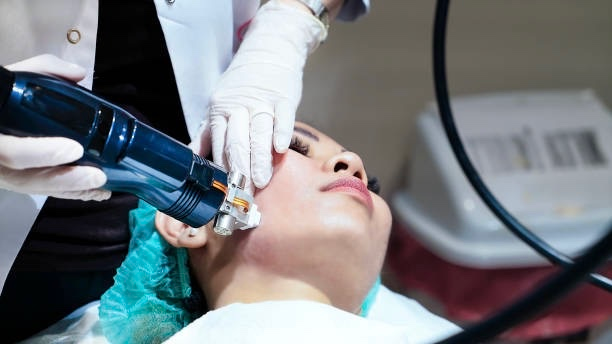
RF microneedling before and after photos show two different changes on two different clocks. The tightening you notice in the first week comes from heat contracting the collagen you already have, and it fades. The firmer, smoother skin visible at six to twelve weeks comes from new collagen your body builds, and that one lasts. This article maps the full timeline day by day and week by week, explains what day three looks like and why grid marks appear, covers how many sessions the research actually supports, and walks through how the neck, body, and under-eye areas heal on schedules of their own.
What Is RF Microneedling?
RF microneedling is a treatment that drives fine needles into the dermis and delivers radiofrequency energy through them at the same time. The needles create controlled micro-channels, and the radiofrequency energy heats the tissue around each channel, so the skin receives a mechanical signal and a thermal signal in one pass. Both signals tell fibroblasts, the cells that manufacture collagen, to get to work.
Treatments like this now account for the bulk of aesthetic volume nationwide. The American Society of Plastic Surgeons counted 28.2 million minimally invasive procedures in 2024, and skin resurfacing procedures alone reached 3,703,305, a six percent rise over the prior year and the fastest growth in that category.
The reason patients keep choosing energy-based resurfacing over topicals comes down to depth. Serums act on the epidermis, while collagen loss happens in the dermis beneath it, and only a device that reaches the dermis can change what is happening there.
What Is the Difference Between Microneedling and RF Microneedling?
The difference between microneedling and RF microneedling is heat. Traditional microneedling creates micro-injuries and relies entirely on the wound-healing response, while RF microneedling adds controlled thermal energy that contracts existing collagen fibers and drives a stronger regenerative signal. The needles are the delivery route in both cases, but the RF version does two jobs on one pass.
A 2025 study published in Scientific Reports put both methods head to head on the same faces. Thirty women aged 60 and over received four sessions of microneedling on one side and RF microneedling on the other. Biopsies showed the RF-treated sides had more proliferating non-senescent fibroblasts, fewer senescent fibroblasts, and higher collagen and elastin content than the microneedling-only sides.
Fewer senescent fibroblasts is the finding worth pausing on. Senescent cells sit in aging skin without producing collagen, so replacing them with active cells changes the tissue’s capacity to repair itself rather than just its appearance. Our full range of microneedling treatments spans both categories because the right choice depends on whether your concern is surface texture or structural laxity.
How Does RF Microneedling Work?
RF microneedling works through two separate mechanisms that run on two separate timelines. Thermal contraction happens during the session and shows up within days, while neocollagenesis, the building of brand new collagen, takes weeks to months. Conflating the two is the most common reason patients misread their own before and after photos.
Thermal contraction comes first. Radiofrequency heat partially denatures existing collagen fibers, causing them to shorten immediately, which is visible in histology taken directly after treatment. Dermal shrinkage was documented immediately post-treatment in a 2023 Journal of Cosmetic Dermatology study, alongside partially denatured collagen fibers.
Neocollagenesis comes second and lasts far longer. The same study biopsied patients again at four months and found increased density and compaction of both collagen and elastin fibers. A separate histometric study of 12 subjects who received three sessions at one-month intervals measured a significant rise in collagen type I at three months, with a significant reduction in abnormal elastin. Those are the changes that hold, and they are what the radiofrequency treatments in our menu are built to trigger.
How Quickly Do You See Results From RF Microneedling?
You see the first results from RF microneedling within three to seven days, but those early results are not the ones that last. Surface brightness and a temporary tightening appear in the first week from thermal contraction and post-treatment swelling, while the durable firming shows up between six and twelve weeks as new collagen matures. Full collagen remodeling continues for up to six months after a session.
Blinded evaluation data gives a useful benchmark for that later window. In a study where patients received a single RF microneedling session, two independent dermatologists rated outcomes at the four-month mark and classified 53.3 percent of patients as very much improved, 26.7 percent as much improved, and 20 percent as improved. Every patient in that group landed somewhere on the improvement scale.
The measured size of the change was modest per session and consistent. Average reduction in fine lines, wrinkles, furrows, and folds ran about 30 percent, with neck silhouette improvement averaging about 20 percent. Patients rated their satisfaction at 8.3 out of 10 while treating clinicians rated the same results at 9.3 out of 10.
What Does RF Microneedling Before and After Look Like Week by Week?
RF microneedling before and after progress moves through eight recognizable stages, and the photo you are looking at online means very little unless you know which stage it represents. Redness dominates the first 48 hours, a bronzed grid pattern appears around day three, a clear glow arrives around day ten, and structural firming becomes obvious between weeks six and twelve. The table below maps each stage against what is actually happening in the tissue.
| Stage | What the skin looks like | What is happening underneath | What the evidence shows |
|---|---|---|---|
| Day 0 | Red, warm, tight, like a moderate sunburn | Micro-channels open, collagen fibers partially denatured | Dermal shrinkage visible on biopsy immediately post-treatment |
| Days 1 to 2 | Redness fading, mild swelling, skin feels taut | Inflammatory phase of wound healing | Erythema reported in all patients in a 40-patient safety study |
| Day 3 | Bronzed tone, faint grid pattern, dryness | Treated microcolumns migrating toward the surface | Temporary and expected; resolves without intervention |
| Days 4 to 7 | Light flaking, texture beginning to smooth | Re-epithelialization, accelerated cell turnover | Erythema duration shorter than with fractional CO2 laser |
| Day 10 | Clear glow, more even tone, smaller-looking pores | Surface healing complete, collagen synthesis underway | Early improvement precedes structural change |
| Weeks 2 to 4 | Texture refining, fine lines softening | Type III collagen deposited as a provisional scaffold | Scar volume reduction reaches significance by week 12 in trials |
| Weeks 6 to 12 | Visible firming, tighter jawline and cheeks | Type III converting to stronger type I collagen | Significant rise in collagen type I on biopsy at 3 months (p = 0.001) |
| Months 4 to 6 | Peak result, sustained firmness and smoothness | Collagen and elastin fibers denser and more compact | 80 percent rated very much or much improved at 4 months |
Sources: Journal of Cosmetic Dermatology clinical and histological evaluation of microneedle fractional radiofrequency, 2023; histometric and immunohistochemical study of combined microneedle and sublative fractional radiofrequency; prospective randomized split-face trial comparing radiofrequency microneedling with fractional carbon dioxide laser; efficacy and safety study of microneedling radiofrequency in 40 patients.
Textural concerns follow that same curve but often need more sessions to reach a visible endpoint. Patients coming to us for scar treatments generally see their most convincing photo comparison after the third session rather than the first.
What Does Day 3 of Microneedling Look Like?
Day 3 of microneedling looks bronzed and slightly rough, often with a faint grid pattern of tiny dots across the treated area. The grid corresponds exactly to the needle array on the device, and the darker tone is treated tissue working its way to the surface before it sheds. Nothing has gone wrong when this appears.
Each needle creates a microcolumn of thermally treated tissue in the dermis. Your body pushes that treated tissue upward as new cells form beneath it, and because the columns sit in a regular pattern, the shedding follows the same regular pattern. The dots typically resolve between days four and seven.
Skin also feels dry and sandpapery through this window. Barrier function is temporarily reduced while re-epithelialization finishes, so a bland moisturizer and no active ingredients is the correct approach for these few days.
How Long Does Redness Last After RF Microneedling?
Redness after RF microneedling lasts 24 to 72 hours for most patients, and lingering pinkness at day five is within normal range for anyone treated at higher energy settings. Erythema is the single most common post-treatment finding and appears in essentially every patient. A safety study of 40 patients recorded erythema in all of them, edema in 12, and post-inflammatory hyperpigmentation in only two.
How long the redness lasts tracks with treatment depth and energy. Deeper settings used for acne scarring keep skin pink longer than the lighter settings used for general skin quality, which is one reason the same device produces different downtime on different patients.
Compared with laser resurfacing, this is a favorable profile. A randomized split-face trial found RF microneedling produced shorter erythema, pain, swelling, and scab-detachment durations than fractional carbon dioxide laser, along with fewer pigmentation events, while achieving statistically comparable scar results.
How Long Does It Take for RF Microneedling to Heal?
RF microneedling takes about seven days to heal on the surface and about six months to finish remodeling underneath. Surface healing means re-epithelialization is complete and makeup and normal skincare can resume, while deep healing means collagen synthesis and maturation have run their course. Those two endpoints are five months apart, which explains why patience is the main requirement of this treatment.
Most patients return to work the day after treatment. Redness is present but coverable at 24 hours, and the visible rough patch around day three lands mid-week for anyone treated on a Friday, which is worth factoring into scheduling.
Healing speed depends partly on how well the skin barrier is supported. Sun exposure during the healing window is the fastest way to slow the process and risk pigmentation, so daily broad-spectrum SPF is not optional during the first month.
How Do You Know if RF Microneedling Is Working?
You know RF microneedling is working when you can point to specific, checkable changes rather than a general impression. Pore visibility, makeup behavior, the way light falls across your cheek, and the depth of individual scars are all trackable markers, and they change in a predictable order. Texture improves before firmness does, essentially always.
Objective markers worth watching between weeks two and twelve include how long foundation stays smooth instead of settling into lines, whether pores on the nose and cheeks look smaller in indirect light, and whether the skin bounces back faster when pinched at the jawline. Clinical studies measure these same properties as elasticity, hydration, and transepithelial water loss.
Photograph yourself in the same spot, at the same time of day, in the same light, before your first session and every four weeks after. Consistent lighting is what makes the difference between a comparison that means something and two photos that just look different.
Is One Session of RF Microneedling Enough?
One session of RF microneedling is enough to produce a measurable change, but it is not enough for the results most patients have in mind. Single-session studies show real improvement, while the larger changes patients expect from before and after photos consistently come from a series of three to four treatments. The evidence on that point is unusually clear.
Acne scarring shows the pattern best. A randomized split-face trial delivered three sessions at eight-week intervals and watched mean scar scores fall from 54.73 to 30.53 on the validated ECCA scale. Research published in Aesthetic Surgery Journal found that after four sessions, every patient achieved at least a 50 percent reduction in median ECCA grading, and a 2025 systematic review noted one study in which 80.64 percent of patients gained a full two-grade scar improvement.
Active acne responds on a similar curve. In a randomized controlled trial, two sessions spaced four weeks apart reduced inflammatory lesions by 80 percent and non-inflammatory lesions by 65 percent by the twelve-week mark, with a significant drop in sebum production. Here is how we sequence a standard series of RF microneedling for a patient starting from scratch:
- Consultation and baseline photography. Standardized lighting and angles, plus a review of medications and skin history.
- Session one. Conservative settings to gauge how your skin responds and how long your redness lasts.
- Four to six week interval. Collagen synthesis peaks during this window, and treating sooner interrupts it.
- Session two. Settings adjusted upward based on session one recovery, with depth matched to the concern.
- Session three. Most patients reach their visible turning point here.
- Session four where indicated. Added for deeper scarring or more advanced laxity.
- Twelve-week assessment. Final comparison photos taken three months after the last session, once collagen has matured.
How Often Can You Do RF Microneedling?
You can do RF microneedling every four to six weeks during an initial series, then once or twice a year for maintenance. The four to six week gap exists because collagen synthesis needs that long to complete its cycle, and stacking sessions closer together adds inflammation without adding collagen. Published protocols use intervals of four weeks at the shortest and eight weeks for deeper scar work.
Maintenance spacing depends on how fast your skin loses ground. Collagen declines by roughly one percent per year from the mid-20s, so an annual session roughly offsets a year of loss for many patients, while those with more advanced laxity often do better on a twice-yearly rhythm.
Device choice affects spacing too, since needle depth and energy delivery differ between platforms. Our comparison of Sylfirm X and Morpheus8 breaks down how those differences play out in practice.
Is RF Microneedling Permanent?
RF microneedling is not permanent, though the collagen it builds is real tissue rather than a temporary filler effect. The new collagen persists, and skin continues aging around it at its normal rate, which is why results fade gradually over one to two years instead of disappearing on a fixed date. That distinction matters for planning.
Think of it as resetting your position on a slope rather than stepping off the slope. Collagen type I makes up roughly 80 percent of dermal collagen and type III about 15 percent in young skin, and both continue their decline after treatment. What changes is your starting point.
Scar improvement behaves differently and holds better than laxity improvement. Remodeled scar tissue does not re-form into its original shape, so acne scar results from a completed series tend to persist far longer than skin tightening results do.
Can RF Tighten Jowls?
RF microneedling can tighten mild to moderate jowls, and it cannot lift jowls caused by significant skin excess or descended deep tissue. The treatment firms the dermis, so it works where the problem is early laxity and reaches its ceiling where the problem is volume displacement or true skin redundancy. Being direct about that ceiling saves patients disappointment.
Measured tightening runs in the moderate range. The 2023 clinical study recorded roughly 20 percent improvement in neck silhouette from a single session, a meaningful change on a face that is starting to soften and an insufficient one on a face with pronounced jowling.
Where laxity has progressed further, layered approaches work better than repeating a single modality. Combining RF microneedling with other skin tightening technologies addresses different tissue depths at once, and we plan those combinations at consultation rather than defaulting to more sessions of the same thing.
What Is the Best Age for RF Skin Tightening?
The best age for RF skin tightening is the early to mid-30s for prevention and the 40s and 50s for correction, though tissue condition matters far more than the number. Collagen falls by about one percent per year starting in the mid-20s, with type III collagen declining earlier and faster than type I, so measurable loss precedes visible loss by years. Starting during that gap produces the easiest maintenance.
Older skin still responds well, which is worth stating plainly because the opposite assumption is common. The Scientific Reports study that showed reduced senescent fibroblasts and increased collagen and elastin recruited women aged 60 and over, and it measured improvement in wrinkles, elasticity, hydration, and barrier function against baseline.
Patients under 30 usually get more from targeted work than from generalized tightening. If the concern is acne scarring rather than laxity, RF microneedling remains a strong choice at any age, while patients whose concern is skin elasticity alone tend to see a stronger return once some decline has actually occurred.
How Does RF Microneedling Work on the Neck, Body, and Under Eyes?
RF microneedling works on the neck, body, and under eyes, and each area heals on its own schedule because the skin and blood supply differ. Facial skin heals fastest, the neck and chest run slower, and body areas like the abdomen and arms are the slowest of all. One universal timeline does not describe any of them accurately.
- Face. Rich blood supply and thicker dermis. Redness for one to three days, visible results at six to twelve weeks. The reference timeline.
- Neck and chest. Thinner dermis, fewer oil glands, less blood flow. Redness can last four to five days and results often need an extra session. Neck silhouette improvement averaged about 20 percent per session in clinical measurement.
- Under eyes. The thinnest skin on the body, treated at shallower depths with lower energy. Swelling is more pronounced and lasts longer than on the cheek. In one periorbital study, all patients showed wrinkle improvement in the lateral eye area, while only two of eleven showed change in the lower eyelid itself.
- Abdomen and stretch marks. Large surface area, slow turnover, and mature stretch marks are established scar tissue rather than laxity. Expect a longer series and a more gradual curve.
- Arms and above the knees. Crepey texture responds, but these areas are slow to heal and generally treated at wider intervals.
Atrophic scarring is unusually common, which is part of why body treatment demand keeps rising. Research published in the Journal of Cosmetic Dermatology in 2025 puts atrophic acne scarring at roughly 90 percent of adults with a history of inflammatory acne, and those scars are not limited to the face.
What Are the Types of RF Microneedling Devices?
The types of RF microneedling devices divide by needle insulation, needle depth range, and whether the energy is delivered in pulses or continuously. Insulated needles release energy only at the tip, concentrating heat in the deep dermis and sparing the epidermis, while non-insulated needles deliver energy along the full needle shaft and treat superficial and deep layers together. That single distinction changes both the result and the downtime.
Depth range is the second variable. Devices treating at shallower depths suit thin skin and surface texture, while deeper settings reach the tissue involved in laxity and scarring. A trial using ultrathin one-millimeter electrodes across six sessions in nine participants documented texture and wrinkle improvement measured three months after the final session, showing that shallower protocols work when the depth matches the concern.
At our Bingham Farms practice we run Morpheus8 for deeper remodeling and contouring work where subdermal tightening is the goal.
We also run Sylfirm X, which uses pulsed-wave delivery alongside continuous wave, giving it a different profile for vascular concerns and pigment-related conditions, and Secret RF for general dermal remodeling. Matching the device to the concern is the whole point of carrying several microneedling options rather than one.
Does RF Microneedling Hurt, and How Do You Prepare for It?
RF microneedling does not hurt much, and preparation starts about a week before your appointment. Topical numbing cream applied 30 to 45 minutes beforehand reduces the sensation to pressure and warmth rather than sharp pain. Deeper settings on bony areas like the forehead and jawline register more than settings used on the cheeks.
Preparation protects both comfort and outcome. Stop retinoids, alpha hydroxy acids, beta hydroxy acids, and physical scrubs three to five days out. Avoid direct sun and tanning for a week, since treating recently tanned skin raises pigmentation risk. Skip alcohol for 24 hours and, with your prescriber’s agreement, pause blood thinning medications and supplements such as fish oil for a week to limit bruising.
Arrive with clean skin and no makeup, lotion, or SPF on the treatment area. Our step-by-step notes on how to prep your skin cover the full pre-treatment window in detail.
What Are the Do’s and Don’ts After RF Microneedling?
The do’s after RF microneedling are gentle cleansing, hydration, and daily sun protection, and the don’ts are heat, sweat, active ingredients, and makeup in the first 24 hours. What helps microneedling heal faster is a stripped-back routine, not an added one. More product on healing skin slows the process rather than speeding it.
In the first 24 hours, cleanse with lukewarm water and pat dry with a clean towel, wash your hands before touching the treated area, and skip makeup entirely. What not to do in that window is exercise, sauna, hot yoga, swimming pools, hot tubs, and any exfoliation. Sweat and chlorine both irritate open micro-channels.
The best thing to put on skin after microneedling is a bland barrier-supporting moisturizer plus broad-spectrum SPF 30 or higher from day two onward. Hold retinoids, vitamin C, and acids for a full week. Any product with fragrance or a long ingredient list can wait until the flaking phase has finished.
Can RF Microneedling Be Combined With PRP?
RF microneedling can be combined with PRP, and the micro-channels are what make the combination work. Platelet-rich plasma drawn from your own blood carries growth factors that reach the dermis directly through the channels the needles have just created, instead of sitting on the skin surface. Timing is what determines whether the pairing adds anything.
Combination protocols show up throughout the scar literature. In one reviewed study, 40 participants receiving fractional RF microneedling with PRP recorded significant quality of life improvements by the fourth session, with statistical significance below the 0.001 threshold on a validated dermatology index.
Not every combination belongs in the same appointment, though. Layering a chemical peel or a resurfacing laser on top of RF microneedling on the same day risks over-treating the barrier, so those get sequenced across separate visits. Our detailed look at RF microneedling combined with PRP covers how we schedule it.
Frequently Asked Questions
Is RF Microneedling Safe?
RF microneedling is safe with a well-documented side effect profile that skews mild and temporary. A 40-patient study recorded erythema in all participants, edema in 12, and post-inflammatory hyperpigmentation in only two, with no serious adverse events. Comparative research found fewer pigmentation events and shorter recovery than fractional carbon dioxide laser at equivalent scar outcomes.
How Will I Look 2 Days After Microneedling?
Two days after microneedling you will look mildly sunburned, with fading redness and possibly slight swelling. Most people are comfortable in public at this point and can cover residual pinkness with mineral makeup after the first 24 hours. Skin feels tight and slightly dry, which is normal at this stage.
Can I Go to Work After Microneedling?
You can go to work after microneedling, and most patients return the very next day. Redness is the main visible effect and it fades substantially within 24 to 48 hours. Anyone with a high-visibility event should schedule at least ten days out, since the day three bronzing phase is the least camera-friendly point in the timeline.
How Soon Can I Shower After Microneedling?
You can shower after microneedling the same day, provided you keep the water lukewarm and off your face where possible. Hot water and steam increase inflammation in freshly treated skin and should be avoided for 48 hours. Pat the treated area dry rather than rubbing it with a towel.
Do I Have to Wait 24 Hours to Wash My Face After Microneedling?
You do not have to wait a full 24 hours to wash your face after microneedling, though many providers prefer you wait several hours before the first cleanse. Use lukewarm water and a mild non-exfoliating cleanser with clean hands. The 24-hour rule that matters more is the one about makeup and active ingredients.
Is RF Microneedling Safe for Darker Skin Tones?
RF microneedling is safe for darker skin tones, and this is one of its clearest advantages over ablative laser resurfacing. Radiofrequency energy passes through the epidermis where melanin sits and deposits its heat in the dermis, so it does not target pigment the way light-based devices do. Post-inflammatory hyperpigmentation occurred in two of 40 patients in one safety study, and comparative research recorded fewer pigmentation events with RF microneedling than with fractional carbon dioxide laser.
Putting It All Together
The honest version of RF microneedling before and after results looks like this: a rough week, a glow around day ten, real texture change by week four, and the firming everyone actually wants somewhere between weeks six and twelve, with collagen still building for months afterward. A single session produces measurable improvement, and a series of three to four produces the kind of change that shows clearly in a photo. Anyone promising a transformation in seven days is selling swelling.
What separates a good result from a mediocre one is matching device, depth, and session count to the concern rather than running one protocol on everyone. That is why we keep several platforms in the treatment room at our Bingham Farms office and why we photograph patients under standardized lighting at every visit. If you want to know what your own skin would realistically do over the next three months, we would be glad to map it out with you at a consultation with our team at FACE Skincare~Medical~Wellness.