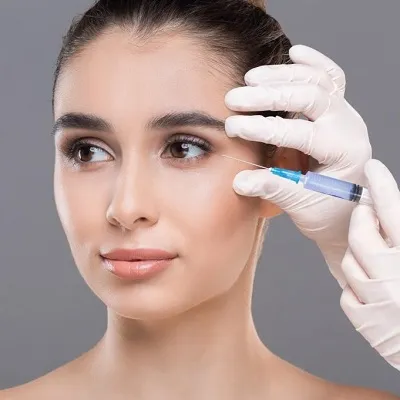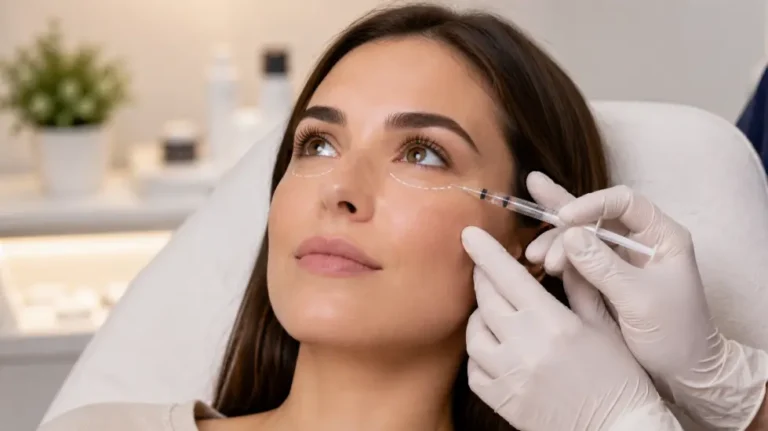
Under eye filler before and after photos show a softer shadow under the lower eyelid, a smoother line where the eyelid meets the cheek, and a rested look that arrives about two weeks after treatment once swelling clears. The change comes from filling a hollow, not from bleaching pigment, so the size of the change depends on what is causing your dark circle in the first place. This article walks through what causes the shadow in your before photo, what the after looks like at each stage of healing, how long the correction holds, what separates a natural result from an overfilled one, and what we do at our practice when filler is not the right answer for your anatomy.
What Is Under Eye Filler?
Under eye filler is a soft hyaluronic acid (HA) gel placed into the infraorbital hollow, the groove that runs along the lower orbital rim between the eyelid and the cheek. Injectors call that groove the tear trough, and filling it lifts the depressed tissue back up to the level of the surrounding skin. Hyaluronic acid already exists in your skin as a water-binding sugar molecule, which is why the gel integrates with tissue instead of sitting on top of it.
Hyaluronic acid gels are the most widely used injectable material in aesthetics. The American Society of Plastic Surgeons counted 5,331,426 HA filler procedures in 2024, a one percent rise over the prior year, out of 28.2 million minimally invasive treatments performed nationwide. The International Society of Aesthetic Plastic Surgery reported a parallel global increase of 5.2 percent, to 6.3 million HA procedures.
Two HA products carry a specific FDA clearance for this exact area. Juvederm Volbella XC received approval for improvement of infraorbital hollowing in adults over 21 in February 2022, and Restylane Eyelight followed in June 2023. Both approvals required manufacturers to run dedicated anatomy training for injectors before they could treat the area, which tells you something about how the regulator views the tear trough compared with a cheek or a lip.
What Does Under Eye Filler Do, and Does Under Eye Filler Make a Difference?
Under eye filler makes a difference by removing the shadow that a hollow casts across the lower eyelid, and the difference is measurable rather than subtle. In the Restylane Eyelight Phase 3 trial, 87 percent of patients showed at least a one-grade improvement in infraorbital hollowing at three months on a validated severity scale. The Juvederm Volbella XC trial recorded 90 percent subject satisfaction sustained through one full year.
Satisfaction data from independent research lines up with the manufacturer numbers. A systematic review and meta-analysis covering 31 studies and 2,556 participants found a pooled satisfaction rate of 91.0 percent for tear trough correction with hyaluronic acid. A separate review of 1,956 patients published through the American Academy of Ophthalmology recorded 84.4 percent satisfaction immediately and 76.7 percent satisfaction at six months or later.
That satisfaction gap between the immediate mark and the six-month mark matters for anyone studying before and after photos. Photos taken at different points in the healing curve show genuinely different faces, which is why we walk every patient through the full timeline during their injectable treatments planning rather than showing a single dramatic image.
What Causes the Shadow in Your Before Photo?
The shadow in your before photo comes from one of four sources, and only some of them respond to filler. A true hollow responds well, visible blood vessels respond partially, surface pigment does not respond at all, and a herniated fat pad usually gets worse with added volume. Sorting which one you have is the single most important step before anyone picks up a syringe.
- Infraorbital hollowing. Fat pads descend and bone remodels with age, and the groove that forms catches shadow under overhead light. This is the classic filler candidate. It often appears in patients in their twenties as an inherited trait, not only in older patients.
- Vascular show. Lower eyelid skin ranks among the thinnest skin anywhere on the body, with almost no subcutaneous cushion between the surface and the orbicularis oculi muscle. Blue and violet vessels read through that thin layer as a bruised-looking tint.
- Periorbital hyperpigmentation. Melanin sits in the epidermis or dermis of the eyelid skin itself. Published dermatology reviews put constitutional pigmentation at roughly half of all cases, with post-inflammatory pigmentation accounting for another quarter. Filler placed under pigment leaves the pigment exactly where it was.
- Fat pad herniation. Orbital fat pushes forward through a weakened septum and creates a genuine bulge, not a groove. Adding gel below a bulge deepens the step rather than smoothing it.
A simple in-office test separates pigment from shadow. Stretching the lower eyelid skin gently flattens a shadow, so the darkness fades, while true pigment holds its color under stretch. We combine that test with side lighting and oblique-angle photography during every facial volume loss assessment, because a single frontal photo hides the depth of a groove.
Does Filler Help With Under Eye Bags?
Filler helps with under eye bags when the bag is really a hollow sitting beneath a normal fat pad, and it does not help when the bag is herniated orbital fat pushing forward. Softening the groove below a mild bag blends the step so the bag stops reading as a separate compartment, which is the improvement most patients are actually asking for. A pronounced, firm bulge that gets worse when you look up is a different problem, and more gel below it exaggerates the contour instead of erasing it.
Patient demographics support how common the hollow presentation is. The 1,956-patient review found a mean treatment age of 44.9 years with a range spanning 18 to 89, and 74.4 percent of those patients were women. Hyaluronic acid accounted for 78.5 percent of all products used in that cohort, with Restylane the most frequently chosen brand at 54.7 percent.
Where a fat pad is genuinely herniated, energy-based skin tightening or a surgical referral serves the patient better than an injection. We would rather tell you that at the consultation than hand you a result you dislike, and our full breakdown of under eye treatments covers the non-filler options in more depth.
What Does Under Eye Filler Before and After Look Like Week by Week?
Under eye filler before and after results move through five distinct stages, and the photo you see depends entirely on which stage it was taken in. Day zero looks corrected but slightly full, week one can look worse than the before photo because of bruising, two weeks shows the true result, three months shows a partial softening as water leaves the gel, and twelve months shows the correction still holding at a reduced level. Precise three-dimensional imaging has quantified that curve.
A multimodal imaging study using photogrammetry measured infraorbital volume maintenance at 70 to 81 percent of the injected amount at 30 days, dropping to 50 to 70 percent at 90 days. That early drop is not the filler disappearing. Hyaluronic acid binds water aggressively in the first days after placement, and the gel gives up that extra water as tissue settles, which is why the ninety-day photo often looks more natural than the day-three photo even though it measures smaller.
| Stage | What the under eye looks like | Measured volume retained | What is happening in the tissue |
|---|---|---|---|
| Immediately after | Hollow filled, slight fullness, possible pinpoint redness | 100 percent of injected volume | Gel plus injection trauma and lidocaine fluid |
| Days 1 to 7 | Bruising in some patients, puffiness above the cheek | Above injected volume from water binding | Ecchymosis in 18.4 percent, swelling in 19.2 percent of cases |
| 2 weeks | True result visible, smooth lid-cheek transition | Approaching 80 percent | Swelling resolved, gel integrated with tissue |
| 30 days | Stable, shadow softened under direct light | 70 to 81 percent | Water content normalized |
| 90 days | Natural correction, 87 percent show graded improvement | 50 to 70 percent | Gradual enzymatic breakdown begins |
| 12 to 18 months | Correction still visible, 90 percent satisfaction at one year | Reduced but present | Slow depolymerization of cross-linked gel |
Sources: multimodal three-dimensional imaging study published in Aesthetic Surgery Journal; systematic review and meta-analysis of 31 studies in Aesthetic Plastic Surgery; Galderma Restylane Eyelight Phase 3 trial data; Allergan Aesthetics Juvederm Volbella XC clinical trial NCT03418545.
Product choice shifts that curve. Firmer gels resist water absorption and stay where they are placed, while softer gels blend more smoothly through thin tissue. A low-viscosity option such as RHA Redensity behaves differently under the eye than a lifting product built for the cheek, and matching the gel to the tissue is where injector judgment shows up in the after photo.
How Long Does It Take for Under Eye Fillers to Look Good?
Under eye fillers take about two weeks to look good, and any photo taken before that point is not the finished result. Swelling and bruising resolve across the first seven to fourteen days, and the gel settles into its final position over the same window. Published complication data puts pooled swelling at 19.2 percent and bruising at 18.4 percent of cases, so roughly one patient in five sees some visible short-term change before the improvement shows.
Bruising traces back to injection method more than to product. A meta-analysis of prospective trials found needle technique carried a higher rate of ecchymosis while cannula technique carried a higher rate of edema, a tradeoff that shapes how injectors plan the appointment. Patients who need to look camera-ready for an event should book at least three weeks ahead, which gives the settling window room plus a buffer.
Delayed reactions can surface later, and knowing that timeline protects you. A systematic review of tear trough filler found that delayed complications appeared at an average of 16.8 months after treatment, with swelling the most common presentation. That figure is one reason we schedule a follow-up rather than treating the two-week photo as the end of the relationship.
How Long Does Under Eye Filler Last?
Under eye filler lasts 12 to 18 months in most patients, which runs longer than the six to twelve months commonly quoted for filler in other areas. A retrospective study of 155 tear trough patients published in the Journal of Clinical and Aesthetic Dermatology found significant improvement in infraorbital hollowing still present at 18 months, with no meaningful difference in outcome between the 6, 12, and 18 month follow-up points. Restylane Eyelight carries manufacturer data supporting results up to 18 months.
The under eye holds correction longer than mobile areas for mechanical reasons. Muscle movement breaks gel down faster, and the tear trough sits in a relatively still zone bounded by the orbicularis retaining ligament, so the gel faces less mechanical stress than filler placed in the lips or nasolabial region.
Skin quality changes how long the result reads well, even when the gel is still present. Thin, crepey lower eyelid skin still shows texture over a filled hollow, so patients who pair filler with a hydrating treatment such as SKINVIVE often feel their result lasts longer simply because the surface holds up alongside the volume.
Can Under Eye Fillers Last 3 Years?
Under eye fillers can last 3 years, and imaging evidence shows hyaluronic acid persisting far longer than that in some patients. A review of 33 magnetic resonance imaging cases published in Plastic and Reconstructive Surgery Global Open detected HA filler in the midface at intervals ranging from 2 to 15 years, and every patient in that group still showed filler present at least two years after their last injection. A separate cross-sectional MRI analysis detected filler as far out as 180 months.
MRI-measured volume in that cross-sectional study exceeded the recorded injected volume at a ratio of roughly 1 to 2.8, meaning the tissue held more measurable volume than the syringe delivered. Researchers attributed the effect in the tear trough to the dense orbicularis retaining ligaments and limited subcutaneous space, which concentrate the swelling response in that one small compartment.
Long persistence cuts both ways for the patient. Correction that outlives its advertised window saves you appointments, and it also means that layering new syringes on top of old product without imaging or a careful exam can build volume you never intended. We treat prior filler history as clinical information, not as a footnote.
Does Under Eye Filler Migrate?
Under eye filler does not always migrate, but the gel can shift or draw water into the surrounding tissue, and that possibility rises with volume and product choice. Malar edema, meaning fluid collecting in the cheek pad just below the treated area, has been reported in up to 11 percent of tear trough cases. Ophthalmology sources trace the mechanism to the malar septum, a fascial sheet that traps fluid between the orbital rim and the mid-cheek and gives it nowhere to drain.
Firmer, high-elasticity gels appear more often in malar edema reports than softer products do, and gravity works against material placed high on the rim. Delayed presentations happen because HA slowly breaks into smaller fragments that bind water more readily than the intact gel did, so a swelling pattern can appear a year or more after an uneventful treatment.
Volume restraint is the strongest protection. Placing less product deep on the bone, then reassessing at two weeks before adding anything more, keeps the tissue from being asked to hold what it cannot drain.
What Does Bad Under Eye Filler Look Like?
Bad under eye filler looks puffy rather than rested, with a visible ridge along the orbital rim, a bluish cast under the skin, or a lower eyelid that sits fuller than the cheek below it. Each of those signatures traces back to a specific technical error, which means each one is preventable. The bluish cast has a name, the Tyndall effect, and it happens when gel is placed too superficially and scatters short-wavelength light through thin skin.
The good news sits in the numbers. Pooled data across 2,556 patients put the Tyndall effect at 0.9 percent and contour irregularity or lumps at 5.3 percent, so both signatures are uncommon when placement is correct. The Restylane Eyelight trial reported no incidence of Tyndall effect at all, which the manufacturer attributes to a gel formulated with low water-binding capacity for exactly this zone.
Photographs help you evaluate an injector before you commit. Ask to see oblique-angle results, not only straight-on frontal shots, because the transition between eyelid and cheek only reveals itself from the side. A well-done result shows a smooth handoff from lid to cheek with the natural contour of the face intact.
What Makes an Under Eye Filler Result Look Natural?
An under eye filler result looks natural when the injector corrects the cheek first, places a small volume deep on the bone, and stops short of complete correction. Restraint produces the result patients describe as rested, while chasing every millimeter of hollow produces the result patients describe as done. The sequence matters as much as the product.
- Assess the cause. Stretch test for pigment, side lighting for depth, upward gaze to check for fat herniation.
- Evaluate midface support. A flattened medial cheek drops the platform the lower eyelid rests on, and correcting the cheek alone resolves some tear troughs without touching the eyelid.
- Select the gel. Low water-binding, low-viscosity products for the tear trough itself, firmer products reserved for deep cheek support.
- Place deep and conservatively. Supraperiosteal placement directly on bone, in small aliquots, well away from the superficial dermis.
- Undercorrect deliberately. Leave room for the two-week settling response rather than filling to visual perfection on the table.
- Reassess at two weeks. Add product only after the tissue has declared itself.
Our injectors in Bingham Farms follow that sequence on every case, and it is the reason our filler treatments for the eye area often use less product than patients expect to need.
Do Injectors Use a Cannula for Under Eye Filler?
Injectors use a cannula for under eye filler in most modern protocols, though needle technique remains appropriate in trained hands. A cannula is a blunt-tipped flexible tube that enters through a single access point and pushes vessels aside instead of piercing them. A needle offers more precision at a fixed point but crosses tissue planes directly.
Meta-analysis of prospective trials quantified the tradeoff. Ecchymosis rates ranged from 0.016 percent with cannula to 0.228 percent with needle, while edema rates ran the other direction, from 0.217 percent with needle to 0.547 percent with cannula. Neither instrument wins outright, and injectors who have developed genuine expertise with one approach generally get better outcomes than those who switch between both.
Vascular safety drives the preference under the eye. The infraorbital region carries branches connected to the ophthalmic circulation, which is why FDA-mandated training accompanied both under eye filler approvals. Our guide to injectables covers how product families differ across the face.
How Painful Is Under Eye Filler, and What Happens Afterward?
Under eye filler is not very painful, and most patients rate the sensation as pressure rather than sharp pain. Both FDA-cleared under eye products contain lidocaine in the syringe, and topical numbing cream applied before treatment covers the entry point. Cannula technique needs only one access point per side, which reduces the number of sensations you feel.
Aftercare in the first 48 hours protects the result. Sleep with your head elevated, skip strenuous exercise and heat, avoid rubbing or massaging the area, and hold off on facials and heat-based devices for two weeks. Cold compresses applied gently in the first 24 hours reduce bruising without pressing on freshly placed gel.
Small lumps in the first days are usually swelling rather than product. Anything still palpable at two weeks deserves a return visit, and it is a straightforward fix rather than a permanent problem.
Can You Dissolve Under Eye Filler?
You can dissolve under eye filler, and reversibility is the main reason hyaluronic acid is the preferred material for this area. Hyaluronidase, an enzyme that breaks the bonds in cross-linked HA gel, removes product within hours to days of injection. Nothing else in aesthetic medicine offers that kind of undo button.
Dissolving is used for overcorrection, persistent malar edema, superficial placement causing a bluish cast, and palpable nodules. Published protocols show the enzyme working across a wide range of presentations, including patients whose original treatment was performed many years earlier. One documented case involved malar edema traced to tear trough filler placed 13 years before.
Dissolving also carries its own considerations, because hyaluronidase acts on natural tissue hyaluronic acid alongside the injected gel. Most patients see their baseline appearance return within a few weeks, and any repeat filler is generally deferred until the tissue has recovered.
Can You Get Permanent Under Eye Fillers?
You cannot get permanent under eye fillers in a way any responsible injector would recommend, and permanent materials are not appropriate for this region. Permanent implants offer no reversal option, and the under eye is the zone where the ability to reverse matters most. Thin skin, tight ligaments, and poor lymphatic drainage all mean a result that looks wrong stays wrong.
Longer-lasting semi-permanent options exist elsewhere on the face. Non-HA fillers accounted for 932,861 procedures in 2024 according to ASPS data, and those products stimulate collagen rather than filling a groove. Their placement targets deeper structural areas of the face, not the infraorbital hollow.
Given the MRI evidence that HA already persists for years in this region, permanence is a solved problem in practice. You get durability without giving up the ability to change your mind.
What to Do Instead of Under Eye Fillers
What to do instead of under eye fillers depends on which of the four causes is driving your shadow, because each cause has a treatment built for it. Pigment responds to resurfacing, thin skin responds to collagen stimulation, upper eyelid heaviness responds to a prescription drop, and mild laxity responds to energy-based tightening. Filler earns its place only where a genuine hollow exists.
For pigment-driven darkness, laser treatments target melanin directly in ways no injection can. Constitutional pigmentation accounts for roughly half of periorbital hyperpigmentation cases in published dermatology series, which means a substantial share of patients asking about filler are better served by resurfacing.
For thin, crepey lower eyelid skin, regenerative options such as EZ Gel use your own platelet-derived material to improve skin quality rather than adding foreign volume. Skin thickness improvements reduce vascular show, which is the mechanism behind the blue-toned circle that filler alone rarely fixes.
For upper eyelid heaviness making the whole eye look tired, Upneeq lifts the upper lid within minutes and brightens the eye itself. Combining approaches usually beats maximizing any single one, and that logic drives most of our treatment plans.
Does Under Eye Filler Work for Men?
Under eye filler works for men, and male patients make up a meaningful share of tear trough cases despite being nearly absent from most before and after galleries. The 1,956-patient review recorded 25.6 percent male patients, and published clinic galleries show similar proportions. Male results follow the same healing timeline and the same longevity curve.
Technique shifts slightly for male anatomy. Men carry thicker dermis, a flatter and more angular midface, and a lower brow position, so the goal is a flat, supported lid-cheek transition rather than the soft convexity often built in female patients. Overcorrection reads as feminizing on a male face faster than it does on a female one, which argues for even more restraint.
Men also tend to present later and with deeper hollowing, often after years of being told they look tired. Our facial injectables planning accounts for that difference rather than applying a single template.
Frequently Asked Questions
Is Under Eye Filler Safe?
Under eye filler is safe when performed by a trained injector, with published data showing low rates of significant complications. Pooled results across 2,556 patients recorded redness at 7.1 percent, contour irregularity at 5.3 percent, and the Tyndall effect at 0.9 percent. Serious events are rare, and both FDA-cleared under eye products required mandatory anatomy training for providers before use.
What Is the Best Filler for Under Eye Bags?
The best filler for under eye bags is a low-viscosity hyaluronic acid gel with low water-binding capacity, since those properties resist the swelling that thicker products can cause in this region. Juvederm Volbella XC and Restylane Eyelight both hold FDA clearance for infraorbital hollowing. The right choice depends on your tissue thickness and hollow depth rather than on brand alone.
Is Botox or Filler Better for the Under Eye Area?
Filler is better than Botox for the under eye area when the concern is a hollow, because Botox relaxes muscle and does not restore volume. Neuromodulators treat crow’s feet at the outer corner and can soften fine crepey lines, and ASPS recorded 9,883,711 neuromodulator treatments in 2024. Many patients get the best outcome from both, applied to different problems.
How Does Under Eye Filler Work?
Under eye filler works by adding volume beneath a depression so light no longer casts a shadow into the groove. The hyaluronic acid gel sits deep against the orbital bone, lifts the overlying tissue, and binds water that helps hold the correction. Because the effect is optical rather than chemical, filler changes shadow but leaves skin pigment unchanged.
What Should You Avoid After Under Eye Filler?
You should avoid strenuous exercise, heat exposure, alcohol, and pressure on the treated area for the first 48 hours after under eye filler. Skip saunas, hot yoga, and face-down sleeping during that window. Facials, heat-based devices, and resurfacing treatments should wait two weeks so the gel can settle without inflammation.
Why Does Under Eye Filler Look Different When You Smile?
Under eye filler looks different when you smile because the orbicularis oculi muscle contracts and compresses the treated tissue upward. A small amount of fullness during a full smile is normal and settles as the muscle relaxes. Fullness that stays visible at rest two weeks after treatment suggests the volume was placed too superficially or too generously.
Can Under Eye and Cheek Filler Be Done Together?
Under eye and cheek filler can be done together, and treating the cheek first often reduces how much product the tear trough needs. The medial cheek supports the lower eyelid, so restoring that platform lifts the hollow indirectly. Some patients find their under eye concern resolves enough with cheek support alone that they choose to skip tear trough injection entirely.
The Bottom Line
Under eye filler before and after photos are honest only when you know what stage they represent. The result that matters shows up around two weeks, holds through 12 to 18 months for most patients, and reads as rested rather than filled when the injector matches product to tissue and stops short of full correction. The photos worth trusting show smooth transitions from lid to cheek at multiple angles, not dramatic erasure of every contour.
Getting there starts with the right diagnosis. A hollow, a pigmented eyelid, a vascular show, and a herniated fat pad all look similar in a mirror and respond very differently to a syringe. Our team in Bingham Farms works through that assessment before recommending anything, and sometimes the recommendation is a laser or a skin quality treatment rather than filler at all. If you have been studying results online and want to know what your own anatomy would actually do, we would be glad to talk it through at a consultation with our team at FACE Skincare~Medical~Wellness.