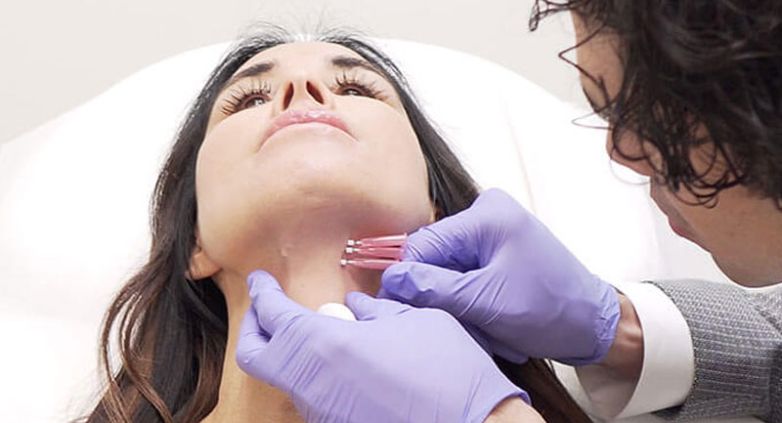
Treatments for neck aging and skin laxity use focused ultrasound, radiofrequency, neurotoxins, and collagen-stimulating technologies to rebuild the structural support that the neck loses progressively with age. The neck is one of the first areas to show visible aging because its skin is thinner, contains fewer sebaceous glands, receives more cumulative sun exposure, and is subject to constant mechanical movement, all of which accelerate collagen and elastin breakdown. Collagen production declines approximately 1% per year starting in the mid-twenties, according to research published by North Biomedical, and the neck’s structural proteins degrade faster than facial skin because of its thinner dermis and greater UV vulnerability. A clinical trial registered with ClinicalTrials.gov documented that 72.9% of patients treated with focused ultrasound (Ultherapy) showed measurable improvement in submental and neck skin laxity at 90 days post-treatment, confirming that non-surgical neck tightening produces real, quantifiable results.
This guide covers the six distinct concerns that contribute to an aging neck, explains why the neck ages differently from the face, walks through each non-surgical technology that addresses neck laxity at a different depth, and shows how to build a combination protocol that matches the right treatment to the right concern. The neck responds to treatment, but precision matters because each neck concern has a different underlying cause and a different optimal solution.
What Causes Neck Skin To Sag With Age?
Neck skin sags with age because of the simultaneous decline of collagen, elastin, facial bone structure, subcutaneous fat volume, and platysmal muscle tone, all compounded by cumulative sun damage that accelerates structural protein degradation. Collagen provides the rigid scaffold that keeps skin firm. Elastin provides the snap-back recoil that allows skin to return to its shape after movement. When both proteins decline, the skin loses its ability to stay taut against gravity. The neck is particularly vulnerable because its dermis is thinner than facial skin, meaning it starts with less structural reserve. Photoaged neck skin shows pronounced solar elastosis, a condition where elastin fibers fragment and clump into disorganized masses rather than forming the organized networks that provide healthy recoil.
Beneath the skin, the platysma muscle, a thin sheet of muscle that covers the front and sides of the neck, weakens and separates with age. The two halves of the platysma pull apart along the midline, creating the vertical bands that become visible on the front of the neck. The jawbone (mandible) also shrinks with age through a process called bone resorption, and the healthy subcutaneous fat that provides smooth facial contour thins and descends. The result is a compounding effect: thinner skin, weaker structural proteins, separated muscles, shrinking bones, and redistributed fat all contribute simultaneously to the sagging, crepey, banded appearance that defines neck aging.
What Is the Difference Between Crepey Neck Skin and Loose Neck Skin?
The difference between crepey neck skin and loose neck skin is the primary structural deficiency driving each concern: crepey skin results from collagen and elastin depletion within the dermis, producing thin, crinkled, tissue-paper texture, while loose skin results from the loss of deeper structural support from the SMAS layer, fat, muscle, and bone, producing draping and sagging. Crepey skin often appears first and is most visible in the front and sides of the neck where sun exposure is highest. Loose skin develops as the deeper layers lose volume and tone, causing the skin to drape over the jawline and create the appearance of jowls and “turkey neck.” Many patients present with both conditions simultaneously, which is why effective neck treatment requires addressing both the surface texture (collagen/elastin) and the deeper structural support (SMAS, muscle, volume).
Does Anything Actually Tighten Neck Skin?
Yes, multiple non-surgical technologies have been clinically proven to tighten neck skin through collagen stimulation, tissue contraction, and structural remodeling at different depths. The clinical evidence is substantial. A study of 70 patients treated with focused ultrasound (Ultherapy) documented that 72.9% showed quantifiable improvement in submental and neck skin laxity at 90 days, as measured by photographic analysis. A separate study found that Ultherapy increased collagen production in treated skin samples by an average of 50%, according to Frontier Dermatology. Across more than 50 clinical studies and 120 peer-reviewed publications, approximately 95% of Ultherapy patients saw firmer, tighter skin within one year. RF microneedling, used in a prior study by Nilforoushzadeh et al., produced a 44.41% increase in skin density through collagen remodeling. These are not marginal effects; they represent measurable structural changes in the skin that produce visible tightening, smoothing, and lifting.
Can Sagging Neck Skin Be Reversed?
Sagging neck skin can be reversed to a meaningful degree through non-surgical treatments, if the laxity is mild to moderate, and the patient commits to a combination protocol that addresses the specific factors driving their concern. Non-surgical treatments rebuild collagen, contract existing collagen fibers, stimulate elastin production, relax overactive platysmal muscles, and restore volume where it has been lost. The degree of reversal depends on the severity of the laxity, the patient’s age and skin quality, and the combination of technologies used. Mild laxity with early jowling and crepey texture responds exceptionally well to non-surgical treatment. Moderate laxity with visible platysmal bands and jawline blurring responds to aggressive combination protocols. Severe laxity with significant skin excess may require surgical intervention for optimal results, though non-surgical treatment can still improve skin quality and delay the need for surgery.
What Are Non-Surgical Treatments for Neck Aging?
Non-surgical treatments for neck aging include focused ultrasound (Ultherapy), radiofrequency (RF) skin tightening, RF microneedling, neurotoxin-based neck contouring, PDO thread lifts, injectable biostimulators, and topical retinoids, each targeting a different layer or component of the aging neck. The American Society of Plastic Surgeons documented 28.2 million minimally invasive aesthetic procedures in 2024, and skin tightening treatments for the neck and jawline represent one of the fastest-growing categories in aesthetic medicine. Over 2 million Ultherapy treatments have been performed worldwide since the device received FDA clearance for the neck and submental area.
How Does Ultherapy Tighten the Neck?
Ultherapy tightens the neck by delivering focused ultrasound energy to the SMAS (superficial musculoaponeurotic system), the same structural layer that plastic surgeons tighten during a surgical facelift, triggering collagen contraction and new collagen production at a depth that no other non-invasive technology reaches. The focused ultrasound energy creates precise thermal coagulation points at targeted depths (1.5mm, 3.0mm, and 4.5mm beneath the skin surface) without disrupting the outer skin layer. These thermal points cause immediate collagen fiber contraction, producing a subtle tightening effect on treatment day, followed by progressive collagen remodeling over the next 2-6 months as the body produces fresh, organized collagen in response to the controlled thermal stimulus.
The Chin Strap Technique is a specialized Ultherapy protocol we use that focuses the ultrasound energy along the jawline and submental area to produce a defined, lifted contour. The FDA clearance study documented 68.6% of subjects showing visibly observable tissue lift in the submental area and neck, with 67% reporting improvement on patient satisfaction questionnaires.
Full results peak at approximately 6 months and last 12-18 months, with some patients maintaining effects for two to three years with good skincare and sun protection. Most patients need only one neck tightening session, with maintenance treatments every 1-2 years.
How Does RF Microneedling Improve Neck Texture?
RF microneedling improves neck texture by delivering radiofrequency energy through microneedles directly into the dermal layer, stimulating collagen and elastin production that smooths crepey skin, reduces fine lines, and improves overall skin density. The neck’s thin skin and crepey texture respond particularly well to RF microneedling because the needles deliver thermal energy precisely to the collagen-depleted dermis where the texture deterioration originates. Morpheus8 delivers bipolar RF energy at adjustable depths up to 4mm, which is deep enough to stimulate significant collagen remodeling in the neck’s thinner dermis. A study by Nilforoushzadeh et al. documented that RF treatment produced a 44.41% increase in skin density and an 18.44% decrease in transepidermal water loss, both of which directly address the thin, dehydrated quality of crepey neck skin.
RF microneedling is the strongest non-surgical option for addressing the textural component of neck aging: the fine horizontal lines, the crepe-paper crinkling, and the rough, uneven surface that develops from collagen and elastin depletion. Most patients complete 3-4 sessions spaced 4-6 weeks apart, with collagen remodeling continuing for 3-6 months after the final session. Combining RF microneedling with Ultherapy addresses both texture (RF) and lift (ultrasound) in a comprehensive protocol. Broader radiofrequency treatments without microneedles also contribute to neck tightening through surface-level collagen contraction and skin heating.
Can Neurotoxins Help With Neck Bands?
Yes, neurotoxins help with neck bands by relaxing the platysma muscle, the thin sheet of muscle that spans the front and sides of the neck and creates the visible vertical bands that define “turkey neck.” The Nefertiti Neck Lift is a specialized injection technique that places small doses of neurotoxin (Botox, Dysport, or similar) along the lower jawline and into the platysmal bands of the neck. The neurotoxin relaxes the downward-pulling platysma fibers, which produces two simultaneous effects: the vertical bands soften and flatten, and the jawline appears sharper and more defined because the upward-lifting muscles of the face are no longer being opposed by the downward pull of the platysma. Results from neurotoxin treatment appear within 5-10 days, making it the fastest-acting neck rejuvenation option available. The effects last approximately 3-4 months before retreatment is needed.
Can a Turkey Neck Be Tightened Without Surgery?
Yes, a turkey neck can be tightened without surgery through a combination of treatments that address each contributing factor: Ultherapy for deep tissue lift, RF microneedling for skin texture and density, neurotoxins for platysmal bands, and injectable biostimulators or thread lifts for structural support. “Turkey neck” is a colloquial term that typically describes the combination of loose skin draping below the jawline, visible platysmal bands running vertically down the front of the neck, and a blurred or obtuse cervicomental angle (the angle between the chin and the neck when viewed from the side). No single treatment addresses all of these factors simultaneously, which is why combination protocols produce the strongest results for turkey neck improvement. The treatment plan starts with identifying which factors are most prominent, then layering technologies that target each one.
How Do You Get Rid of Saggy Jowls and Turkey Neck?
Getting rid of saggy jowls and turkey neck requires treating both areas as a connected system because the jawline and neck share the same structural anatomy, including the platysma muscle, the SMAS layer, and the subcutaneous fat that bridges both zones. Jowls form when skin and soft tissue descend below the jawline due to collagen loss, fat atrophy, and bone resorption in the mandible. Turkey neck develops when the platysmal bands separate and the skin drapes forward under gravity. Treating the jowls without treating the neck, or vice versa, produces an unbalanced result. Ultherapy addresses the deep SMAS layer across both the jawline and neck in a single session. RF microneedling treats the surface texture across both zones. Neurotoxin injection along the jawline (Nefertiti technique) and into the neck bands addresses the muscular component. This layered approach restores a continuous, defined contour from chin to collarbone.
How Do Non-Surgical Neck Treatments Compare?
Non-surgical neck treatments compare across five dimensions: which neck concern each addresses, the mechanism of action, the depth of treatment, the results timeline, and how long the effects last.
| Treatment | Neck Concern Targeted | Mechanism | Depth | Results Timeline | Duration |
|---|---|---|---|---|---|
| Ultherapy (Focused Ultrasound) | Laxity, sagging, jawline loss | SMAS-layer collagen contraction + new collagen | 1.5-4.5mm (deepest non-invasive) | Peak at 6 months | 12-18 months; up to 2-3 years |
| RF Microneedling (Morpheus8, Sylfirm X) | Crepey texture, fine lines, skin density | Thermal collagen remodeling via needles + RF | Up to 4mm (dermis) | Progressive over 3-4 sessions | 12-18 months with maintenance |
| Nefertiti Neck Lift (Neurotoxin) | Platysmal bands, jawline definition | Relaxes downward-pulling platysma fibers | Muscle layer | 5-10 days | 3-4 months |
| PDO Thread Lift | Mild sagging, jawline contour | Mechanical lift + collagen stimulation around threads | Subcutaneous tissue | Immediate lift; collagen over 4-6 months | 12-18 months |
| Topical Retinoid | Fine lines, skin quality, texture | Accelerates cell turnover + superficial collagen | Epidermis + superficial dermis | 8-12 weeks | Ongoing with continued use |
Sources: ClinicalTrials.gov (Ultherapy 72.9% improvement, N=70); Frontier Dermatology (50% collagen increase); Nilforoushzadeh et al./PMC (44.41% skin density increase); Journal of Cosmetic Dermatology 2023 (retinol neck study); FDA clearance data (68.6% submental lift); ASPS 2024 report (28.2M procedures).
What Is the Best Non-Surgical Procedure for Neck Tightening?
The best non-surgical procedure for neck tightening depends on which component of neck aging is most prominent: laxity and sagging, crepey texture, platysmal bands, or a combination of all three.
- Laxity and sagging (loose skin draping below the jawline): Ultherapy is the strongest single-technology option because it is the only non-invasive device that reaches the SMAS layer. The 72.9% improvement rate and FDA clearance for submental/neck lift make it the most evidence-supported choice for structural tightening.
- Crepey texture and fine horizontal lines: RF microneedling (Morpheus8 or Sylfirm X) produces the most measurable improvement in skin density and texture through deep collagen stimulation. Three to four sessions produce progressive smoothing that continues improving for months.
- Visible platysmal bands and soft jawline: The Nefertiti Neck Lift provides the fastest visible improvement by relaxing the platysmal fibers that create bands and pull the jawline downward. Results appear within days.
- Mild sagging with good skin quality: PDO thread lifts provide immediate mechanical lift with gradual collagen stimulation around the threads. Threads dissolve over 4-6 months as the collagen they stimulated takes over the structural support role.
- Comprehensive neck aging (multiple concerns): A combination protocol layering Ultherapy (deep lift), RF microneedling (texture), and Nefertiti Neck Lift (bands/definition) addresses every component of neck laxity in a single coordinated treatment plan.
What Is the Fastest Way To Tighten Your Neck?
The fastest way to tighten your neck is with a neurotoxin-based Nefertiti Neck Lift, which produces visible jawline sharpening and band smoothing within 5-10 days, combined with a PDO thread lift that provides immediate mechanical lift on treatment day. These two treatments produce the fastest visible change because neurotoxins relax muscle immediately (with full effect developing over 5-10 days) and threads physically reposition tissue at the time of placement. Ultherapy and RF microneedling produce stronger, longer-lasting structural improvement, but their results develop over months through collagen remodeling rather than days through muscle relaxation or mechanical repositioning. For patients who want both immediate visible change and long-term structural improvement, we often combine the Nefertiti Neck Lift for fast-acting definition with Ultherapy for deep progressive tightening.
How Long Do Neck Tightening Results Last?
Neck tightening results last 12 to 18 months for Ultherapy, 12 to 18 months for RF microneedling, 3 to 4 months for neurotoxins, and 12 to 18 months for PDO threads, with maintenance treatments extending the benefits indefinitely. Ultherapy results peak at approximately 6 months as the collagen remodeling process matures, then gradually diminish as natural aging resumes. Some patients maintain noticeable improvement for two to three years before retreatment, depending on skin quality and lifestyle factors. RF microneedling results are maintained through the new collagen produced during the treatment series and last until natural aging degrades the new collagen over the following 12-18 months. Neurotoxin effects wear off predictably as the body metabolizes the product, requiring retreatment every 3-4 months to maintain band smoothing and jawline definition.
The most effective long-term strategy combines periodic retreatments on a structured schedule:
- Ultherapy every 12-18 months for deep structural maintenance of the SMAS layer and collagen framework that produces lift.
- RF microneedling touch-up sessions annually (1-2 sessions) to maintain the skin density and texture improvement achieved during the initial treatment series.
- Nefertiti Neck Lift retreatments every 3-4 months to sustain platysmal band smoothing and the jawline definition that neurotoxins provide.
- Daily retinoid applied to the neck every evening plus SPF 30+ sunscreen every morning to protect the collagen that treatments produce and slow the rate at which new degradation occurs.
A 2023 study published in the Journal of Cosmetic Dermatology found that a retinol-containing topical applied specifically to the neck produced significant improvements in horizontal neck lines, skin texture, and overall appearance after 12 weeks. Our guide to RF tightening results covers how to maximize the duration of collagen-based treatment results.
Who Is a Good Candidate for Non-Surgical Neck Treatment?
A good candidate for non-surgical neck treatment is anyone with mild to moderate neck laxity, crepey texture, visible platysmal bands, or loss of jawline definition who wants measurable improvement without surgery. The strongest candidates are patients in their 40s through mid-60s with early to moderate signs of neck aging who are not yet ready for or interested in surgical intervention. Non-surgical treatments work best for patients whose skin still has some baseline collagen production capacity, allowing the body to respond to the collagen-stimulating signals that Ultherapy and RF microneedling deliver. Patients with very severe laxity and significant skin excess may benefit more from surgical neck lift, though non-surgical treatment can improve skin quality in preparation for surgery or maintain results after surgical intervention.
Men represent a growing segment of neck treatment patients, particularly for platysmal band smoothing and jawline definition. Patients who have lost significant weight through GLP-1 medications or bariatric surgery often present with new neck laxity that responds well to combination protocols. Patients who want to explore what non-surgical treatment can achieve before committing to surgery find that starting with Ultherapy and RF microneedling provides a realistic preview of how much improvement is possible without an incision. A thorough skin elasticity assessment determines which treatments will produce the strongest results for each individual’s anatomy and skin quality.
What Is the Best Treatment for Neck Skin Laxity?
The best treatment for neck skin laxity matches the primary concern to the technology that addresses it most effectively, then layers complementary treatments for comprehensive improvement. At our Bingham Farms, Michigan practice, we assess each patient’s neck anatomy, skin quality, and goals to determine whether a single technology or a combination protocol is the right starting point. Dr. Doug Cutler’s naturopathic approach also evaluates nutritional factors that influence collagen production, including vitamin C status, protein intake, zinc levels, and inflammatory markers, because the body builds collagen more efficiently when these foundational building blocks are optimized. Supporting the skin tightening process from the inside out produces stronger results than device-based treatment alone.
Frequently Asked Questions
How To Tighten Crepey Skin on the Neck?
Tightening crepey skin on the neck requires treatments that rebuild collagen and elastin in the dermis, the structural layer where the depletion has occurred. RF microneedling (Morpheus8 or Sylfirm X) is the most effective treatment for crepey neck texture because it delivers thermal energy directly into the depleted dermis. Three to four sessions produce progressive improvement in skin density and smoothness. A daily retinoid and sunscreen applied to the neck maintain and extend the results. Ultherapy adds deeper structural lift when crepey texture coexists with sagging.
How Many Sessions of Neck Tightening Treatment Are Needed?
The number of sessions depends on the technology used. Ultherapy typically requires one session for the neck, with maintenance every 12-18 months. RF microneedling requires 3-4 sessions spaced 4-6 weeks apart. Nefertiti Neck Lift requires one session every 3-4 months. PDO thread lift requires one session, with results lasting 12-18 months. Combination protocols layer these technologies across a coordinated treatment timeline, typically spanning 3-6 months for the initial series.
Is Neck Tightening Treatment Painful?
Comfort levels vary by technology. Ultherapy involves moderate discomfort from the focused ultrasound energy reaching the deep SMAS layer; providers use oral medication or numbing strategies to maintain comfort during the 60-90 minute session. RF microneedling uses topical numbing cream applied 30-45 minutes before treatment, and most patients describe the sensation as tolerable warmth with mild prickling. Nefertiti Neck Lift injections involve brief needle discomfort at each injection point, similar to standard Botox injections. PDO thread placement uses local anesthesia.
Can Men Benefit From Non-Surgical Neck Treatment?
Yes, men benefit significantly from non-surgical neck treatment. Men commonly seek treatment for platysmal bands, submental fullness (double chin), loss of jawline definition, and crepey texture. The ASPS has documented increasing demand for aesthetic procedures among male patients. The same technologies, including Ultherapy, RF microneedling, and the Nefertiti Neck Lift, produce equivalent results in men. Male patients often prioritize jawline sharpening and band reduction for a stronger, more defined profile.
What Skincare Helps Neck Aging?
The most evidence-supported skincare for neck aging includes a daily retinoid (retinol or prescription tretinoin) applied to the neck every evening and broad-spectrum sunscreen with SPF 30 or higher applied every morning. A 2023 study in the Journal of Cosmetic Dermatology confirmed that retinol applied to the neck produced significant improvements in horizontal lines and texture at 12 weeks. Peptide serums, vitamin C, and ceramide-based moisturizers provide additional support for collagen synthesis and barrier function. Skincare alone produces modest improvement; professional treatment accelerates and amplifies the results. Our guide to neck wrinkle treatment covers the full range of at-home and professional approaches.
At What Age Should You Start Neck Treatments?
There is no single right age to start neck treatments because aging is influenced by genetics, sun exposure history, and lifestyle factors. Preventive skincare (retinoid and sunscreen applied to the neck) should begin in the late twenties or early thirties, when collagen loss is first measurable. Professional treatments like RF microneedling and Ultherapy are most commonly sought in the 40s and 50s, when visible laxity and crepey texture become noticeable. Starting treatment earlier, when laxity is mild, produces the best long-term outcomes because the collagen stimulation builds on a stronger baseline.
Can You Combine Neck Treatments?
Yes, combining neck treatments produces stronger results than any single technology used alone. The most effective combination protocols pair Ultherapy (deep SMAS lift) with RF microneedling (texture and density), supported by the Nefertiti Neck Lift (band smoothing and jawline definition). Each technology targets a different layer and a different concern, and the combined effect is a comprehensively rejuvenated neck that appears tighter, smoother, and more defined across all dimensions. Treatments are typically staged across weeks to months rather than performed in a single visit.
The Takeaway
Neck aging is not a single problem; it is the convergence of collagen loss, elastin degradation, muscle separation, bone resorption, fat redistribution, and cumulative sun damage, all happening simultaneously in one of the body’s thinnest and most exposed skin zones. The most effective non-surgical treatment recognizes this complexity and layers technologies that address each contributing factor at its specific depth: Ultherapy for the deep SMAS, RF microneedling for the collagen-depleted dermis, neurotoxins for the overactive platysma, and daily retinoid and sunscreen for the skin surface.
We welcome patients with neck concerns at FACE Medspa, where our combination approach to neck rejuvenation and the Skin Management Experts™ philosophy produce results that are progressive, natural, and maintained over time. If you are ready to address the neck aging that bothers you and see what a precision, layered treatment plan can achieve, we are here to build that plan around your anatomy, your goals, and the results you want.