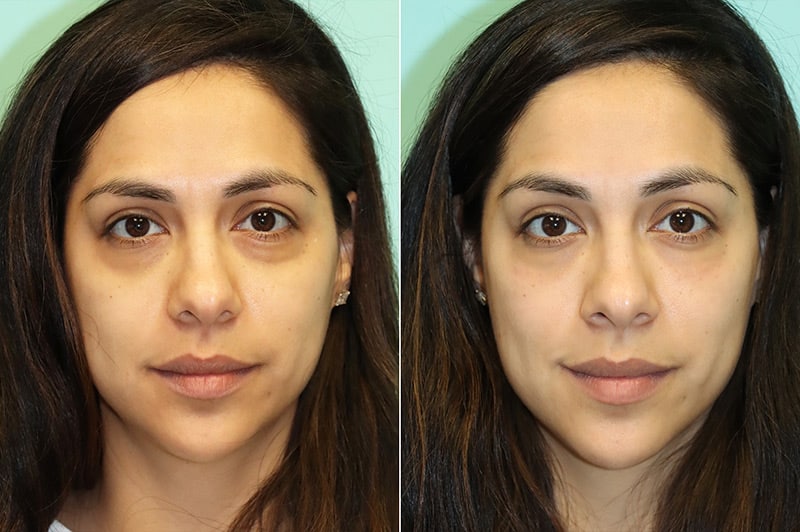
Under eye filler works very well for dark circles caused by shadowing and volume loss (tear troughs), but it does not fix darkness caused by skin pigmentation or visible blood vessels. How well the treatment works depends entirely on what is causing your dark circles. A 2023 meta-analysis published in Aesthetic Plastic Surgery involving 2,556 patients found a 91% overall satisfaction rate with tear trough hyaluronic acid (HA) filler, confirming that when the cause is hollowing, filler delivers results most patients are genuinely happy with.
How well it works by cause:
Shadows and hollowness: Highly effective. Injecting a hyaluronic acid gel into the sunken tear trough area lifts the depression, smooths the transition to the cheek, and eliminates the shadow. Results are visible immediately and settle into their final form within 2 to 4 weeks.
Pigmentation (brown or black tones): Ineffective on color. Filler changes contours, not skin pigment. It may slightly brighten the area by flattening the surface so light reflects more evenly, but it will not erase melanin-based darkness. Pigmentation requires a different treatment approach entirely.
Thin skin and blood vessels (blue or purple tones): Mixed results. Filler can help by placing a barrier between the blood vessels and the skin surface, reducing the blue-purple show-through. It can also make the area look bluish (the Tyndall effect), if placed too superficially, which occurs in about 0.9% of patients according to pooled clinical data.
Understanding which type of dark circle you have is the single most important step before considering treatment. Below, we break down each cause, explain exactly how under eye filler addresses it, and cover everything from the best filler products to recovery and realistic expectations.
What Causes Dark Circles Under the Eyes?
Dark circles under the eyes are caused by four primary factors: volume loss and hollowing, hyperpigmentation, thin skin with visible blood vessels, and lifestyle-related fluid changes. Most people have a combination of two or more causes, which is why a single treatment rarely fixes every aspect of under-eye darkness. The 2024 Aesthetic Surgery Journal published a stepwise assessment framework for lower eyelid dark circles, confirming that proper diagnosis of the underlying cause type is critical to choosing the right treatment.
- Volume loss and hollowing (the most common cause): As fat pads and bone structure in the midface diminish with age, the area beneath the eyes sinks inward. This sunken groove, called the tear trough, casts a shadow that the eye reads as a dark circle. The shadow is not pigment; it is a contour problem. Genetics can produce this hollowing even in patients in their 20s, independent of aging.
- Hyperpigmentation: Excess melanin production in the periorbital skin creates brown, dark brown, or grayish discoloration. Genetics, chronic sun exposure, allergies (allergic shiners), and frequent eye rubbing can all increase melanin deposition around the eyes. This type of darkness is a pigment problem, not a volume problem.
- Thin skin with visible blood vessels: Under-eye skin measures approximately 0.5mm thick, the thinnest on the human body. When collagen and elastin decline with age, the skin becomes even more translucent. The blood vessels and dark muscle tissue beneath show through as a blue, purple, or reddish tint. This is a transparency problem.
- Lifestyle and fluid retention: Poor sleep, dehydration, high sodium intake, and excessive screen time temporarily worsen under-eye dark circles by affecting fluid balance and circulation. These factors are rarely the sole cause of persistent darkness, but they amplify whichever structural cause is already present.
Most patients who seek treatment have volume loss as their dominant cause, sometimes layered with mild pigmentation or vascular show-through. The consultation process identifies which causes are present and in what proportion, because each cause requires a different intervention.
How Well Does Under Eye Filler Work for Each Type of Dark Circle?
Under eye filler works highly effectively for dark circles caused by volume loss and shadowing, partially for thin skin and vascular show-through, and minimally for hyperpigmentation-based darkness. The effectiveness depends on matching the treatment to the cause. Filler is a volume-restoration tool. It adds structure beneath the skin. Causes that respond to added volume improve dramatically; causes that do not respond to volume see limited benefit.
Shadows and Hollowness: Highly Effective
When the dark circle is a shadow cast by a sunken tear trough, dermal fillers address the root cause directly. The hyaluronic acid gel fills the depression, lifts the sunken tissue back toward the orbital rim, and creates a smooth transition between the lower eyelid and the cheek. The shadow disappears because the surface is no longer concave. Light reflects evenly off the filled area instead of falling into a groove.
A real-world evidence study published in Aesthetic Plastic Surgery (2025) enrolled 136 subjects receiving HA filler for the tear trough and found that more than 70% achieved measurable improvement on the Global Aesthetic Improvement Scale (GAIS), with 84.3% of subjects reporting satisfaction with treatment. The treatment effect persisted up to 12 months post-injection, and no severe adverse events were reported. Separate clinical data on Restylane Eyelight showed 83% patient satisfaction at both 4 weeks and 6 months after treatment.
Thin Skin and Blood Vessels: Mixed Results
When under-eye darkness comes from blood vessels showing through translucent skin, filler can help by adding a physical layer between the vessels and the surface. The added volume acts as an opaque barrier that reduces the blue-purple show-through. Results can be meaningful, but they come with a specific risk: if the filler is placed too close to the surface, the gel itself can create a bluish tint visible through the thin skin. This complication is called the Tyndall effect, and it occurs in fewer than 1% of tear trough treatments based on pooled clinical data. Experienced injectors minimize this risk by placing filler deep, in the supraperiosteal plane directly above the bone, rather than in the superficial dermis.
Pigmentation: Filler Does Not Erase Melanin
When the darkness is caused by excess melanin in the skin itself, under eye filler does not get rid of dark circles from pigmentation. Filler changes the contour of the area, not the color of the skin. It may slightly brighten the zone by smoothing the surface so light reflects more evenly, but the brown or grayish discoloration remains. Patients whose primary cause is hyperpigmentation benefit more from topical brightening agents, chemical peels, or laser treatments that target melanin directly.
How Does Under Eye Filler for Dark Circles Work?
Under eye filler for dark circles works by injecting a small amount of hyaluronic acid gel into the tear trough to restore lost volume, lift the sunken tissue, and eliminate the shadow that creates the appearance of darkness. Hyaluronic acid is a naturally occurring substance in human skin that attracts and holds up to 1,000 times its weight in water. In filler form, the HA gel acts as a soft, pliable scaffold that replaces the volume the body lost through aging, genetics, or fat pad atrophy.
The injection is typically performed using a blunt cannula rather than a sharp needle. A cannula enters through a single entry point on the outer cheek and glides beneath the skin to the tear trough, depositing small amounts of filler along the way. The cannula technique reduces bruising and swelling significantly compared to multiple needle punctures because the blunt tip pushes blood vessels aside rather than piercing them. Most injectable treatments in the tear trough area take 15 to 30 minutes to complete.
Placement depth is critical. The filler sits in the supraperiosteal plane, directly above the orbital bone and beneath the orbicularis oculi muscle. This deep placement keeps the gel invisible beneath the thin periorbital skin and avoids the Tyndall effect that occurs with superficial injection. The volume required is small, typically 0.5 to 1 milliliter per side, because even a fraction of a milliliter produces visible change in tissue this thin.
Many experienced injectors address the midface and cheeks before or alongside the tear trough. Volume loss in the cheekbone area removes the structural support that holds the under-eye tissue in place. Without restoring that foundation first, tear trough filler alone may not produce a smooth, natural-looking transition. We often recommend building cheek support first, then refining the tear trough at a second appointment 2 to 4 weeks later. This staged approach uses less filler in the delicate tear trough zone and produces more natural, longer-lasting results.
What Is the Best Filler for Under Eye Dark Circles?
The best filler for under eye dark circles is a soft, low-viscosity hyaluronic acid product with minimal water-attracting properties. The tear trough requires a filler that sits smoothly beneath extremely thin skin without creating visible lumps, ridges, or excessive swelling. Not every HA filler is appropriate for this area. Thicker, higher-viscosity fillers designed for cheeks or jawlines can produce puffiness, visible edges, and prolonged swelling when placed under the eyes.
| Filler Product | Technology | Best For | Water Attraction | Duration |
|---|---|---|---|---|
| Restylane / Restylane Eyelight | NASHA (particulate gel) | Tear trough hollowing, moderate depth | Low to moderate | 9 to 18 months |
| Juvederm Volbella XC | Vycross (smooth gel) | Fine lines, subtle tear trough fill | Moderate | 6 to 12 months |
| RHA Redensity | Preserved-network (resilient HA) | Tear trough, dynamic areas, natural movement | Low | 9 to 15 months |
| Belotero Balance | Cohesive polydensified matrix | Very superficial lines, delicate areas | Low | 6 to 12 months |
Restylane and its tear-trough-specific formulation, Restylane Eyelight, remain the most widely used fillers for the under-eye area worldwide. The NASHA technology produces a particulate gel that attracts less water than Vycross-based products, which translates to less post-injection swelling in the periorbital zone. Clinical trials of Restylane Eyelight demonstrated 83% patient satisfaction at both 4 weeks and 6 months.
RHA Redensity is a newer option designed specifically for dynamic facial areas where skin moves constantly during expression. The preserved-network technology produces a flexible gel that adapts to the natural movement of the orbicularis oculi muscle during blinking and smiling, reducing the chance of visible ridging. We offer RHA Redensity alongside Restylane and Volbella at our practice, and the choice between them depends on the patient’s anatomy, skin thickness, and the depth of hollowing being corrected.
How Long Does Under Eye Filler Last for Dark Circles?
Under eye filler for dark circles lasts 6 to 18 months, with an average duration of approximately 10.8 months. A 2025 retrospective study published in the Journal of Clinical and Aesthetic Dermatology analyzed 155 patients treated over a 16-year period and found significant results lasting up to 18 months, with clinical evidence suggesting some patients retain improvement at 24 months. The tear trough is a low-movement area compared to the lips or nasolabial folds, which contributes to longer-than-average filler retention.
The specific product used affects longevity. NASHA-based fillers like Restylane tend to last 9 to 18 months in the tear trough. Vycross-based fillers like Volbella typically last 6 to 12 months. RHA Redensity falls in the 9 to 15 month range based on clinical observation. Individual metabolism, lifestyle, and the volume injected also influence how long results persist.
We recommend maintenance appointments at 10 to 12 month intervals to keep results looking fresh. Touch-up sessions typically require less filler than the initial treatment because some residual HA gel remains from the previous injection. Patients across Oakland County who maintain a consistent touch-up schedule report the most stable, long-term improvement in their dark circle treatment results.
Can Under Eye Filler Make Dark Circles Worse?
Yes, under eye filler can make dark circles worse when the wrong candidate receives treatment, the wrong product is used, or the injection technique is not precise enough for the periorbital area. The under-eye zone is one of the most technically demanding areas to inject because the skin is exceptionally thin and shows every imperfection immediately. An experienced, anatomy-trained injector is not optional for this treatment; it is essential.
The most common ways filler worsens the under-eye appearance include overfilling, which replaces a sunken look with a puffy, swollen look that makes the patient appear more tired than before. The Tyndall effect, where superficially placed HA gel creates a bluish discoloration visible through the skin, occurs in about 0.9% of tear trough treatments based on the 2023 meta-analysis. Contour irregularities, where the filler creates visible lumps or ridges, were reported in 5.3% of patients in the same meta-analysis. Filler migration, where the gel shifts from the tear trough onto the upper cheekbone over time, can create an unnatural roll of volume in the wrong location.
All of these complications are treatable. HA fillers can be dissolved with an enzyme called hyaluronidase, which breaks down the hyaluronic acid gel within 24 to 48 hours and returns the area to its pre-treatment state. This reversibility is one of the primary safety advantages of HA-based fillers over non-HA products like Radiesse or Bellafill, which should not be used in the tear trough because they cannot be dissolved.
When Does Filler Not Work for Dark Circles?
Filler does not work for dark circles when the darkness comes entirely from pigmentation, fat pad prolapse (true puffiness), or a very tight orbital retaining ligament. Identifying these non-candidate situations before treatment prevents disappointing results and unnecessary product use.
Pigmentation-only dark circles, where the skin itself is brown, gray, or discolored without any underlying hollowing, do not respond to filler because the problem is melanin, not volume. These patients benefit from hyperpigmentation treatments like topical retinoids, vitamin C serums, chemical peels, or laser treatments that break down excess melanin in the dermis.
Fat pad prolapse, where the orbital fat pads push forward and create a visible bulge beneath the eye, produces under-eye bags that look puffy rather than hollow. Adding filler to an already-protruding area makes the puffiness worse, not better. Protruding fat pads are best addressed through lower blepharoplasty surgery, which repositions or removes the herniated fat. We always evaluate whether the patient has hollowing (filler candidate) or protrusion (surgical candidate) during the consultation at our Bingham Farms office.
A tight orbital retaining ligament, the fibrous band that connects the skin and muscle to the orbital bone, can prevent filler from lifting the tear trough smoothly. When this ligament is tight, filler injected beneath it cannot spread evenly. Instead, it creates a visible ridge or roll at the ligament border. Patients with a very tight ligament often see only partial improvement from filler, and surgery may produce a better long-term outcome.
What Is the Downside of Under Eye Fillers?
The downside of under eye fillers includes temporary swelling and bruising during recovery, the possibility of complications with inexperienced injectors, and the need for repeat treatments because results are not permanent. The 2023 meta-analysis across 2,556 patients reported a pooled swelling rate of 19.2% and a bruising rate of 18.4%, meaning roughly one in five patients experiences some degree of visible swelling or bruising during the first week.
Recovery is generally quick. Most patients return to normal activities the same day, with swelling peaking at 24 to 48 hours and resolving within 3 to 7 days. Bruising, when it occurs, typically clears within 7 to 10 days. The final, settled result is visible at 2 to 4 weeks after injection, which is when we recommend assessing satisfaction and determining whether a touch-up is needed.
The cost commitment is another consideration. Because HA fillers metabolize over time, maintaining results requires periodic retreatment. Most patients return for touch-ups every 10 to 12 months. Each touch-up typically uses less product than the initial session because residual filler from the previous treatment provides a foundation. Our injectables guide covers the full range of products we offer and how they fit into a long-term maintenance plan.
Which Is Better for Dark Circles, Botox or Fillers?
Fillers are better than Botox for dark circles caused by volume loss and hollowing, because Botox does not add volume. Botox (botulinum toxin) relaxes muscles to smooth dynamic wrinkles like crow’s feet and forehead lines. Botox does not fill a hollow or lift a sunken tear trough. Dark circles caused by shadowing require volume replacement, which only dermal fillers provide.
Botox can play a supporting role in under-eye rejuvenation. Small doses of Botox injected into the orbicularis oculi muscle can smooth fine lines directly beneath the lower lash line, which complements the volume restoration from filler. Some injectors also use Botox to soften the “jelly roll,” a band of hypertrophied muscle beneath the eye that creates a visible ridge. These applications target muscle-based concerns, not volume-based darkness.
The two treatments address different problems and work best in combination for patients who have both hollowing (filler) and fine lines or muscle banding (Botox). Neither treatment alone addresses every component of under-eye aging. A comprehensive assessment determines which combination produces the most natural-looking improvement for each individual patient.
Frequently Asked Questions
How Painful Is Under Eye Filler?
Under eye filler is not very painful for most patients. A topical numbing cream is applied to the treatment area 20 to 30 minutes before injection, and most modern HA fillers contain lidocaine (a local anesthetic) mixed directly into the gel. The cannula technique further reduces discomfort because it enters through a single point rather than multiple needle sticks. Most patients describe the sensation as mild pressure rather than sharp pain.
Who Should Avoid Fillers?
People with active skin infections near the injection site, known allergies to hyaluronic acid or lidocaine, bleeding disorders, or autoimmune conditions that affect wound healing should avoid fillers. Pregnant and breastfeeding women are also advised to postpone treatment. Patients whose dark circles are caused entirely by fat pad protrusion (puffiness) rather than hollowing are not good candidates for under-eye filler specifically, though they may benefit from other treatments.
Are Face Fillers Worth the Money?
Face fillers are worth the money for patients whose concerns match what filler can address. For under-eye dark circles caused by volume loss, clinical data supports a 91% satisfaction rate across thousands of patients. Results are visible immediately, recovery is minimal, and the treatment is fully reversible with hyaluronidase if needed. The value depends on choosing the right candidate, the right product, and the right injector.
What Is the Best Age to Start Fillers?
There is no single best age to start fillers. Some patients develop tear trough hollowing in their 20s due to genetics, while others do not notice volume loss until their 40s or later. The deciding factor is anatomy, not a number. If volume loss is creating shadows under your eyes and affecting how rested you look, filler may be appropriate regardless of whether you are 25 or 55. A consultation determines candidacy based on your facial structure, not your birth year.
Is Under Eye Filler Safe?
Under eye filler is safe when performed by an experienced, anatomy-trained injector using FDA-cleared hyaluronic acid products. The EYELIGHT real-world study (2025) involving 136 subjects and 958 injections reported no severe adverse events. All common treatment responses (swelling, redness, tenderness) were mild to moderate and resolved within one month. The under-eye area is a high-skill zone, so injector expertise directly correlates with safety outcomes.
Does Under Eye Filler Get Rid of Dark Circles Completely?
Under eye filler gets rid of dark circles caused by shadowing and hollowing in most cases. A 2025 quantitative evaluation using 3D imaging and MRI found a 95.24% subject satisfaction rate at 6 months for HA filler in the infraorbital area. Filler does not completely eliminate dark circles that have a pigmentation or vascular component in addition to hollowing; those aspects require complementary treatments like under-eye treatments targeting color and skin quality.
The Takeaway
Under eye filler for dark circles is one of the most effective non-surgical treatments available for the right candidate. The critical word is “right.” Dark circles caused by volume loss and tear trough hollowing respond beautifully to hyaluronic acid filler, with satisfaction rates consistently above 80% in published clinical research. Dark circles caused by pigmentation or vascular show-through require different approaches. The difference between a great result and a disappointing one almost always comes down to accurate diagnosis of the cause before any filler is injected.
The treatment is quick, recovery is minimal, results last 6 to 18 months, and HA fillers are fully reversible if needed. Choosing an experienced injector who understands periorbital anatomy, selects the right product, and uses proper placement depth is the single most important decision you make in this process.
If dark circles have been affecting how rested and refreshed you look, a consultation is the best next step. At FACE Skincare ~ Medical ~ Wellness, we evaluate the specific cause of your under-eye hollowing, recommend the right treatment approach, and build a plan matched to your anatomy and goals.