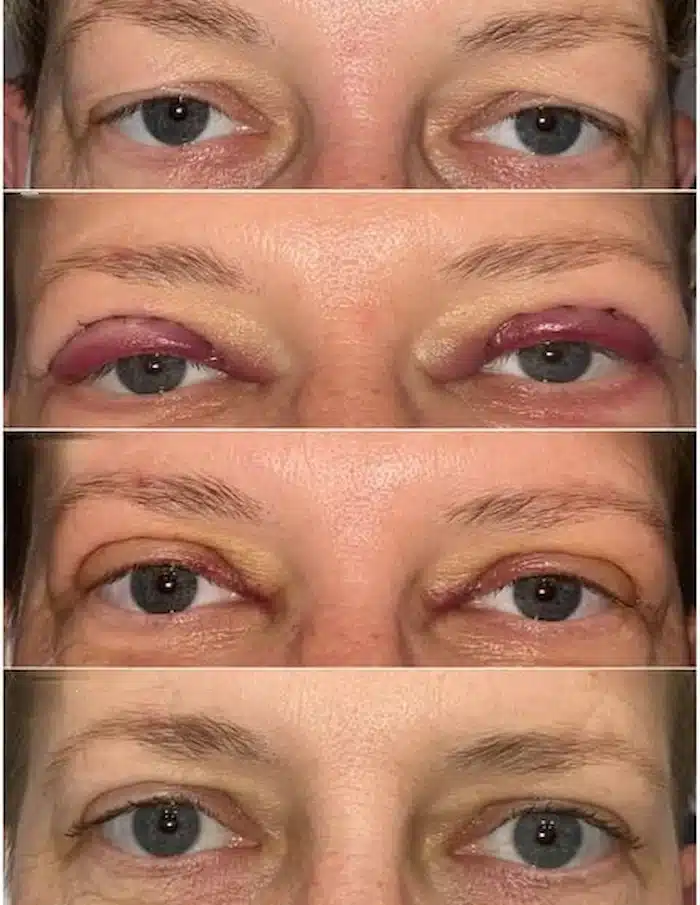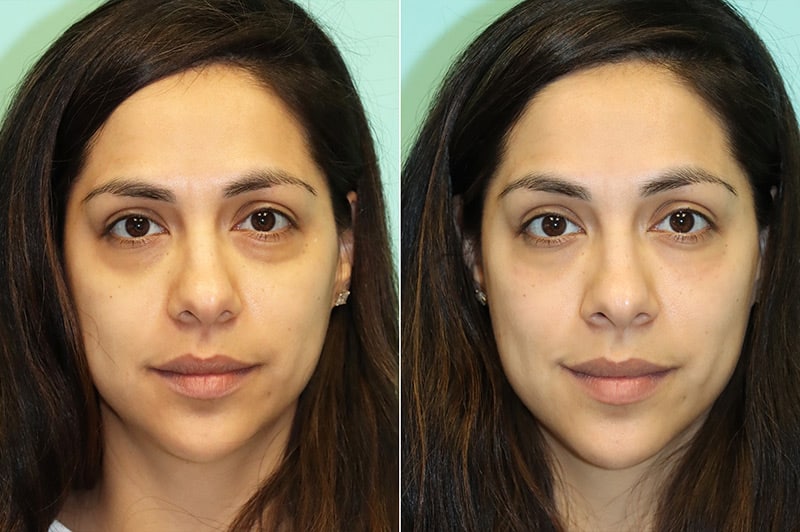
Under eye filler swelling typically peaks within 48 to 72 hours after injection and fully resolves into a final result within 2 to 4 weeks. The swelling moves through four day-by-day stages, each with a distinct look and a specific biological process happening beneath the skin.
Days 0 to 1 (Initial Reaction): Mild puffiness, redness, and tenderness appear immediately at the injection sites due to the body’s initial inflammatory response and needle trauma. The area may look asymmetrical or overfilled.
Days 2 to 3 (Peak Swelling): Swelling and bruising reach their maximum level. The under-eye area can look tight, firm, or “overfilled” because hyaluronic acid (HA) filler pulls in surrounding water and reaches its peak fluid absorption.
Days 4 to 7 (Visible Reduction): Trapped fluid begins to clear, bruises shift in color from purple to yellow, and the injected gel starts to soften and integrate with natural tissue.
Weeks 2 to 4 (Final Settling): Most residual puffiness disappears by week 2, and the filler fully integrates with natural tissue to reveal the final contour. A 2023 meta-analysis published in Aesthetic Plastic Surgery involving 2,556 patients found a 91% overall satisfaction rate with tear trough HA filler by this stage.
Below, we break down each of these under eye filler swelling stages in full detail so you know exactly what to expect, what is normal, and when to reach out to your provider.
What Are the Under Eye Filler Swelling Stages?
The under eye filler swelling stages consist of four phases: the initial trauma response (day 0 to 1), peak swelling (days 2 to 3), visible improvement (days 4 to 7), and final settling (weeks 2 to 4). Each phase reflects a distinct biological process happening beneath the skin. The inflammatory cascade that produces swelling is not a complication. Swelling is a normal immune response to the micro-trauma of injection and to the introduction of a gel-based substance into delicate periorbital tissue.
We see patients go through these stages after every dermal fillers treatment in the tear trough area. The progression is consistent enough that we can reassure patients before their appointment: the puffiness you see on day two is not your final result. The actual result reveals itself gradually over the following weeks as the filler integrates with your natural tissue.
Why Does the Under Eye Area Swell So Much After Filler?
The under eye area swells more than other injection sites because of three physiological characteristics unique to the periorbital region. These characteristics explain why swelling in the tear trough looks more dramatic than swelling after cheek or lip filler, even when the injected volume is much smaller.
The first characteristic is the extreme thinness of periorbital skin. Under-eye skin measures approximately 0.5mm thick, making it the thinnest skin on the entire human body, according to dermatology literature. Skin this thin cannot conceal even minor fluid accumulation beneath it. Every fraction of a milliliter of extra fluid becomes immediately visible as surface puffiness.
The second characteristic involves hyaluronic acid’s hydrophilic nature. HA fillers are designed to attract and bind water molecules. This water-binding property is what creates volume and plumpness in the treated area. The HA gel creates an osmotic gradient that draws extracellular fluid into and around the injection site. A multicenter imaging study published in a plastic surgery journal found that infraorbital HA volume measured 70% to 81% of its injected amount at 30 days, confirming the gel’s water-absorption behavior stabilizes over the first month.
The third characteristic is sluggish lymphatic drainage. The under-eye hollows sit in a region with limited lymphatic circulation. Lymphatic vessels are responsible for clearing excess fluid from tissue. When injection creates localized inflammation, the weak lymphatic network beneath the orbicularis oculi muscle struggles to drain the accumulated fluid efficiently. The result is prolonged puffiness compared to areas with stronger lymphatic activity, like the cheeks or jawline.
What Does Under Eye Filler Look Like the Next Day?
Under eye filler looks noticeably puffy, slightly red, and often asymmetrical on the next day. The puffiness you see within the first 24 hours is a combination of the filler gel itself, the localized inflammatory response triggered by the needle or cannula entering the tissue, and the numbing agent (lidocaine) mixed into most modern fillers.
The immediate “false fullness” is important to understand. The volume you see on day one does not represent the final amount of filler in place. It represents filler volume plus inflammatory fluid plus residual anesthetic solution. All three of those components are stacked together in that thin periorbital tissue, which is why the area can look overfilled or swollen beyond what you expected.
Asymmetry between the two eyes is entirely normal during this stage. Facial vascular anatomy is not symmetrical. One side often has slightly different blood vessel positioning, slightly different tissue density, or slightly different lymphatic drainage capacity. These small anatomical differences mean one eye may swell more, bruise more, or resolve faster than the other. The asymmetry almost always equalizes by the end of the first week.
Tenderness along the orbital rim is also expected. Tear trough filler is injected deep, right above the orbital bone in the supraperiosteal plane. The periosteum (bone covering) is sensitive, and gentle pressure from blinking, washing your face, or even smiling may produce a dull ache during day one. This tenderness typically resolves within 48 hours.
When Does Under Eye Filler Swelling Peak?
Under eye filler swelling peaks between 48 and 72 hours after injection. This is the stage where the treated area looks its most swollen and where many patients feel the most concerned. The peak reflects maximum edema, meaning the HA gel has absorbed as much surrounding fluid as it will attract, and the body’s inflammatory response has reached its highest intensity.
During peak swelling, the under-eye area may look uncomfortably full or puffy. Some patients describe a firm, almost “sausage-like” appearance. This is peak edema, not excess filler. The distinction matters because the instinct to press or massage the area during this stage can actually move the still-malleable gel out of the tear trough and onto the upper cheekbone, creating contour irregularities that may require dissolution with hyaluronidase.
Bruising also becomes most visible during this window. If a micro-vessel was disrupted during the injection process, the pooled blood beneath the skin oxidizes and becomes visible as a dark purple, blue, or reddish shadow. According to the same 2023 meta-analysis from Peking Union Medical College, the pooled bruising rate across 2,556 patients was 18.4%, meaning roughly one in five patients develops some degree of visible bruising. Bruising at this stage looks worse than it is because the surrounding edema pushes the discolored blood closer to the skin surface.
The filler itself feels firm and distinct from natural tissue at this point. The gel has not yet undergone tissue integration, which is the process by which the cross-linked HA meshes with the body’s own extracellular matrix. That stiffness and the palpable difference between filler and native fat pad resolves over the following 7 to 14 days.
How Long Does It Take for Under Eye Filler Swelling to Go Down?
Under eye filler swelling begins going down noticeably between days 4 and 7, with the most rapid improvement occurring on days 4 and 5. By this point, the lymphatic system catches up to the excess fluid load and begins draining the trapped interstitial fluid from the periorbital tissue. The intense osmotic pressure that peaked on days 2 and 3 stabilizes as the HA gel reaches its equilibrium hydration level.
Bruise discoloration shifts during this window. The hemoglobin trapped beneath the skin breaks down into biliverdin and then bilirubin, producing a visible color change from dark purple to green and then to pale yellow. This color shift is a reliable indicator that your body is actively clearing the byproducts of the initial micro-trauma. Most bruising resolves completely by day 10.
The filler begins softening during days 4 through 7 as tissue integration progresses. Areas that felt hard or lumpy against the orbital bone start to feel pliable and blend with the natural contour of the volume loss you were treating. The “overfilled” appearance from peak swelling is replaced by something much closer to the intended result.
Fluctuation is normal during this stage. Swelling often looks slightly worse in the morning after a night of lying flat, because gravity allows fluid to pool in the periorbital area during sleep. By afternoon, after several hours upright, the puffiness improves. This morning-to-evening fluctuation pattern continues until the swelling fully resolves.
Do Fillers Look Better After 2 Weeks?
Yes, fillers look significantly better after 2 weeks. The 2-week mark is when most residual puffiness has resolved, bruising has completely cleared, and the HA gel has integrated with the surrounding tissue. The volume you see at 2 weeks is very close to your actual final result. We consider 2 weeks the earliest reliable point at which patients can judge whether they are satisfied with their outcome.
By weeks 2 through 4, the filler has fully locked into its position above the orbital bone. The localized inflammation is entirely gone, and the gel is completely hydrated and blended with natural tissue. The contour of the tear trough appears smooth, and the treated area moves naturally when you smile, laugh, or squint. Patients who combine tear trough treatment with facial contouring often see the most dramatic overall improvement. There should be no visible ridges or bunching during facial expression.
A large multicenter randomized controlled trial studying FDA-approved HA under-eye filler found that 87.4% of patients showed measurable improvement at 3 months, with patients reporting they looked younger (71%) and less tired (79%) with reduced under-eye shadows (76%). The same study found 63.5% of patients maintained results at 12 months after a single treatment. A 2025 retrospective study published in the Journal of Clinical and Aesthetic Dermatology found significant tear trough filler results lasting up to 18 months, with clinical evidence suggesting retention as long as 24 months in some patients.
If the area still looks excessively puffy, lumpy, or carries a bluish tint (known as the Tyndall effect) after 4 weeks, the swelling may not be standard post-procedural edema. The Tyndall effect occurs in only about 0.9% of tear trough filler patients, according to pooled data across 31 clinical reports. Persistent issues at the 4-week mark warrant a follow-up appointment with your injector to determine whether the filler was placed too superficially or whether the volume needs adjustment.
Is It Normal for One Eye to Swell More Than the Other After Filler?
Yes, it is completely normal for one eye to swell more than the other after filler. Asymmetrical swelling reflects natural asymmetry in facial vascular anatomy, not an error in injection technique. The blood vessel network beneath each eye differs slightly in density and positioning. One side may have more superficial capillaries, slightly denser tissue, or slightly less efficient lymphatic drainage. These small structural differences produce different inflammatory responses to the same amount of filler.
The asymmetry is most pronounced during peak swelling on days 2 and 3 and typically equalizes by the end of the first week. If noticeable asymmetry persists beyond 2 weeks, a follow-up visit can determine whether a small touch-up is needed on one side. We recommend waiting until the full 2-to-4-week settling period has passed before making any assessment about symmetry.
Does the Type of Filler Affect How Much You Swell?
Yes, the type of filler affects how much you swell, because different filler technologies have different water-absorption properties. Not all injectable treatments behave the same way in the tear trough. The manufacturing technology behind each filler determines how much water the gel attracts, how firm or soft it sits in tissue, and how long the swelling phase lasts.
There are three primary HA filler technologies used in the under-eye area, and each has a different swelling profile.
| Filler Technology | Water Absorption | Swelling Duration | Tissue Feel | Common Brands |
|---|---|---|---|---|
| NASHA (Non-Animal Stabilized HA) | Low to moderate | 3 to 7 days | Firmer, holds shape well | Restylane, Restylane-L |
| Vycross (cross-linked HA blend) | High | 7 to 14 days | Softer, integrates smoothly | Juvederm Volbella, Juvederm Vollure |
| RHA (Resilient HA) | Moderate | 5 to 10 days | Flexible, moves with expression | RHA Redensity, RHA Collection |
NASHA-based fillers attract less water than Vycross-based fillers because of their particulate gel structure. This lower hydrophilicity produces less post-injection swelling and makes NASHA fillers a frequent choice for the tear trough, where even small amounts of extra fluid become visible. Vycross technology produces a smoother gel with excellent tissue integration, but its higher water-binding capacity means a longer and more pronounced swelling phase. RHA fillers sit between the two in terms of water absorption and offer the added benefit of flexibility during facial movement, which reduces the chance of visible ridging when smiling.
At our practice in Bingham Farms, we select the filler technology based on each patient’s anatomy, skin thickness, and the degree of hollowing being corrected. There is no single “best” filler for every under-eye. The best choice depends on the individual. This is one reason why a thorough consultation before treatment matters as much as the injection itself. Our injectables guide covers the full range of filler options we offer.
How Do You Get Rid of Puffy Under Eyes After Fillers?
You get rid of puffy under eyes after fillers by combining cold therapy, head elevation, dietary adjustments, and avoiding behaviors that worsen fluid retention. While you cannot eliminate the body’s natural inflammatory response entirely, targeted aftercare shortens the peak swelling window and reduces the overall severity of puffiness.
The most effective aftercare steps, in order of impact, are:
- Apply a cold compress wrapped in a clean cloth for 10 minutes at a time during the first 24 hours. Cold constricts blood vessels and slows the delivery of inflammatory fluids to the injection site. Do not apply ice directly to the skin or press firmly on the treated area.
- Sleep on your back with your head elevated on two pillows for the first 3 nights. Elevation uses gravity to prevent lymphatic fluid from pooling in the periorbital tissue overnight. Side sleeping or face-down sleeping during the first 72 hours significantly increases morning puffiness.
- Reduce sodium intake for the first 3 to 5 days. Sodium causes systemic water retention, and high-sodium meals amplify the HA gel’s water-attracting effect. Avoiding processed foods, soy sauce, and heavy restaurant meals during recovery keeps fluid levels lower.
- Stay well hydrated with plain water. Adequate hydration supports healthy lymphatic function. Dehydration paradoxically triggers the body to retain more fluid, worsening puffiness.
- Consider Arnica Montana and Bromelain supplements. Many dermatologists recommend starting Arnica (to reduce bruising) and Bromelain (a pineapple-derived enzyme that reduces inflammation) one day before the procedure and continuing for 3 days after. Both are available over the counter.
These steps work best when started immediately. Patients across Oakland County who follow this aftercare protocol consistently report shorter peak swelling periods and less overall puffiness compared to patients who skip aftercare steps.
What Not to Do After Getting Under Eye Fillers?
After getting under eye fillers, do not massage the treated area, exercise vigorously, consume alcohol, apply heat, or sleep face-down. Each of these behaviors either increases blood flow to the injection site, raises facial blood pressure, or physically shifts the filler before it has locked into place.
- Do not massage, press, or attempt to “flatten” the swelling during the first 7 days. The filler remains malleable during this period, and manual pressure can push the gel out of the tear trough and onto the cheekbone, creating contour irregularities.
- Do not engage in heavy cardiovascular exercise or weightlifting for at least 48 to 72 hours. Intense physical activity elevates heart rate and facial blood pressure, forcing more inflammatory fluid into the periorbital tissue and increasing both swelling and bruising risk.
- Do not drink alcohol for 48 hours. Alcohol is a vasodilator that widens blood vessels, increasing blood flow to the face and worsening both swelling and bruising.
- Do not apply heat, warm compresses, or use saunas during the first week. Heat dilates blood vessels and draws more fluid to the area, producing the opposite of the desired effect.
- Do not wear heavy eye makeup for at least 24 hours. Applying and removing makeup involves touching and rubbing the treated area. Light mineral makeup is usually acceptable after 24 hours, provided you use clean brushes and gentle application.
Following these restrictions protects the placement of the biostimulation or filler product and supports the cleanest possible healing trajectory.
Why Does Under Eye Filler Swell More in the Morning?
Under eye filler swells more in the morning because gravity redistributes fluid to the periorbital area during the hours you spend lying flat overnight. When you sleep horizontally, lymphatic fluid that normally drains downward throughout the day instead pools in the loose connective tissue surrounding the eyes. HA filler amplifies this effect because the gel continues to attract water molecules even after the initial swelling phase has passed.
Morning puffiness after filler is most pronounced during the first week and gradually diminishes as the inflammatory response resolves and the filler reaches its stable hydration level. By weeks 2 through 4, the morning-to-evening difference shrinks to a negligible amount. Sleeping with your head elevated on two pillows minimizes this overnight fluid pooling and produces noticeably less morning swelling.
What Causes Delayed Swelling After Under Eye Filler?
Delayed swelling after under eye filler is swelling that appears or returns weeks to months after the initial recovery period. This condition, sometimes called late-onset edema, differs from normal post-procedural puffiness in both its timing and its mechanism. A 2022 systematic literature review noted that 44.3% of tear trough filler patients reported some form of complication, though the vast majority were minor and included transient swelling and bruising.
Late-onset edema can be triggered by several factors. Illness, sinus infections, and dental procedures can create localized inflammation near the orbit that reactivates swelling around the filler. Seasonal allergies and high-sodium dietary periods can also shift fluid balance enough to produce visible puffiness in an area containing HA gel. In rare cases, delayed swelling signals filler migration (the gel shifting from its original placement) or a low-grade inflammatory reaction to the product itself.
The Tyndall effect, a bluish discoloration visible through thin skin, can accompany late swelling when filler has been placed too superficially. This occurs in fewer than 1% of patients based on pooled clinical data. Persistent puffiness, visible discoloration, or hard lumps that remain beyond 4 weeks should be evaluated by your injector. Treatment options include observation, anti-inflammatory protocols, or dissolution of the filler using an enzyme called hyaluronidase.
Patients who experience chronic fluid retention, lymphatic sluggishness, or recurrent late-onset edema with HA fillers may benefit from alternative approaches to under-eye rejuvenation. PRP therapy, regenerative aesthetics, and microneedling offer collagen-stimulating results without the water-attracting properties of HA gel.
Frequently Asked Questions
How Long Does Under Eye Filler Take to Settle?
Under eye filler takes 2 to 4 weeks to fully settle. The gel reaches its equilibrium hydration level and completes tissue integration during this period. Most patients see their near-final result by the 2-week mark, with subtle refinement continuing through week 4. We recommend waiting until at least 2 weeks before assessing satisfaction or scheduling any touch-up.
Can Under Eye Fillers Last 3 Years?
Under eye fillers do not typically last 3 years. Most HA tear trough fillers provide results lasting 10 to 18 months. A 2025 retrospective study in the Journal of Clinical and Aesthetic Dermatology found significant results up to 18 months, with clinical observations suggesting retention in some patients up to 24 months. The tear trough is a low-movement area, which contributes to longer-than-average filler retention compared to areas like the lips.
What Is the Downside of Under Eye Fillers?
The downside of under eye fillers includes temporary swelling and bruising during recovery, the possibility of contour irregularities or the Tyndall effect with superficial placement, and the need for repeat treatments as the filler gradually metabolizes. A 2023 meta-analysis across 2,556 patients found the pooled contour irregularity rate at 5.3% and the Tyndall effect rate at 0.9%. Choosing an experienced injector who understands periorbital anatomy significantly reduces these risks.
What Is Forbidden After Fillers?
After fillers, vigorous exercise, alcohol consumption, hot saunas, heavy eye makeup, and manual pressure on the treated area are all forbidden for at least 48 to 72 hours. These activities increase blood flow, raise facial blood pressure, or risk physically displacing the filler before it has stabilized. Most patients can resume normal activities, including full exercise and makeup application, within 3 to 7 days.
Does Filler Ever Fully Leave Your Body?
Yes, HA filler does fully leave your body. Hyaluronic acid is a naturally occurring substance in human skin, and the body gradually breaks it down through enzymatic degradation. The cross-linked HA in dermal fillers resists this breakdown longer than natural HA, which is why results last months rather than days. Once the cross-linked bonds degrade, the HA fragments are metabolized into water and carbon dioxide and eliminated naturally.
Do Fillers Age You Over Time?
Fillers do not age you over time. When dissolved or metabolized, the treated area returns to its pre-treatment baseline. The concern about accelerated aging typically stems from overfilling, which stretches tissue beyond its natural capacity. Conservative, anatomy-appropriate filler volumes do not stretch skin. Research from the ISAPS Global Survey (2025) confirmed that 86.1% of the 5.46 million HA filler procedures performed globally in 2024 were on women, many of whom are repeat patients, suggesting sustained confidence in long-term outcomes.
What Happens to Your Face If You Stop Using Fillers?
If you stop using fillers, your face gradually returns to its pre-treatment appearance as the HA metabolizes over the following months. You do not look worse than before treatment. You simply return to the baseline that natural aging produces. Some patients find that years of filler use alongside collagen-stimulating treatments creates a modest lasting improvement in skin quality even after discontinuation, though this varies by individual.
Putting It All Together
Under eye filler swelling is temporary, predictable, and part of a well-understood healing process. The four stages, from initial puffiness through peak edema to visible improvement and final settling, follow a consistent biological timeline. The first 72 hours feel the most concerning, but the puffiness you see during that window does not reflect your actual result. Your real result emerges over the following 2 to 4 weeks as the filler integrates with your natural tissue and the inflammatory response fully resolves.
The choice of filler technology, the depth of injection, and your individual anatomy all influence how much you swell and how quickly you recover. Consistent aftercare, including cold therapy, elevation, sodium reduction, and activity modification, shortens the swelling timeline and supports the best possible outcome. With a 91% satisfaction rate across thousands of patients in published clinical research, hyaluronic acid fillers remain one of the most effective and well-studied treatments for tear trough hollowing.
If you have questions about your own healing timeline, or if you are considering under-eye treatments for the first time, we are here to help. At FACE Skincare ~ Medical ~ Wellness, every treatment plan starts with a thorough consultation to match the right approach to your unique anatomy and goals.