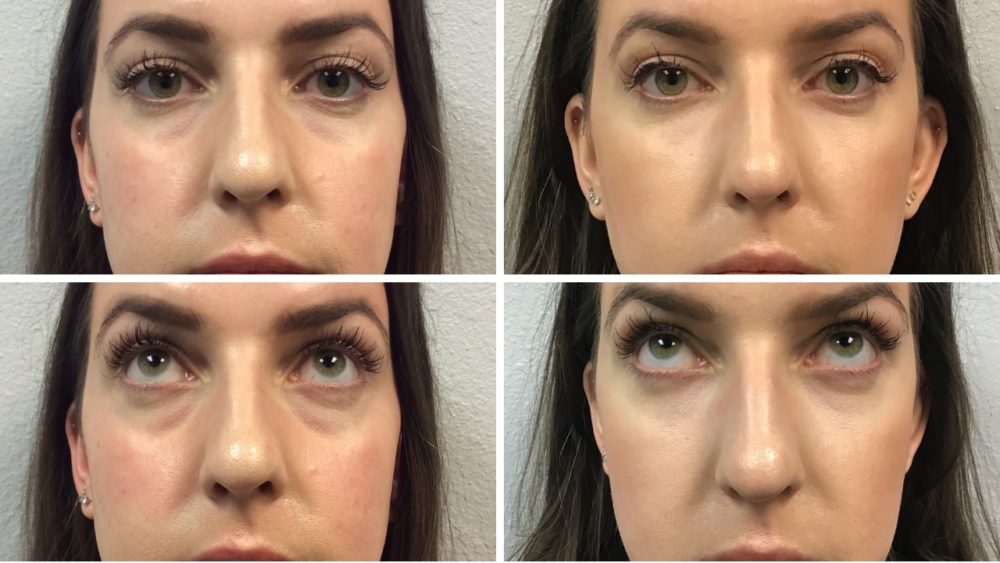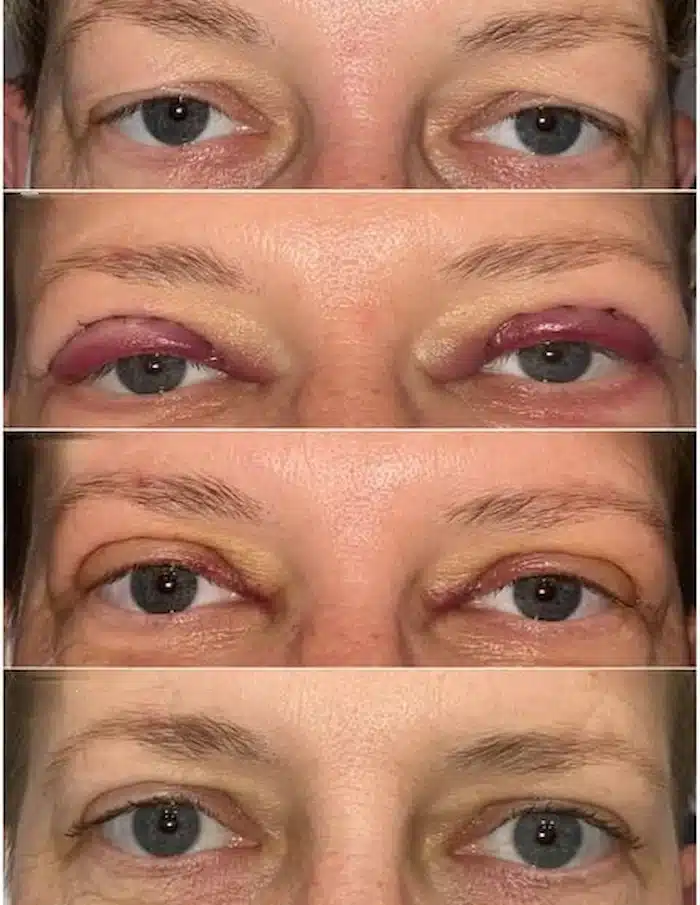
Under-eye filler settles over about 2 to 4 weeks, though most people look socially normal within 3 to 7 days. Between those two points the area changes almost daily, and not always in the direction you expect. Swelling peaks on days 2 to 3 rather than on day one, bruising often darkens before it fades, and firmness you can feel in week one is usually gone by week three. This article walks through what each day looks like, what is happening under the skin while it looks that way, and how to tell on any given day whether what you are seeing is on schedule.
What Does the Full Day-by-Day Timeline Look Like?
The day-by-day timeline runs from initial puffiness on day 0, through peak swelling on days 2 to 3, to a sharp improvement by day 7, integration in week 2 and final settling in weeks 3 to 4. Seeing the whole map at once is more useful than any single day in isolation, because it shows you that the worst point arrives early and passes quickly.
The table below collects the stages described across published recovery guidance and injector reporting, with what is happening underneath alongside what you can see.
| When | What you see | What is happening | What to do |
|---|---|---|---|
| Day 0 | Mild puffiness, redness, tenderness, tiny pinpoint marks. Area may look slightly overfilled or uneven | Fresh injection trauma plus hyaluronic acid drawing water into the tissue | Cold compress, head elevated, hands off |
| Days 1 to 2 | Swelling building, bruising appearing or darkening | Inflammatory response climbing toward its peak | Keep up the cold compresses, sleep on your back, skip alcohol and exercise |
| Day 3 | Swelling and bruising at their maximum. Contour looks distorted | Peak fluid retention and peak bruise colour arriving together | Do not evaluate, do not photograph for comparison, do not request changes |
| Days 4 to 7 | Visible swelling drops sharply, often by around 70%. Bruises shift toward yellow-green and conceal easily | Fluid clearing, haemoglobin breaking down in the bruise | Light makeup if needed, resume normal routine, still no massage |
| Week 2 | Residual puffiness and discolouration resolve. Early firmness softens | Filler beginning to blend with surrounding tissue | Form an early impression, but hold off on conclusions |
| Weeks 3 to 4 | Smooth, settled contour. This is your actual result | Full integration and equilibrium hydration reached | Photograph, evaluate, attend your review appointment |
Two things stand out when you read it as a whole. The visible low point and the biological low point are not the same thing, and the result you judge at day three has almost nothing to do with the result you keep. Knowing that in advance is the main reason we walk every patient through this timeline before any injectable treatments take place.
Days 0 to 1: The Initial Reaction
On day 0 the under-eye area looks mildly puffy with some redness, tenderness and tiny pinpoint marks at the injection sites, and it often looks fuller than you expected. Fuller than expected catches almost everyone, because people brace for looking bruised and are surprised to look slightly overfilled instead.
Two separate things are producing that fullness. The first is simple trauma, since fine needles or a cannula have just passed through tissue and the body responds with a normal inflammatory reaction. The second is chemistry: hyaluronic acid is hygroscopic, meaning it starts pulling water into the surrounding tissue almost immediately, so the area holds more volume on day 0 than the product alone accounts for.
The area can also look uneven or slightly brighter than usual on day 0, which is not a placement problem at this stage. Uneven swelling produces an uneven surface, and the surface will not be a reliable guide to anything for another fortnight. By day 1 the redness has usually faded and the marks have closed, while the swelling is still building. Anyone comparing this against other under-eye treatments will notice that injectables front-load their visible change in a way energy-based work does not.
Days 2 to 3: Why This Is the Hardest Part
Swelling and bruising reach their maximum on days 2 to 3, which makes this the most difficult stage of recovery and the point at which the area can genuinely look worse than before treatment. Worse than before treatment is not an exaggeration people use loosely here. Temporary swelling distorts the very contour the treatment was meant to refine, so the shape you see is not the shape that was placed.
Bruising compounds it. If you bruised at all, this is when the colour is deepest, and under-eye bruising can read as a black eye for a day or two because the skin is thin enough to show everything beneath it. The combination of maximum fluid and maximum colour arriving on the same day is why this stage has a reputation.
The useful instruction for days 2 and 3 is to do nothing. Do not evaluate the result, do not take comparison photographs, do not press the area to check firmness, and do not contact your injector to request adjustments. Every one of those impulses is understandable and every one of them is premature. If you need something to do, cold compresses and an early night both help more than inspecting.
Is It Normal to Look Worse Than You Did Yesterday?
Yes, it is normal to look worse on day two or three than you did on day one, because recovery is not linear and swelling peaks well after the treatment itself. Not linear is the key idea, and almost nobody is told it in advance.
Most people assume healing is a straight line from worst to best, with the day of treatment being the low point. Under-eye filler does not work that way. The inflammatory response takes 24 to 48 hours to build, which puts the visible peak two full days after you left the appointment. Bruising runs on its own separate schedule and often deepens while swelling is still climbing.
Those two curves peaking together is what makes day three feel alarming. By day four both are already reversing, and the improvement from day four onward is usually fast enough to be noticeable morning to morning. In our Bingham Farms practice, almost every worried phone call we take falls on day two or day three, and almost all of them end with us confirming that everything is proceeding exactly as it should.
Days 4 to 7: When It Turns Around
Visible swelling drops significantly between days 4 and 7, often by around 70%, and most people feel comfortable returning to work or social plans by day 5 to 7. Around 70% is a large enough change that you notice it between one morning and the next, which is the first genuinely encouraging part of the process.
Bruising follows behind swelling rather than alongside it. By this stage any bruise has usually begun shifting out of the dark purple or blue phase, and once it does, light concealer covers it easily. Tenderness fades across the same window, and most people stop being aware of the area unless they touch it.
This is also the point at which ordinary routine resumes for most people. The restrictions that mattered most have expired, though massage and manipulation of the area are still off the table. Patients who paired their filler with a skin-quality treatment such as platelet-rich fibrin may find their timelines overlap slightly differently, since those treatments have their own recovery pattern.
What Does Bruise Colour Tell You?
Bruise colour is a reliable progress marker, since bruises shift from dark purple or blue toward yellow-green as the body breaks down the blood within them. A bruise that has turned yellow-green is a bruise in its final stage, not a worsening one, even though yellow-green is arguably less attractive than purple. Most under-eye bruising clears within about a week. A bruise that is still deepening after day four, or one accompanied by increasing pain or warmth, is a different matter and worth a call.
Week 2: Integration Begins
In week 2 the majority of residual puffiness and discolouration resolves, and the filler begins blending smoothly with the surrounding tissue. Blending is a real physical process rather than a figure of speech. The gel is incorporating into the tissue around it rather than sitting as a discrete deposit, and that is what makes the result eventually feel like part of your face.
Firmness is what changes most noticeably this week. Product that felt distinctly firm in the first few days softens as it integrates and as swelling leaves, which is why pressing the area in week one tells you very little. The surface also looks considerably more natural, which makes week 2 the first point at which forming an impression is reasonable.
Impression is not the same as conclusion. Anyone treating a broader pattern of volume loss should expect week 2 to look good and week 4 to look better, and the same applies when restoring volume across more than one area in a staged plan.
Why Is My Filler Still Hard After 2 Weeks?
Filler can still feel firm at two weeks because full integration takes 3 to 4 weeks, and residual swelling can make an area feel harder than the product actually is. Two weeks sits in an awkward middle: visible recovery is essentially finished while the tissue-level work is still underway.
Three things contribute. Integration is incomplete, since the gel has begun blending but has not finished. Residual fluid in the tissue adds firmness that has nothing to do with the filler. And the product itself has a texture, which feels more noticeable in an area where there is almost nothing between it and your fingertips.
What matters is the trajectory rather than the reading. Firmness that is softening week on week is on schedule. Firmness that has not changed at all by week four, or a discrete lump you can feel in one spot, is worth having looked at. Until then, resist pressing it, since repeatedly checking tells you nothing useful and risks moving product that has not settled.
Does the Filler Used Change How It Feels While It Settles?
Yes, the filler used changes how firm the area feels while it settles, because gels differ in density and in how much water they attract. Density and water attraction are the two properties that drive the sensation, and both are chosen rather than fixed.
Firmer, more structured gels are built to hold shape against gravity, which is useful in a cheek or a jawline and unnecessary under an eye. A product with that density placed in thin tissue will feel firmer for longer. Highly water-attracting gels add the other half of the problem, since they swell more in an area where swelling is already the dominant complaint of the first week.
This is why product selection under the eye leans toward softer, low-swelling formulations, and why a dermal filler appropriate for one part of the face is often wrong for this one.
We work across several hyaluronic acid families including the RHA family, and choosing by property rather than by habit affects the first fortnight as much as it affects the final result.
When Do Fillers Stop Hurting?
Tenderness after under-eye filler usually resolves within a few days, and most people are no longer aware of the area by the end of the first week. Tenderness is the accurate word, since what people experience is sensitivity to touch rather than pain at rest.
The sensation is at its most noticeable on days 1 to 3, alongside the swelling, and fades on roughly the same schedule. Pressure or a feeling of fullness can linger slightly longer in some people, particularly those who had more product placed. Lightly touching the area or sleeping awkwardly will still produce a reaction for several days.
Pain is a different signal entirely. Recovery discomfort improves each day, so pain that is severe, throbbing or escalating rather than fading is not part of this timeline and should be assessed rather than waited out.
Weeks 3 to 4: Final Settling
The filler fully integrates and settles into its final position at weeks 3 to 4, reaching its equilibrium hydration level and producing the result you actually keep. Equilibrium is the technical milestone. The gel has drawn in as much water as it is going to and released the excess, so what you see is stable rather than still moving.
This is the correct window for everything you have been holding off on. Photograph the result now, evaluate it now, and attend your review appointment now. It is also the point at which a touch-up conversation becomes reasonable, since adjustments made earlier are adjustments made against swelling.
From here the result holds for months rather than days, and the next relevant date is well in the future. Anyone managing progressive facial volume loss is effectively starting a maintenance cycle at this point rather than finishing a treatment.
Patients who combined filler with collagen-stimulating work are on a longer curve again, since biostimulation builds over months and continues improving well after the filler has settled.
Do Fillers Look Better After 2 Weeks?
Yes, fillers look better after 2 weeks, and they look better again between week 2 and week 4 as integration completes. The improvement between those two points is smaller than the improvement across week one, but it is the difference between a good result and a finished one.
What changes in that window is subtlety. Any remaining edge softens, firmness resolves, the contour reads as continuous rather than placed, and the whole area stops drawing the eye. People who evaluate at two weeks are usually pleased. People who wait until four are usually more pleased, which is a useful thing to know if you are tempted to book a touch-up at day fifteen.
The practical consequence is scheduling. If something is in your calendar, give yourself three to four weeks rather than two, and if you are weighing up your injectable options for a specific date, work backward from the settled result rather than from the appointment.
Which Symptoms Are Normal on Which Day?
Normal symptoms follow the timeline closely: puffiness and marks on day 0, peak swelling and bruising on days 2 to 3, rapid improvement from day 4, firmness through week 2, and a settled contour by week 4. Checking yourself against the day rather than against your expectations is the single most useful habit during recovery. Here is what to do as each stage arrives:
- Day 0: cold compress for about 10 minutes at a time, head elevated, nothing touching the area. Expect fullness and accept it
- Days 1 to 2: keep cold compresses going, sleep on your back, skip alcohol, exercise, heat and salty food. Expect it to get worse rather than better
- Day 3: do nothing except wait. This is the peak, and anything you do on this day is being done to swelling rather than to filler
- Days 4 to 7: resume normal routine, use light concealer if you want it, still no massage or pressure. Expect a noticeable improvement each morning
- Week 2: form an early impression, note anything that concerns you, and wait rather than acting on it. Firmness at this stage is expected
- Weeks 3 to 4: photograph, evaluate properly, attend your review, and raise any adjustment now that the result is stable
Running a staged plan changes the rhythm slightly, since treating a second area restarts part of this timeline. We sequence facial contouring work with that overlap in mind so patients are never recovering from two areas at once.
What Is Not Part of Normal Healing
Severe or escalating pain, changes in skin colour, spreading warmth or redness, and any change in vision are not part of normal healing and need urgent assessment. Everything described above is expected. These four are not, and none of them should be waited out:
- Severe, throbbing or escalating pain. Recovery discomfort improves daily, so pain moving the other way needs attention
- Skin turning pale, white, grey or blotchy around the treated area, which can indicate compromised blood flow
- Unusual warmth, spreading redness or any discharge, which can indicate infection and usually appears days later rather than immediately
- Any change in vision, including blurriness, double vision or loss of sight, which is a medical emergency
Two further things are worth raising without urgency: swelling that persists past two weeks, and a bluish or greyish tint appearing in the treated area, which is a known and correctable issue covered in its own article. Neither is an emergency and both are worth a phone call. Across all of our injectable work we would far rather field a call that turns out to be nothing than have someone sit on something that was not.
Frequently Asked Questions
Why Does One Side Heal Faster Than the Other?
One side often heals faster because faces are not symmetrical, injection points differ slightly between sides, and sleep position concentrates pressure and fluid on whichever side you favour. Uneven swelling and bruising across the first week is common and usually evens out on its own. Asymmetry still present at week four is worth reviewing, since by then the result is stable.
Can You Speed Up the Day-by-Day Timeline?
You cannot meaningfully speed up the timeline, though you can avoid slowing it down. Cold compresses in the first 24 hours, sleeping elevated, staying hydrated and avoiding alcohol, heat and strenuous exercise all support the normal pace. Nothing available to you shortens integration, which takes 3 to 4 weeks regardless of how well you behave.
Is Day 3 Always the Worst?
Day 3 is the worst for most people, though the peak can land anywhere between 24 and 72 hours depending on how you respond. People who bruise easily sometimes find day 4 harder than day 3, since bruise colour peaks slightly later than swelling. Either way the peak arrives early and passes quickly.
Should You Take Photographs During Recovery?
Take photographs, but take them in consistent lighting and resist comparing them day to day. A day 3 photograph compared against day 7 is reassuring; a day 3 photograph compared against the mirror on day 3 is not. The most useful set is a pre-treatment photograph and one at week 4, with the rest kept for your own reference.
When Can You Book a Follow-Up?
Book your follow-up for around two to four weeks after treatment, which is late enough for swelling to resolve and early enough to address anything that needs attention. Reviewing earlier than two weeks means assessing a result that has not finished arriving. Most practices, including ours, build this appointment into the plan rather than leaving you to ask for it.
What if You Are Still Swollen at Four Weeks?
Swelling that persists at four weeks is outside the normal timeline and should be assessed rather than waited out. It can reflect the product chosen, where it was placed, or an individual response to a highly water-attracting gel. The cause determines the answer, and all of them are easier to address once someone has looked at the area in person.
The Bottom Line
Under-eye filler recovery has a shape, and knowing the shape is most of what makes it bearable. Day 0 looks fuller than you expected. Days 2 and 3 are the worst and look worse than before you started, because swelling and bruising peak together and distort the contour. Day 4 turns the corner and the improvement from there is fast. Week 2 is when firmness softens and the area starts looking like yours again. Weeks 3 and 4 are when the filler reaches its final position and you finally see what you paid for.
The single most common mistake is judging on day three, and the second most common is requesting changes at day fifteen. Both are assessments of swelling rather than of filler. Check yourself against the day you are on rather than against the result you were hoping for, keep your hands off the area, and save the verdict for week four. If something looks wrong for the day you are on, or you see pain, colour change, spreading warmth or anything affecting your vision, call rather than wait. Patients across the Detroit metro reach us mid-recovery more often than at any other point, and we would always rather talk it through than have someone worry alone. That is how we handle recovery at FACE Skincare. If you are still weighing treatment up, book a consultation and we will map the timeline around your calendar before anything is placed.