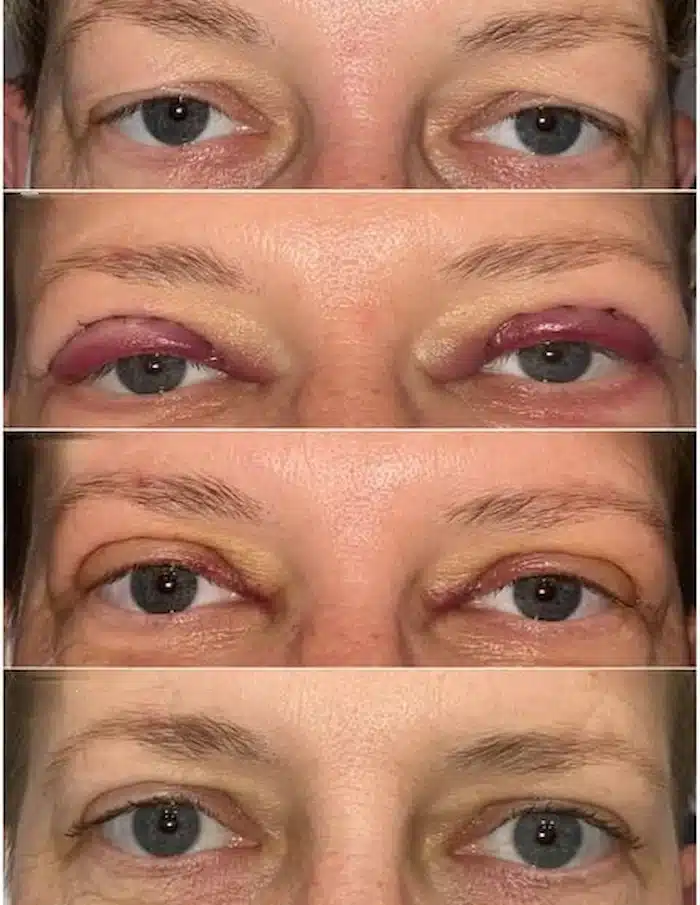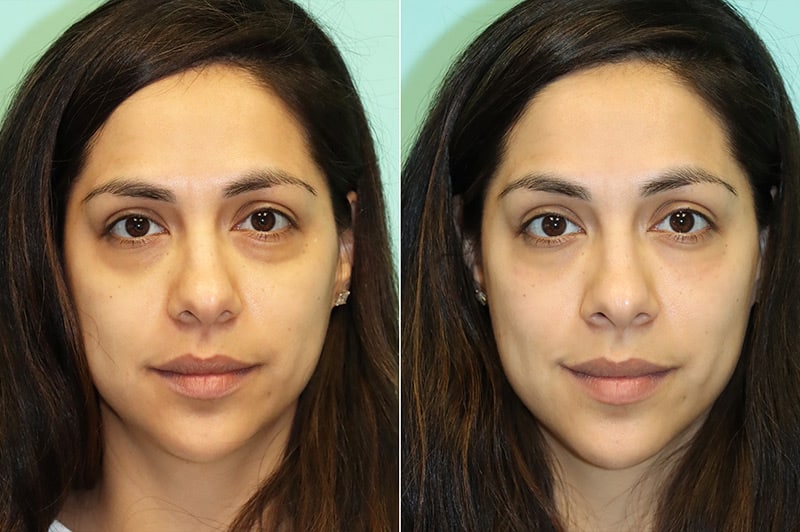
Under-eye filler recovery takes 3 to 7 days of social downtime, meaning the point at which you feel comfortable going back to work or out in public, and 2 to 4 weeks for the filler to settle completely and show its final result. Those are two different milestones and conflating them is the reason so many people panic on day two. Swelling peaks in the first 24 to 48 hours, the area can genuinely look worse before it looks better, and the version of your face you see in the first week is not the version you paid for. Below we walk through the day-by-day progression, why the middle of the first week is the hardest part, when the result is actually finished, what to avoid and for how long, how to settle swelling faster, and the short list of symptoms that mean you should call someone rather than wait.
How Long Does It Take to Fully Recover From Under Eye Filler?
Full recovery from under-eye filler takes 2 to 4 weeks, though most people are comfortable in public within 3 to 7 days. The gap between those two numbers is where most of the anxiety lives, so it is worth separating them clearly from the start.
Social downtime is the shorter figure. It describes the point at which visible swelling and bruising have faded enough that you are not thinking about them, which for most people lands somewhere between day four and day seven. Full settling is the longer one. It describes the point at which the filler has integrated into the tissue and reached its stable hydration level, which happens around weeks three and four.
How long your own recovery takes depends on a few things outside anyone’s control. Skin thickness matters, since thinner tissue shows swelling and bruising more readily. How easily you bruise is largely individual. The injection technique and the amount of product placed both play a part. We walk patients through their expected timeline before any injectable treatments go ahead, because knowing what day four is supposed to look like is most of what stops day two from being alarming.
What Happens Day by Day After Under Eye Filler?
Recovery follows a consistent pattern: immediate fullness, peak swelling on days two to three, steady improvement through the first week, blending in week two, and the final result at weeks three to four. Knowing the pattern lets you compare your progress against what is expected rather than against yesterday, which is a far more useful reference point.
In summary: day 0 brings mild puffiness, redness and tiny pinpoint marks, with the area often looking fuller than you expected. Days 2 to 3 are the peak, when swelling and bruising reach their maximum and the contour looks distorted. Days 4 to 7 bring a sharp improvement, with visible swelling dropping significantly and most people comfortable returning to normal routine. Week 2 resolves residual puffiness and softens the early firmness. Weeks 3 to 4 are when the filler fully integrates and shows the result you keep. Our separate day-by-day guide breaks each of those stages down in detail, including what is happening beneath the skin and how to tell normal from not on any given day.
Comparing a photograph from day one against day seven is far more reassuring than comparing the mirror against your memory. We cover what to expect across the broader range of under-eye treatments separately, since timelines differ considerably between injectables and energy-based work.
Why Does It Look Worse Before It Looks Better?
It looks worse before it looks better because swelling peaks at 24 to 48 hours, and swelling in an area this thin distorts the contour the treatment was meant to refine. Distorting the contour is the key phrase. You are not seeing too much product. You are seeing product plus fluid plus tissue reaction, and only one of those three is staying.
Three things are happening at once in those first days. Hyaluronic acid is hygroscopic, meaning it attracts water into the tissue around it, so the area holds more fluid than it will once it stabilises. The injections themselves produce a normal inflammatory response, which adds its own swelling. And any bruising tends to darken before it fades, following the same colour sequence a bruise follows anywhere else on the body.
Product choice influences how pronounced this phase is. Highly water-attracting gels swell more visibly here than low-swelling formulations, which is part of why product selection under the eye is treated so carefully. We work across several hyaluronic acid families including the RHA family, and a formulation with low swelling behaviour makes the first week considerably easier.
The practical advice for this window is simple and difficult: do not evaluate, do not photograph for comparison, and do not request adjustments. Nothing you see between day one and day three is the result.
How Long Will You Look Different Before It Settles?
You will look visibly different for about 3 to 7 days, with any residual puffiness typically resolving inside two weeks. Visibly different means noticeable to you and possibly to people who look closely, rather than dramatic to a stranger across a room.
Most people find days two and three are the ones worth planning around. By day four the swelling has turned the corner, by day seven bruising is usually gone or easily covered, and the remaining change is subtle enough that nobody comments. Patients who bruise easily or who had more product placed sit at the longer end of that range.
If something specific is in your calendar, the sensible move is to build in margin rather than hope. Two weeks before an event clears the social downtime comfortably, and three to four weeks before means you are photographed with your settled result rather than a work in progress.
When Do Under Eye Fillers Look Their Best?
Under-eye fillers look their best at 3 to 4 weeks, once the product has integrated into the tissue and reached its stable hydration level. Integration is what separates a result that reads as your own face from one that reads as something sitting under your skin, and it takes weeks rather than days.
Two to three weeks is commonly cited as the point of optimal results, and the difference between that and the four-week mark is usually small. What is not small is the difference between week one and week three. Judging a result before the swelling has fully resolved is the single most common reason people believe a treatment did not work when it simply had not finished.
Longevity is a separate question from settling, and once the result stabilises it holds for roughly 9 to 12 months before the body metabolises the product. Anyone managing ongoing facial volume loss should expect that cycle to repeat rather than to be a one-time correction.
Do Fillers Look Better After 2 Weeks?
Fillers do look better after 2 weeks, and the improvement between the first week and the third is substantial in this area specifically. Settling resolves the puffiness that makes early results look overdone, and integration softens any edges or firmness you can feel in the first few days. If you dislike the result at week one, wait. If you still dislike it at week three, that is the point at which a conversation about adjustment is worth having, and touch-ups are generally considered at the two to four week mark for exactly this reason.
Why Is My Filler Still Hard After 2 Weeks?
Filler can still feel hard at 2 weeks because integration is not finished until weeks three to four, and firmness you can feel is usually not firmness anyone can see. The distinction between felt and seen matters enormously here, because most people discover the firmness by pressing on the area rather than by looking at it.
Freshly placed gel sits as a defined deposit before it incorporates into the surrounding tissue. As it integrates, it softens and the boundary between product and tissue blurs. That process runs on its own schedule, and two weeks lands in the middle of it rather than at the end.
Pressing to check makes it worse rather than better. Repeated prodding during the settling window is one of the few things that can genuinely move product, and it also makes the area feel more irregular than it is. Leave it alone, reassess at week four, and raise it at your review appointment if firmness is still obvious to the touch or visible in the mirror by then.
When Do Fillers Stop Hurting?
Fillers stop hurting within a few days, with tenderness typically fading by day three to five and gone entirely within a week. Tenderness is the right word for what most people experience, since sharp pain is not part of normal recovery in this area.
What you should feel is mild soreness when you touch the area, a sense of pressure or fullness, and sensitivity that decreases each day rather than holding steady. That pattern of steady improvement is as important as the sensation itself, and it is what distinguishes ordinary recovery from something that needs attention.
Pain that increases rather than fades, that throbs, or that feels severe is a different situation entirely and belongs in the section below on when to call. Ordinary recovery gets easier every day, and if yours is getting harder, that is information rather than impatience.
What Not to Do After Getting Under Eye Fillers
Avoid pressure on the area, heat, alcohol, blood thinners and strenuous exercise in the first 24 to 48 hours, and avoid rubbing or massaging the area for several days. Pressure and heat are the two that matter most, since both can move product that has not yet integrated. The full list:
- Do not rub, scratch or press the area for at least one to three days, including while removing makeup or washing your face
- Do not sleep face down or on your side for the first two to three nights, since sustained pressure through the night is more than enough to shift unsettled product
- Avoid strenuous exercise for 24 to 48 hours, with intense workouts better delayed longer if you are prone to swelling
- Avoid heat including saunas, steam rooms, hot yoga and very hot showers for 24 to 48 hours, and in some protocols up to two weeks for sustained heat exposure
- Skip alcohol for at least 24 to 48 hours, since it dilates vessels and worsens both swelling and bruising
- Go easy on high-sodium foods for the first few days, because salt encourages fluid retention and the under-eye area shows fluid retention before anywhere else on the face
- Avoid blood-thinning medications and supplements such as aspirin, ibuprofen, fish oil and vitamin E unless they are medically necessary, having ideally stopped them about a week before treatment
- Hold off on active skincare including retinoids, acids and exfoliation for about a week
- Do not book another facial treatment in the same area until the filler has settled
None of this is arbitrary caution. Every item on that list either moves product, increases swelling or increases bruising, and all three are avoidable with a few days of care. The settling period is short, and protecting it is the cheapest insurance available on any dermal filler result.
What Is Forbidden After Fillers?
Nothing is permanently forbidden after fillers, and the restrictions that do apply are measured in days rather than weeks. The firmest rules are no pressure or massage on the treated area, no face-down or side sleeping for the first few nights, and no heat or strenuous exercise for the first 24 to 48 hours. Everything else is a matter of degree. Makeup, normal skincare, work, travel and ordinary daily activity resume quickly, and the list shortens with each day that passes.
How Should You Sleep After Under Eye Filler?
Sleep on your back with your head elevated on an extra pillow for the first two to three nights, and avoid side-sleeping or sleeping face down. Elevation is doing two jobs here. It encourages fluid to drain away from the under-eye area rather than pooling there overnight, which is why morning puffiness is usually the worst puffiness of the day.
Position matters as much as elevation. Hours of sustained pressure from a pillow against one side of the face is more force, applied for longer, than anything you would do to the area while awake. Product that has not finished integrating can shift under that pressure, and it tends to shift on the side you favour, which is one of the more common causes of asymmetry showing up in the first week.
Back-sleeping is harder than it sounds if you are not used to it. A pillow on either side of your head helps, and so does accepting that two or three imperfect nights is a reasonable trade for a result that stays where it was placed.
When Can You Wear Makeup, Exercise and Travel Again?
Makeup can usually go on after 24 hours, exercise after 24 to 48 hours, and travel is generally fine once any bruising has settled. Rather than scattering these through the article, the table below collects the common questions in one place, drawing on the aftercare protocols published across dermatology and oculoplastic practice.
| Activity | When to resume | Why |
|---|---|---|
| Gentle cleansing | Same evening or next day | Keeping injection points clean reduces infection risk, provided you do not scrub |
| Makeup over the area | After at least 24 hours, some protocols say 2 to 3 days | Applicators carry bacteria, and injection points need time to close |
| Light activity and work | Same day | Nothing about normal daily movement affects the result |
| Strenuous exercise | 24 to 48 hours | Raised blood flow and pressure increase swelling and bruising |
| Saunas, steam and hot yoga | 24 to 48 hours, longer for sustained heat | Heat dilates vessels and prolongs swelling |
| Alcohol | 24 to 48 hours | Worsens both swelling and bruising |
| Retinoids, acids and exfoliation | About a week | Active ingredients irritate skin that is already reacting |
| Flying | Once bruising has settled, generally after a few days | Cabin pressure and dehydration can make residual swelling more noticeable |
| Facial massage or another treatment in the area | At least 2 weeks | Manipulation can move product that has not finished integrating |
| Judging the result | 3 to 4 weeks | Earlier than this and you are assessing swelling rather than filler |
Combining treatments is worth planning rather than improvising. Collagen-stimulating work such as biostimulation is often paired with filler in this area, and spacing the two means you are never recovering from both at once.
Hydration-focused injectables follow the same logic. SkinVive addresses skin quality rather than volume, which makes it a natural companion to under-eye filler, and we usually sequence it rather than stacking it into the same appointment.
Muscle-relaxing treatments are more flexible, since neurotoxins work in different tissue and on a different timeline. Even so, treating everything at once makes it harder to tell which treatment produced which part of the result.
How Can You Reduce Swelling and Bruising Faster?
Reduce swelling and bruising faster with cold compresses in the first 48 hours, head elevation, good hydration and avoiding anything that increases blood flow to the face. Cold is the most effective thing available to you, and the technique matters as much as the tool.
Working through the first 48 hours in order gives you the best result from the least effort:
- Start cold early. Begin compresses as soon as you get home rather than waiting for swelling to appear, since preventing fluid build-up is easier than reversing it
- Use the right technique. A clean ice pack wrapped in a cloth, or a cold flannel, for about ten minutes on and twenty minutes off. Rest it lightly against the area rather than pressing, and never apply ice directly to skin this thin
- Elevate from the first night. An extra pillow keeps fluid from pooling in the area overnight, which is why morning puffiness is usually the worst of the day
- Cut the aggravators. Alcohol, salty food, heat and strenuous exercise all widen vessels or add fluid, and skipping them for two days makes a visible difference
- Hydrate and sleep. Swelling clears through normal circulation, so anything that supports circulation shortens the process
- Leave it alone. No massage, no pressing to check firmness, no repeated inspection in different lighting
Hydration, sleep and a few days without alcohol all support the process more than people expect, largely because swelling resolves through normal circulation and anything that impairs that circulation slows it down. Arnica is widely used for bruising and is low risk, though evidence for it is mixed. Some patients also pair their treatment with platelet-rich fibrin for the skin-quality side of the result, which has its own recovery pattern worth discussing in advance.
What does not help is interfering. Heat, massage, pressing to check firmness, and repeatedly examining the area in different lighting all make the week feel longer without changing the outcome.
Does Drinking Water Help Fillers Last Longer?
Drinking water supports your recovery and general skin health, but it does not meaningfully extend how long filler lasts. The honest answer is more useful than the popular one here, because the popular one sets up a disappointment.
Hyaluronic acid does bind water, which is where the idea comes from, and good hydration does help the gel perform as intended while it is in place. What determines longevity is something else entirely: how quickly your own enzymes break the cross-linked gel down, which is individual and not something a water bottle influences. People who metabolise filler quickly will do so whether they drink two litres a day or not.
What genuinely affects longevity is the product chosen, where it was placed, how much movement the area sees, and your own metabolism. The under-eye happens to do well on that scale because it moves far less than the lips. If longevity is your priority, the conversation worth having is about product selection rather than habits, and our guide to injectable options covers how those choices differ.
When Should You Contact Your Provider?
Contact your provider immediately if you have severe or worsening pain, any change in vision, skin turning pale, white or mottled around the injection site, or signs of infection. These four are the ones that matter, and none of them belongs in the normal recovery pattern described above.
Severe, escalating or throbbing pain is not typical. Ordinary recovery involves mild tenderness that improves each day, so pain that intensifies rather than fades needs assessment. Any change in vision is a medical emergency, including blurriness, double vision, eye pain or loss of sight, and warrants urgent care rather than a message and a wait.
Skin colour changes around the treated area are the other urgent sign, specifically a pale, white, grey or dark blotchy patch, since these can indicate compromised blood flow. Signs of infection, meaning unusual warmth, spreading redness or any discharge, also need prompt attention, though these usually appear days later rather than immediately.
Two things are worth raising without urgency. Swelling that persists beyond two weeks should be reviewed, and a bluish or greyish tint appearing in the treated area is a known and correctable issue with its own separate discussion. Neither is an emergency, and both are worth a phone call rather than months of waiting.
How We Support Your Recovery
We support recovery by setting expectations before treatment, sending you home knowing what each day should look like, and reviewing the result at two weeks rather than leaving you to interpret it alone. Setting expectations first is the part that prevents most of the worry, because almost every distressed call we take comes from someone on day two who was not told about day two.
Before treatment we go through the timeline, the restrictions and the red flags, and we check medications and supplements that affect bruising so they can be paused in advance where appropriate. We also ask what is in your calendar, since the planning conversation is easier before an appointment than after one. Patients in our Bingham Farms practice who are treating ahead of a wedding or a photographed event get scheduled with margin built in rather than hoping for a fast recovery.
After treatment we review at around two weeks, which is early enough to catch anything that needs attention and late enough that most swelling has gone. Adjustments, where they are needed, are made once the result is stable rather than in the middle of the settling window. The same staged approach applies to facial contouring anywhere on the face, and the under-eye is simply the area where it matters most.
We are also reachable in between. Patients across the Detroit metro call us during the peak swelling window more than at any other point, and the answer is usually that everything is proceeding exactly as it should. Our approach to injectable aftercare treats that call as part of the service rather than an inconvenience.
Frequently Asked Questions
What Is the Most Painful Area for Fillers?
The most painful areas for fillers are generally the lips and the nose, with the under-eye usually described as pressure rather than sharp pain. Topical numbing cream is applied beforehand, many fillers contain a numbing agent, and blunt-tipped cannula technique reduces discomfort further in this area. Most patients report the under-eye as more tolerable than they expected.
Can You Fly After Under Eye Filler?
You can fly after under-eye filler, though waiting a few days until bruising has settled is sensible. Cabin pressure and the dry air on a flight can make residual swelling more noticeable, which is uncomfortable rather than harmful. If you are flying within 48 hours of treatment, stay well hydrated and skip the in-flight alcohol.
Why Is One Side More Swollen Than the Other?
One side is often more swollen than the other because faces are not symmetrical, injection points differ slightly between sides, and sleep position concentrates pressure and fluid on whichever side you favour. Uneven swelling in the first week is common and usually resolves on its own. Asymmetry that persists past the third week is worth a review, since that is when the result is stable enough to assess.
Is It Normal to Feel Lumps in the First Week?
Feeling small lumps or firm areas in the first week is normal, since the product has not yet integrated and swelling makes the area feel irregular. Most of this resolves on its own as the filler settles over two to three weeks. Lumps that remain visible or palpable after three weeks are worth having assessed, and resist the urge to massage them in the meantime.
How Long Before a Wedding or Event Should You Book?
Book at least three to four weeks before a wedding or photographed event so the filler has fully settled. Two weeks clears the visible downtime but may leave minor residual puffiness, and anything inside one week risks being photographed mid-recovery. If this is your first under-eye treatment, give yourself four weeks so there is room for a review appointment if one is needed.
Can You Massage Under Eye Filler?
Do not massage under-eye filler yourself, because pressure on unsettled product is one of the few things that genuinely moves it out of position. If your injector asks you to massage a specific area in a specific way, follow their instruction rather than general advice. Otherwise, leave the area alone for at least two weeks and let it settle.
The Bottom Line
Under-eye filler recovery is short, predictable and mostly a matter of patience. Three to seven days gets you back to feeling normal in public, two to four weeks gets you the result you actually paid for, and the stretch between day one and day three is the hardest part because swelling peaks there and distorts the very contour the treatment was meant to refine. Almost everything that goes wrong emotionally in this period comes from judging a result that has not finished arriving.
Protect the first few nights by sleeping on your back and elevated, keep pressure and heat off the area for a couple of days, use cold compresses early rather than late, and leave the assessing until week three. Then there is the short list that is not about patience at all: severe or worsening pain, any change in vision, skin turning pale or mottled, or signs of infection all mean picking up the phone immediately rather than waiting to see. If you want your recovery mapped around something specific in your calendar, book a consultation before you book the treatment. We plan timelines backward from your date at FACE Skincare, which is a far easier conversation to have in advance than in week one.