Most patients need 0.5 to 1 mL of filler in total, split between both eyes, for mild to moderate under-eye hollowing, and 1 to 2 mL when the hollowing is moderate to severe. For many people that works out to less than one full syringe, because the under-eye area uses less product than any other part of the face. The number is not chosen from a menu. It comes out of an assessment of how deep the trough is, how much support the cheek underneath is still providing, how thin the skin is, and what is actually causing the shadow in the first place. Below we walk through what a syringe holds, how much goes under each eye, the factors that decide where you land in the range, why treating the cheeks first often lowers the number, where the ceiling sits, how the other facial areas compare, and when filler is not the answer at all.
How Many Syringes Do You Need for Under Eye Fillers?
You need 0.5 to 1 mL of filler for mild to moderate under-eye hollowing and 1 to 2 mL for moderate to severe hollowing, measured as a total across both eyes rather than per eye. Across both eyes is the detail that trips people up. A single syringe is usually the whole treatment, not the starting point for each side.
That makes the under-eye the most product-efficient area on the face. A cheek can absorb several syringes before anything looks different, while a tear trough shows change from a fraction of one. The reason is purely anatomical: you are filling a shallow groove under skin that measures roughly half a millimetre, so a small volume travels a long way visually.
The range exists because faces differ, not because providers are hedging. A shallow groove caused by mild fat pad shifting needs very little. A deep, long-standing hollow that extends out toward the cheek needs structural volume, and that is where the upper end of the range comes in. Our injectable treatments are planned around which of those two pictures your face presents, which is why the honest answer before an assessment is always a range.
How Much Filler Is in One Syringe?
One standard dermal filler syringe holds 1 mL of product, which is about one fifth of a teaspoon. One fifth of a teaspoon is less than most people picture when they hear the word syringe, and that gap between expectation and reality explains a lot of the confusion around these numbers.
Not every product comes in a full millilitre. Some are supplied in 0.5 mL or 0.7 mL volumes, specifically because certain areas call for smaller amounts and a smaller unit lets an injector work precisely without opening more product than the plan requires. Products designed with delicate areas in mind frequently come this way, and the RHA family we carry includes formulations built around that kind of precision.
Knowing the volume per syringe reframes every other number in this article. A full face taking six syringes sounds enormous until you work out that six syringes is a little over a teaspoon of product distributed across an entire face. The same arithmetic running the other way is why half a syringe is a meaningful treatment under one eye.
How Much Filler Goes Under Each Eye?
Roughly 0.25 to 0.5 mL goes under each eye in a typical tear trough treatment, which means one syringe usually covers both sides. Half a syringe per side is the standard starting point for most people with a visible but not severe hollow, and plenty of patients need less than that on one side than the other.
Asymmetry is normal and expected. Almost nobody has two identical tear troughs, so the volume per side is decided separately rather than split down the middle out of tidiness. Deciding separately is one of the small things that separates a planned treatment from a routine one.
Incremental placement is how that precision actually happens. Product goes in small deposits with the contour reassessed between each one, rather than as a single bolus that cannot be taken back. Anyone reading up on under-eye treatments will see this described as conservative technique, and under the eyes conservative is a clinical standard rather than a personality trait.
How Do Providers Decide How Many Syringes You Need?
Providers decide how many syringes you need by assessing the depth of the tear trough, the support in your midface, your skin thickness, what is causing the shadow, and the result you are after. Assessment comes before any number, and the number falls out of it rather than the other way around. These are the factors we work through:
- Depth and length of the tear trough: a shallow groove from mild fat pad shifting takes very little, while a deep hollow extending toward the cheek needs structural volume and sits at the top of the range
- Midface support: cheekbone volume is checked before the under-eye is treated at all, because a deflated midface changes what the tear trough needs and sometimes removes the need entirely
- Skin thickness and translucency: thin, translucent skin shows product far more readily, so those patients get smaller amounts in smaller deposits rather than a standard volume
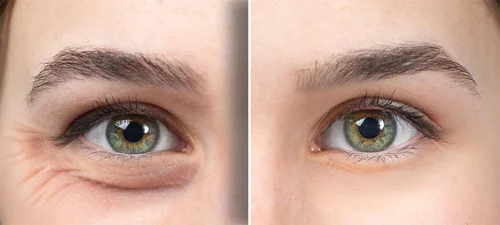
- Hollows versus bags: filler corrects shadow caused by a sunken groove. Bulging fat pads and pigment-based dark circles do not respond, and filling around a bulge can make the bulge more obvious
- Product density: a soft, low-density gel integrates into thin tissue and behaves differently from a firmer gel built for deep structural support, so the product chosen changes the volume used
- Your goal: a subtle softening of the shadow and a full correction of the hollow are two different plans with two different numbers
- Treatment history: product placed previously, anywhere in the midface, changes what the area needs now
Notice that only one of those is about the under-eye groove itself. The rest are about context, which is why a number quoted over the phone before anyone has looked at your face is a guess rather than a plan. A dermal filler plan is built on an assessment or it is not built on anything.
Why Treating the Cheeks First Changes the Number
Treating the cheeks first changes the number because restoring midface volume physically lifts the tissue that was collapsing into the tear trough, reducing the shadow before any product goes under the eye. Lifting the tissue addresses the cause rather than the symptom, and the under-eye shadow is very often a symptom of something happening above it.
Here is the mechanism. The cheek fat pads sit above the tear trough and provide the support that holds the lower eyelid area smooth. As those pads deflate and descend with age, the junction between the lid and the cheek deepens into a visible groove. The groove looks like an under-eye problem, and it is being produced by a midface problem.
Restoring that support often softens the trough substantially on its own. Patients who arrive asking for under-eye filler and leave with a plan that treats the cheeks first are frequently surprised to need very little tear trough product afterward, or none. This is also the safest version of the treatment, since less product under thin skin means less of everything that can go wrong there.
In our Bingham Farms practice this is one of the most common conversations we have, because it sounds like an upsell and is the opposite of one. A patient treating the cheeks alone usually needs fewer total syringes than a patient who treats the tear trough repeatedly while the facial volume loss above it goes unaddressed.
Is 2 Syringes of Fillers a Lot?
Two syringes of filler is a lot for the under-eye area and a modest amount almost anywhere else on the face. Where it goes decides whether the number is large or small, which is why the question has no single answer.
Two millilitres placed under the eyes sits at the upper end of what that area can take, and it is reserved for moderate to severe hollowing rather than offered as a standard. Two syringes in the cheeks is a routine correction for someone in their forties. Two syringes along a jawline is the minimum for visible definition rather than a generous allowance. Same volume, three completely different meanings.
For comprehensive plans covering several areas, two syringes is a small total. The number only becomes meaningful once you know the map it is being spread across, which is the reason a syringe count on its own tells you very little about what someone had done.
Will One Syringe of Filler Make a Difference?
Yes, one syringe of filler makes a clear difference under the eyes, because a full millilitre is at or above the typical total for the entire tear trough area. At or above the typical total means one syringe is a complete treatment here rather than a partial one, which is not true of most other areas.
Elsewhere the answer changes. One syringe produces a noticeable result in the lips, the chin or a single nasolabial fold, a modest result in one cheek, and very little across a whole jawline. The variable is the size of the area relative to the volume, and the under-eye is the smallest treatment area on the face.
Underfilling is a real failure mode worth naming, though it rarely applies here. Placing too little product in a large area produces a change so subtle that it fades quickly and leaves people feeling the treatment did not work, when the truth is there was never enough product to do what they wanted. That is a cheek and jawline problem. Under the eyes the risk runs the other direction entirely.
Is More Filler Always Better Under the Eyes?
No, more filler is not better under the eyes, because the margin between a correction and an overcorrection is narrower here than anywhere else on the face. The margin is narrow for the same reason small volumes work so well: there is almost nothing between the product and the surface.
Overfilling this area produces puffiness rather than smoothness, and puffiness reads as tired in exactly the way the treatment was meant to fix. Excess volume in a confined space also has nowhere to disperse except upward and outward, which is how lumps and visible edges appear. Hyaluronic acid draws water into the tissue around it as well, so an area that looked correct on the day can look fuller a week later.
Placing too much also raises the risk of the bluish or grayish tint sometimes called the Tyndall effect, which appears when product ends up too close to the surface of translucent skin. Volume and depth work together on that, since overfilling pushes product upward even when it started in the right plane. Experienced injectors treat the ceiling here as seriously as the floor, and stopping below it is a deliberate decision rather than caution.
How Many Units of Filler Are in a Syringe?
Filler is not measured in units at all, it is measured in millilitres, and the two systems are not interchangeable. Units belong to botulinum toxin treatments like Botox, where the dose is counted in units of product per muscle. Filler is a gel that occupies space, so it is measured by volume.
The confusion is extremely common and worth untangling properly, because it changes how you read every number you encounter. There is no conversion between the two. Asking how many units are in a syringe of filler is a little like asking how many miles are in a gallon of fuel, since the quantities describe different things entirely.
A quick way to keep them straight: if the goal is to add volume or rebuild structure, you are counting millilitres and syringes. If the goal is to relax a muscle that creates a line when it moves, you are counting units. Many treatment plans involve both, which is exactly how the two numbers end up tangled in people’s heads. They appear on the same plan, they are never added together.
How Many Syringes for Jawline Filler?
Jawline filler typically takes 2 to 4 syringes in total, with 2 being the minimum for visible definition and 4 more common for comprehensive contouring. The jawline needs more product than people expect because the mandible is a long structure and the gel has to be placed along its full length to read as a continuous line rather than a pair of spots.
The ranges below reflect published injector guidance across the main treatment areas, and the right end of each range for you is an assessment finding rather than a preference.
| Area | Typical range | What moves you higher in the range |
|---|---|---|
| Under eyes (tear troughs) | 0.5 to 1 mL total, up to 2 mL for severe hollowing | Deep, long-standing hollowing extending toward the cheek |
| Jawline | 2 to 4 syringes total | A naturally round jaw shape, pre-jowl hollowing, a sharply defined goal |
| Cheeks | 1 to 3 syringes per side | Bone resorption, significant fat pad descent, history of weight loss |
| Chin | 1 to 2 syringes | Greater projection needed, or width as well as projection |
| Temples | 1 to 2 syringes per side | Deeper hollowing, usually after 55 or after weight loss |
| Nasolabial folds | 1 to 2 syringes | Deep established folds, though cheek support often reduces this |
| Lips | 1 to 2 syringes | Naturally thin lips or a goal of noticeably fuller rather than defined |
Reading down the under-eye row against the rest makes the point this whole article rests on. Every other area is counted in whole syringes per side or per region, and the tear trough is counted in fractions of one syringe for both sides together. Patients planning facial contouring across several areas should expect the under-eye line item to be the smallest on the plan by a wide margin.
How Many Syringes Do You Need for a Full Face?
A full-face plan typically runs 4 to 8 syringes for contouring and up to 10 for comprehensive age-related restoration, spread across the cheeks, jawline, chin, temples and under eyes. Spread across is the operative phrase, since that total is never placed in one region.
You will hear a rule of thumb that estimates roughly one syringe per decade of life for comprehensive correction, so a patient in their forties might plan for four. It is useful as a starting framework because it reflects something true: volume loss is cumulative, and bone resorption and fat pad descent both increase what is needed over time. It breaks down the moment you apply it to an individual. Someone at 45 with strong bone structure and good skin quality may need two, while someone at 35 after significant weight loss may need four.
Collagen stimulators sit outside this counting system entirely. Sculptra is supplied in vials rather than syringes and works by prompting your own collagen production over several months, so comparing it syringe for syringe against a hyaluronic acid gel compares two different things. Plans that include both are counted separately for each.
Should You Do It All at Once or Split It?
Plans of five or more syringes are usually split across two sessions two to four weeks apart, while plans of three or fewer are typically completed in one. Splitting is a clinical decision about accuracy rather than a scheduling convenience.
The logic is that a face swelling in several places at once is hard to assess honestly. Staging lets the first round settle so the second round is placed against a real result rather than a temporary one. Here is how we sequence it:
- Treat the structural areas first. Cheeks, temples and jawline provide the support that everything else sits on, so they are addressed before anything closer to the surface
- Let it settle for two to four weeks. Swelling resolves, product integrates, and the area stops changing day to day
- Reassess in the same lighting and at the same angles. Comparing against photographs taken before the first session rather than against memory
- Treat the refining areas second. The under-eye, the lips and fine detail work go last, when the support beneath them is already in place
- Reduce the planned volume where the first round did more than expected. This happens most often with the tear trough after cheek work, and the plan should shrink rather than proceed on autopilot
- Review again at two weeks after the final session. The standard assessment point for deciding whether anything further is needed
Staging is also the conservative choice on safety, since smaller volumes placed in stages are easier to evaluate and easier to adjust. Anyone comparing injectable options for a larger plan should ask how a practice sequences the work, not just what it totals.
How Long Does One Syringe of Under-Eye Filler Last?
One syringe of under-eye filler lasts about 9 to 12 months on average, with a reported range of roughly 6 to 18 months depending on the product and the individual. The variation comes from how quickly your body metabolizes hyaluronic acid, which differs between people and is not something you can change much.
Filler in this area tends to hold reasonably well despite constant movement from blinking, partly because the volumes are small and placed deep where there is less mechanical disruption. It fades gradually rather than disappearing, so the change registers as the slow return of a shadow instead of a sudden loss.
Many people find the second treatment needs slightly less product than the first, since a residual base remains when they return. That is one of the few places in this topic where the number reliably goes down rather than up.
When Filler Is Not the Right Answer for Under Eyes
Filler is not the right answer when your dark circles come from pigment rather than shadow, when bulging fat pads are the main feature, or when the skin is too thin to conceal product safely. Pigment is the most common of the three and the easiest to test for at home.
Stand in front of a mirror in good light and tilt your head up so the light falls directly on your under-eye area. If the darkness lightens or disappears as the shadow is filled with light, you are looking at a hollow and filler can help. If the color stays put, you are looking at pigment in the skin, and adding volume underneath will not change it and can draw more attention to it.
Bulging fat pads are the second case. Adding product around a bulge makes the whole area fuller rather than smoother, and the better route is usually surgical repositioning or a treatment aimed at the bulge itself. Very thin, translucent skin is the third, where even a correctly placed small volume may show, and an honest assessment says so before treatment rather than after.
None of those patients is out of options. EZ Gel biofiller is made from your own plasma and supports volume while improving the quality of the tissue itself, which suits faces where a clear synthetic gel would be visible.
For skin quality and tone rather than volume, platelet-rich fibrin releases growth factors into the area across a series of sessions. The improvement builds slowly rather than appearing at once, and it addresses crepiness and dullness that no amount of filler would have touched.
How We Plan Your Syringe Count
We plan your syringe count by assessing your face before quoting any number, starting with the midface, and treating the under-eye last and conservatively. Assessing first is not a formality, since the most useful thing we can tell some patients is that the tear trough is not where their plan should start.
Our assessment covers the depth and length of the groove, how much cheek support remains, skin thickness and translucency, whether the shadow is structural or pigmented, and what product has been placed before. We photograph in consistent lighting so there is a real reference point rather than a memory to compare against later.
From there we build a plan in ranges rather than fixed totals, place incrementally, and reassess at two weeks before adding anything. Patients across the Detroit metro frequently arrive with a syringe number already in mind from something they read, and roughly as often the number is higher than what their face actually calls for. Our injectable planning works backward from the result rather than forward from a quantity.
Cost is the other half of this question for most people, and it is a separate conversation from volume because it depends on which product an area calls for as well as how much. We cover dermal filler costs in their own article rather than attaching figures to ranges that have not been assessed yet.
Frequently Asked Questions
Can You Buy Half a Syringe of Filler?
You can often have half a syringe used, and under the eyes half a syringe per side is the standard amount rather than a compromise. Some products are also manufactured in 0.5 mL and 0.7 mL volumes for exactly this reason. In larger areas such as the cheeks or jawline, half a syringe rarely produces a visible change, so the practice is area-specific rather than universal.
Does Under-Eye Filler Need More Syringes the Second Time?
Under-eye filler usually needs the same amount or slightly less the second time, because a residual base of product often remains when you return at 9 to 12 months. Returning before the previous treatment has fully metabolized is the main reason the number goes down. Waiting until it has disappeared entirely means starting from your original baseline again.
What Happens to Filler Left in the Syringe?
Filler left in a syringe is discarded, because these are single-patient sterile products that cannot be stored and reused once opened. This is why plans are built around how much product an area needs rather than around using up what has been opened. A provider who suggests placing the remainder somewhere simply to avoid waste is making a decision for the wrong reason.
Can One Syringe Be Split Across Two Different Areas?
One syringe can be split across two areas when both are small and the same product suits each, such as treating the tear troughs and a small amount of adjacent cheek support. Splitting across areas that need different gel densities is a different matter, since the right product for thin under-eye tissue is rarely the right product for structural work. The decision is driven by what each area needs rather than by economy.
Do Syringe Counts Differ Between Filler Brands?
Syringe counts differ between brands mainly because the volume per syringe varies, with most holding 1 mL and some supplied at 0.5 mL or 0.7 mL. Gel density matters too, since a firmer product placed deep can achieve structural lift with less volume than a softer product would need. Comparing brands by syringe count alone tells you very little without knowing both figures.
Why Did Someone Else Need More Syringes Than Me?
Someone else needed more syringes because their anatomy, degree of volume loss and treatment goals were different from yours, not because one of you received better care. Depth of hollowing, midface support, bone structure, age-related changes and how dramatic a change each person wanted all move the number independently. A syringe count is a measurement of a face, not a measurement of a treatment’s quality.
The Bottom Line
For most people, under-eye filler means 0.5 to 1 mL in total across both eyes, or 1 to 2 mL when the hollowing is more advanced, which often makes a single syringe the entire treatment. That makes the tear trough the most product-efficient area on the face and also the least forgiving, since the gap between a good correction and a puffy one is measured in fractions of a millilitre. The number itself comes out of an assessment rather than a price list: how deep the groove is, how much support the cheek above it still provides, how thin the skin is, and whether the darkness you are seeing is a shadow at all.
If there is one thing worth taking from this, it is that the most common way to lower your syringe count is to look higher up the face. Restoring midface support frequently softens the tear trough enough that very little product is needed underneath it, which is both the better aesthetic answer and the safer one. We would rather tell you that at a consultation than place product you did not need. That assessment is the whole service at FACE Skincare, where a plan is built around what your face needs rather than around what was opened. If you want your under-eye area looked at properly before you commit to a number, book a consultation and we will map it out with you.