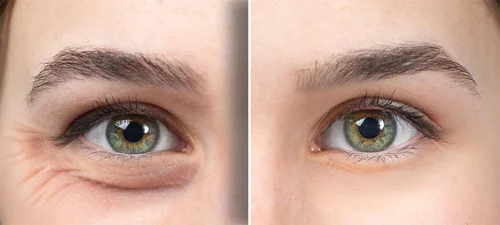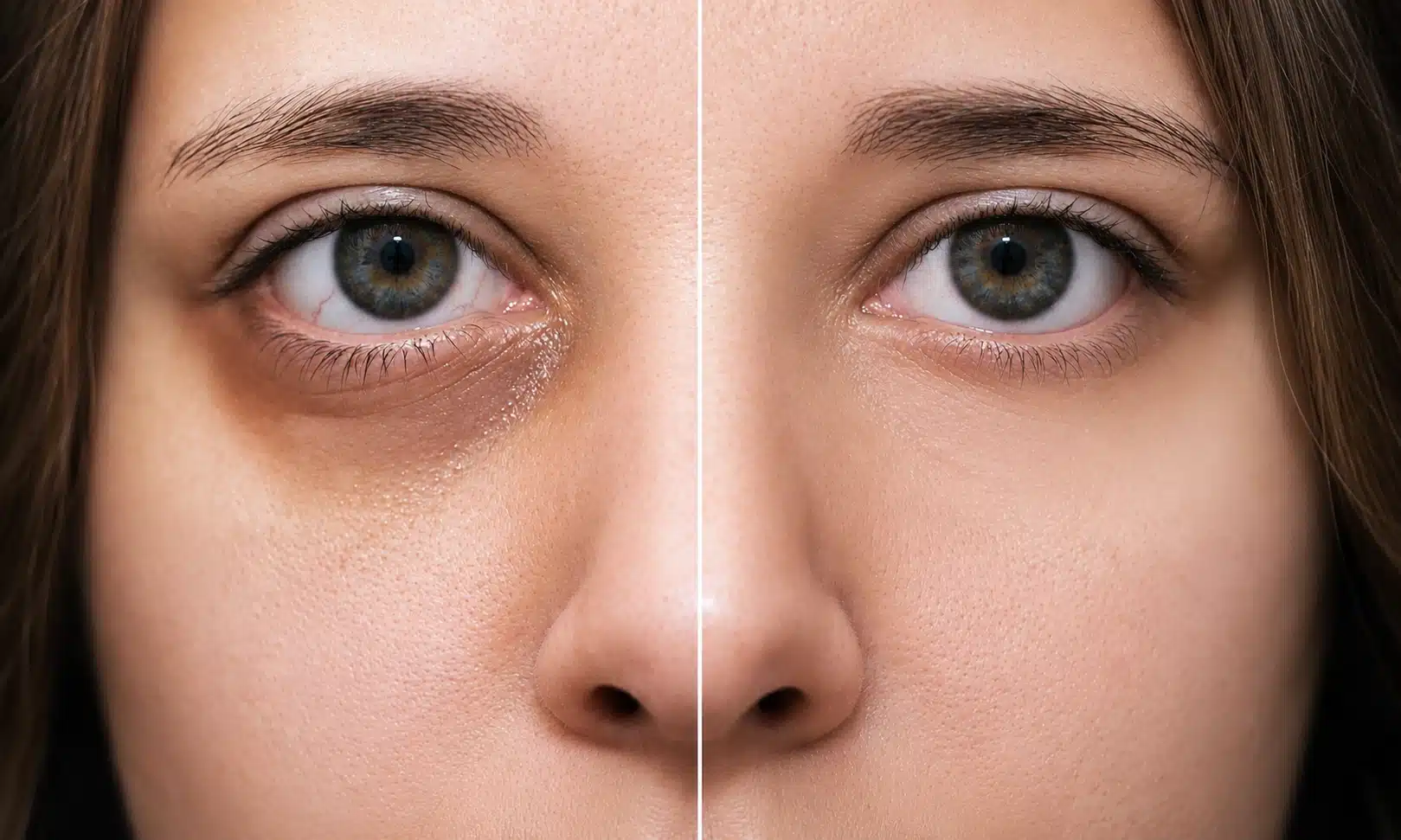
Hyaluronic acid under-eye filler is a gel-like substance injected into the tear trough, the groove between the lower eyelid and the cheek, to restore lost volume, soften the hollows that cast dark shadows, and hydrate delicate skin. It matters because hyaluronic acid is not simply one option among many for this area. It is the only filler material whose behaviour genuinely suits skin this thin, largely because it is the one that can be dissolved and removed if the result is not right. Below we cover what hyaluronic acid actually is, the four things it does under the eyes, why the other approved filler materials are not used here, how long it really lasts, what it cannot fix, who it suits, and what the alternatives are when it is not the right answer.
Is Hyaluronic Acid Filler Good for Under Eyes?
Yes, hyaluronic acid filler is good for under eyes when the problem is a hollow casting a shadow, and it is the only category of filler material appropriate for this area. The condition on that answer matters as much as the answer. Hyaluronic acid corrects volume loss, and darkness under the eyes is not always a volume problem.
Where it earns its place is in the combination of properties it brings. It is soft enough to integrate into tissue measuring roughly half a millimetre thick, it attracts water and hydrates the skin it sits beneath, and it can be dissolved on demand. No other approved filler material offers all three, and the third one is what makes the first two usable in an area this unforgiving.
That is also why hyaluronic acid dominates this part of the menu. Among the injectable treatments available for facial volume, hyaluronic acid is the one we reach for under the eyes almost without exception, and the rest of this article explains what makes that the case rather than just asserting it.
What Is Hyaluronic Acid and Why Is It Used Under the Eyes?
Hyaluronic acid is a natural component of the skin’s connective tissue, and it is used under the eyes because your body already recognises it. Already recognising it is not a marketing line. Johns Hopkins Medicine describes hyaluronic acid as a naturally occurring part of connective tissue and notes that its safety and effectiveness have made it the most common filler used in cosmetic facial procedures.
The molecule is a sugar molecule, and its defining property is how much water it holds. A single hyaluronic acid molecule can bind up to 1,000 times its own weight in water, which is why it behaves like a sponge in tissue rather than like an inert implant. Your skin produces its own supply, and that supply declines with age alongside collagen and the fat pads around the eye.
Injectable hyaluronic acid is cross-linked, meaning the chains are bonded together so the gel holds its shape and resists breaking down quickly. Cross-linking is what turns a substance your body makes naturally into something that can sit in a tear trough for the better part of a year. The degree of cross-linking and the particle size differ between products, and Johns Hopkins notes that smaller particles are designed for fine lines while larger particles address deeper wrinkles and folds. That single variable explains most of what separates one hyaluronic acid product from another, and why some belong in a cheekbone and others belong in an area where you can see almost everything underneath. Anyone researching under-eye treatments will find this framed as product softness, and particle size is the mechanism behind it.
How Does Hyaluronic Acid Work Under the Eyes?
Hyaluronic acid works under the eyes by restoring volume, drawing in water, changing how light reflects off the surface, and integrating into the surrounding tissue rather than sitting on top of it. Four separate mechanisms, and most people only know about the first one. Here is what each contributes:
- Volume restoration: as the fat pads and collagen around the eye socket diminish, a groove forms between the lower lid and the cheek. The gel replaces that missing cushion directly, which is the primary mechanism
- Hydration: hyaluronic acid draws water into the tissue around it, plumping and hydrating from beneath the surface rather than from a topical layer above it
- Light reflection: by lifting thin skin up and away from the vessels and structures below, the surface becomes more even, so light bounces off it uniformly instead of falling into a depression. This is why the darkness softens even though no pigment has been treated
- Tissue integration: a well-matched gel incorporates into the surrounding tissue instead of sitting as a discrete pocket, which is what makes the result feel like your own face rather than something added to it
The light reflection mechanism is the one worth holding onto, because it explains a result that otherwise seems illogical. Nothing about your skin colour changes, and yet the area looks brighter. A hollow creates a shadow, a shadow reads as darkness, and filling the hollow removes the shadow. That is the whole effect.
What Makes Hyaluronic Acid the Safest Choice for Under Eyes?
Hyaluronic acid is the safest choice for under eyes because it is completely dissolvable with an enzyme called hyaluronidase, which means any result you dislike can be reversed. Reversibility is the single most important property for this area, and it is the one that separates hyaluronic acid from everything else on the approved list. Johns Hopkins Medicine states it plainly: if a person is unhappy with the result of a hyaluronic acid filler, the clinician can safely dissolve the product and remove it.
Think about why that matters here specifically. Under-eye skin is the thinnest on the body, the margin between a good correction and a visible one is measured in fractions of a millilitre, and small errors show immediately. In an area with that little tolerance, the ability to undo the work is not a nice extra. It is the reason treatment is reasonable at all.
Reversibility also covers the complications that are specific to this zone. Product placed too close to the surface of translucent skin can produce a bluish or greyish tint, and the correction for that is dissolving the superficial deposit rather than waiting it out. We cover that complication and its prevention in detail separately, since it is a placement question rather than a material one.
How Is Hyaluronic Acid Different From Other Filler Types?
Hyaluronic acid differs from the other approved filler materials in that it is temporary, water-attracting and reversible, while the others are longer-lasting, firmer and cannot be dissolved. Longer-lasting sounds like an advantage until you apply it to the under-eye area, where it becomes the reason those materials stay out.
Johns Hopkins Medicine lists five categories of FDA-approved filler material, and the comparison below reflects their descriptions of how each one behaves.
| Material | How it works | Typical longevity | Reversible | Under the eyes |
|---|---|---|---|---|
| Hyaluronic acid | Gel that adds volume and binds water | Months to about a year, varying by area | Yes, with hyaluronidase | Yes, the standard choice |
| Calcium hydroxylapatite | Firm particles that fill and support deeper folds | Up to 3 years for wrinkles, up to 1 year for contouring | No | No, too firm for thin tissue |
| Poly-L-lactic acid | Stimulates your own collagen over months | Up to 2 years | No | No, works gradually and cannot be undone |
| Polymethyl methacrylate | Microspheres in collagen gel that stay permanently | Permanent structural support | No | No, permanence is unacceptable here |
| Your own fat | Harvested by liposuction and reinjected | Variable and unpredictable | No | Occasionally, surgically, not as an injectable alternative |
Reading down the reversibility column makes the argument on its own. Every material except hyaluronic acid commits you to the result until your body deals with it in its own time, and in the case of polymethyl methacrylate the microspheres are designed to remain in place indefinitely. Those properties are useful in a jawline or a deep fold. Under skin half a millimetre thick, they turn a correctable situation into a surgical one, which is why a dermal filler plan for this area starts and ends with hyaluronic acid.
Will Under-Eye Fillers Eventually Go Away?
Yes, under-eye fillers eventually go away, because your body metabolises hyaluronic acid using the same enzymes it uses on the hyaluronic acid it produces itself. Metabolising means breaking the gel down gradually into components your body clears, not pushing it out or absorbing it into somewhere else.
The process is slow and even rather than sudden. Cross-linked gel resists those enzymes for months, and as the bonds break down the gel softens, loses a little volume, and the groove it was filling slowly returns. Most people experience this as a shadow creeping back rather than as a result disappearing one morning.
That temporary nature is a genuine feature in this area. Your face continues changing while the product is in place, and a material that clears on its own means each treatment is a fresh decision rather than a commitment made years ago that you are now stuck with. It is also why progressive facial volume loss is better managed with a material you can reassess than one you cannot.
Can Under Eye Fillers Last 3 Years?
No, under-eye fillers do not last 3 years, and the realistic range is 9 to 12 months, with some patients seeing results hold for up to 18 months. You will find longer figures online, including claims of three to five years, and those numbers do not describe hyaluronic acid under the eyes.
Where the confusion comes from is worth explaining, because the longer figures are not invented. Other filler materials genuinely do last that long. Calcium hydroxylapatite can last up to three years when used for wrinkles, and poly-L-lactic acid up to two, according to Johns Hopkins Medicine. Neither is used in the tear trough. Quoting their longevity alongside under-eye treatment mixes two different conversations.
Several things influence where you land inside the real range. How quickly you metabolise hyaluronic acid is individual and largely outside your control. The specific product matters, since cross-linking density affects how long the gel resists breakdown. Movement matters too, and the under-eye area works in your favour here, because it moves far less than the lips and filler consequently lasts longer in this zone than in higher-motion areas.
Planning around 9 to 12 months is the honest version. Anyone promising three years under the eyes is either quoting the wrong material or quoting an outcome you should not expect.
What Are the Limits of Hyaluronic Acid Filler?
Hyaluronic acid filler corrects structural hollowness, and it does not correct pigmentation, puffy fat pads, loose skin or fine surface lines. Four distinct limits, and mistaking which category your concern falls into is the most common reason people are disappointed by an otherwise well-performed treatment.
Pigmentation is the first. When darkness comes from melanin in the skin, from visible vessels showing through, or from post-inflammatory discolouration, adding volume beneath it changes nothing about the colour. Those concerns respond to brightening treatments, lasers or light-based therapy instead.
Puffiness is the second and the one most likely to go wrong. Bags under the eyes are usually herniated fat pads pushing forward, not an absence of volume. Adding gel around a bulge raises the surrounding tissue and can make the bulge more pronounced rather than less. Loose or crepey skin is the third, since filler adds volume but does nothing to tighten or resurface the surface above it. Fine surface lines are the fourth, because gel placed deep along the tear trough does not reach the shallow creases etched into the skin itself.
There is a simple test for the most common of these. Stand in good light and tilt your head up so light falls directly into the under-eye area. If the darkness lightens as the hollow fills with light, you are looking at a shadow and filler can help. If the colour stays, you are looking at pigment.
Who Is a Good Candidate for Hyaluronic Acid Under-Eye Filler?
You are a good candidate if you have visible tear trough hollowing, reasonably firm skin with decent elasticity, and realistic expectations about how subtle the change will be. Realistic expectations belong on that list as genuinely as the anatomical criteria, because the best version of this result is one nobody can identify.
Candidacy also runs the other way, and being clear about it saves people money and disappointment. Hyaluronic acid under-eye filler is generally not appropriate if you have significant fat prolapse producing true under-eye bags, excess loose skin beneath the eye, or very thin and translucent skin where product is likely to show regardless of placement.
Festoons and malar bags deserve a specific mention, because they are frequently mistaken for treatable puffiness. These are fluid-filled or lax tissue pouches sitting lower on the cheek than the tear trough, and adding volume into or near them makes existing puffiness worse. They are a contraindication rather than a judgement call.
Active infection or inflammation in the area, and certain medications or conditions affecting bleeding and healing, push treatment later rather than ruling it out. In our Bingham Farms practice the assessment that sorts these cases out takes longer than the treatment itself, which is deliberate, since the only way to get this wrong expensively is to skip it.
Can You Rebuild Collagen Under Your Eyes?
Yes, you can rebuild collagen under your eyes, but not with hyaluronic acid filler, because a gel occupies space rather than prompting your tissue to produce anything. That distinction between filling and regenerating is the one most people have never had explained, and it changes which treatment is right for which complaint.
Filling is immediate and additive. A gel goes in, the hollow is corrected the same day, and when the gel clears you return to your starting point. Regenerating is gradual and cumulative. A treatment prompts your own fibroblasts to produce new collagen over weeks and months, the change builds rather than appears, and what you are left with is your own tissue rather than a product.
Our biostimulation treatments work on exactly that mechanism, improving the quality and thickness of thin under-eye skin rather than adding volume beneath it. The two approaches are not competitors, and plenty of plans use both for different aspects of the same complaint.
Patients whose main issue is skin quality rather than a hollow often get more from regenerative aesthetics than from any filler. Crepiness, dullness and thin translucent skin are tissue-quality problems, and no amount of volume underneath improves the tissue itself.
What to Do Instead of Under Eye Fillers
Instead of under-eye fillers you can use regenerative injectables made from your own blood, hydration-focused injectables, energy-based skin treatments, or surgery when the issue is structural. Which one fits depends entirely on which of the four limits from earlier applies to you.
Platelet-rich fibrin uses growth factors drawn from your own blood to improve skin quality and tone beneath the eye across a series of sessions. It suits thin, crepey skin and mild discolouration far better than filler does, and because it is your own biological material rather than a clear gel, it does not create the optical problems that come with product under translucent skin.
For patients who want something closer to volume without a synthetic gel, EZ Gel biofiller is prepared from your own plasma into a gel form that supports volume while stimulating the tissue around it. It sits between the two categories and is a sensible route for faces where a conventional filler would be visible.
Surgery remains the right answer for a specific group. Significant fat prolapse, substantial excess skin and festoons are structural problems, and lower eyelid surgery addresses them in a way no injectable can.
How to Plump Up Under Eyes Without Fillers
You plump up under eyes without fillers by improving the skin’s own thickness and hydration rather than adding volume beneath it. Hydration-focused injectables work on this directly, and SkinVive is formulated to improve skin smoothness and hydration rather than to fill a hollow, which makes it a different tool for a different complaint. Medical-grade skincare with retinoids and peptides thickens thin skin slowly over months, and consistent sun protection prevents the collagen loss that made the area thin in the first place.
What Tightens Skin Around Eyes Naturally?
Collagen production is what tightens skin around the eyes, and it is stimulated by controlled energy, consistent sun protection, and topical retinoids rather than by anything injected for volume. Collagen is the structural protein that gives skin its firmness, and production declines steadily from your twenties onward.
Energy-based treatments are the fastest route. Radiofrequency treatments heat the deeper layers of skin enough to contract existing collagen immediately and prompt new collagen over the following months, which firms thin periorbital skin without adding anything to it. Results build gradually rather than appearing at once.
Daily habits matter more here than most people want to hear. Ultraviolet exposure is the single largest driver of collagen breakdown in the skin around the eyes, so sunglasses and consistent sunscreen protect the structure you still have. Sleep, hydration and not rubbing the area all contribute modestly. None of this reverses a deep hollow, and all of it slows how fast the next one forms.
How We Choose the Right Hyaluronic Acid for Your Under-Eye Area
We choose the right hyaluronic acid by matching product properties to your tissue rather than by defaulting to one brand for every face. Matching to tissue is only possible if a practice carries more than one option, which is why we stock several hyaluronic acid families rather than one. The sequence we follow:
- Establish what is causing the darkness. Shadow, pigment, puffiness or thin skin, since only the first responds to filler at all
- Assess skin thickness and translucency. Thin, translucent skin narrows the product options considerably and shifts the plan toward smaller volumes or a regenerative route instead
- Check midface support before the tear trough. A deflated cheek changes what the under-eye needs, and sometimes removes the need entirely
- Select by particle size and gel softness. Smaller particles and softer gels integrate into delicate tissue, while firmer products built for structural lift stay out of this area
- Check the product’s water-attracting behaviour. Highly hydrophilic gels swell where swelling shows most, so a low-swelling formulation is preferable under the eyes
- Review what has been placed before. Existing product anywhere in the midface changes what the area needs now and how it will respond
- Start conservatively and reassess at two weeks. Adding is straightforward and dissolving is a second appointment, so the plan errs low by design
Patients across the Detroit metro frequently arrive asking for a specific brand they have seen recommended online, and the honest answer is usually that the brand matters less than whether its properties suit their tissue. We carry the RHA family alongside other hyaluronic acid options precisely so that conversation can end in a match rather than a compromise.
The same principle runs through the rest of our injectable work. A practice that carries one product will recommend that product, and a practice that carries several can afford to tell you when none of them is right for what you came in for.
Frequently Asked Questions
Is Injectable Hyaluronic Acid the Same as the Hyaluronic Acid in My Serum?
Injectable hyaluronic acid is not the same as the hyaluronic acid in your serum, because injectable filler is cross-linked into a stable gel while topical hyaluronic acid is not. Topical hyaluronic acid draws moisture into the surface layers of the skin and improves hydration and smoothness, which is genuinely useful and completely different from restoring volume in a groove beneath it. Serum cannot reach the depth where a tear trough forms, and no topical product substitutes for filler.
Do Fillers Age You Over Time?
Fillers do not age you over time, because hyaluronic acid is metabolised by the same enzymes that act on the hyaluronic acid your body produces, leaving the tissue as it found it. What people often notice is that their face has continued aging during the months the filler was in place, so the baseline they return to is genuinely older than the one they started from. That is the passage of time showing through rather than damage from the product.
Can You Be Allergic to Hyaluronic Acid Filler?
Allergic reaction to hyaluronic acid filler is rare, largely because hyaluronic acid is a substance your body already produces and recognises. Reactions, when they occur, are more often to other components in the formulation than to the hyaluronic acid itself. Disclose any history of reaction to injectable products at consultation, since that history changes what we would use and whether we would treat at all.
Does Hyaluronic Acid Attract Water and Cause Puffiness?
Hyaluronic acid does attract water, and in the tear trough that property can produce puffiness when a highly hydrophilic product is used. Drawing water into tissue is the same mechanism that creates the hydration benefit, so it is not a flaw so much as a property that has to be matched to the area. Products formulated with lower water-attracting behaviour are preferred under the eyes for exactly this reason.
How Soon Will You See Results From Under-Eye Filler?
You see results from under-eye filler immediately, though swelling in the first days can make the area look fuller than the final outcome. Swelling settles over one to two weeks, and that is the point at which the result should be judged rather than photographed. Evaluating the area in the first few days is the most common reason people think something has gone wrong when nothing has.
Can Hyaluronic Acid Filler Be Combined With Other Treatments?
Hyaluronic acid filler can be combined with other treatments, and under the eyes it frequently is, since volume and skin quality are separate problems that often appear together. A common plan pairs filler for the hollow with a regenerative or energy-based treatment for the thin skin above it. Sequencing and spacing are decided case by case, since some combinations are better staged across appointments than performed together.
The Bottom Line
Hyaluronic acid matters under the eyes for one reason above all the others: it is the only approved filler material that can be dissolved and removed. In an area where the skin is half a millimetre thick, where product sits close enough to the surface to show, and where the difference between a correction and an overcorrection is a fraction of a millilitre, being able to undo the work is what makes doing it reasonable. The calcium-based, poly-L-lactic acid and permanent materials all outlast it and none of them offers that, which is why they have no place in a tear trough regardless of how well they perform elsewhere.
The other thing worth carrying away is where the limits sit. Hyaluronic acid corrects a hollow casting a shadow, and it does nothing for pigment, for puffy fat pads, for loose skin or for fine surface lines. Plan for 9 to 12 months rather than the multi-year figures that circulate online, since those numbers belong to materials nobody injects under an eye. If you want to know which of those categories your own under-eye concern actually falls into, that is a five-minute answer in person and an impossible one online. Book a consultation and we will look at it properly. We treat the whole range of under-eye concerns at FACE Skincare, which means we have no reason to tell you filler is the answer when it is not.