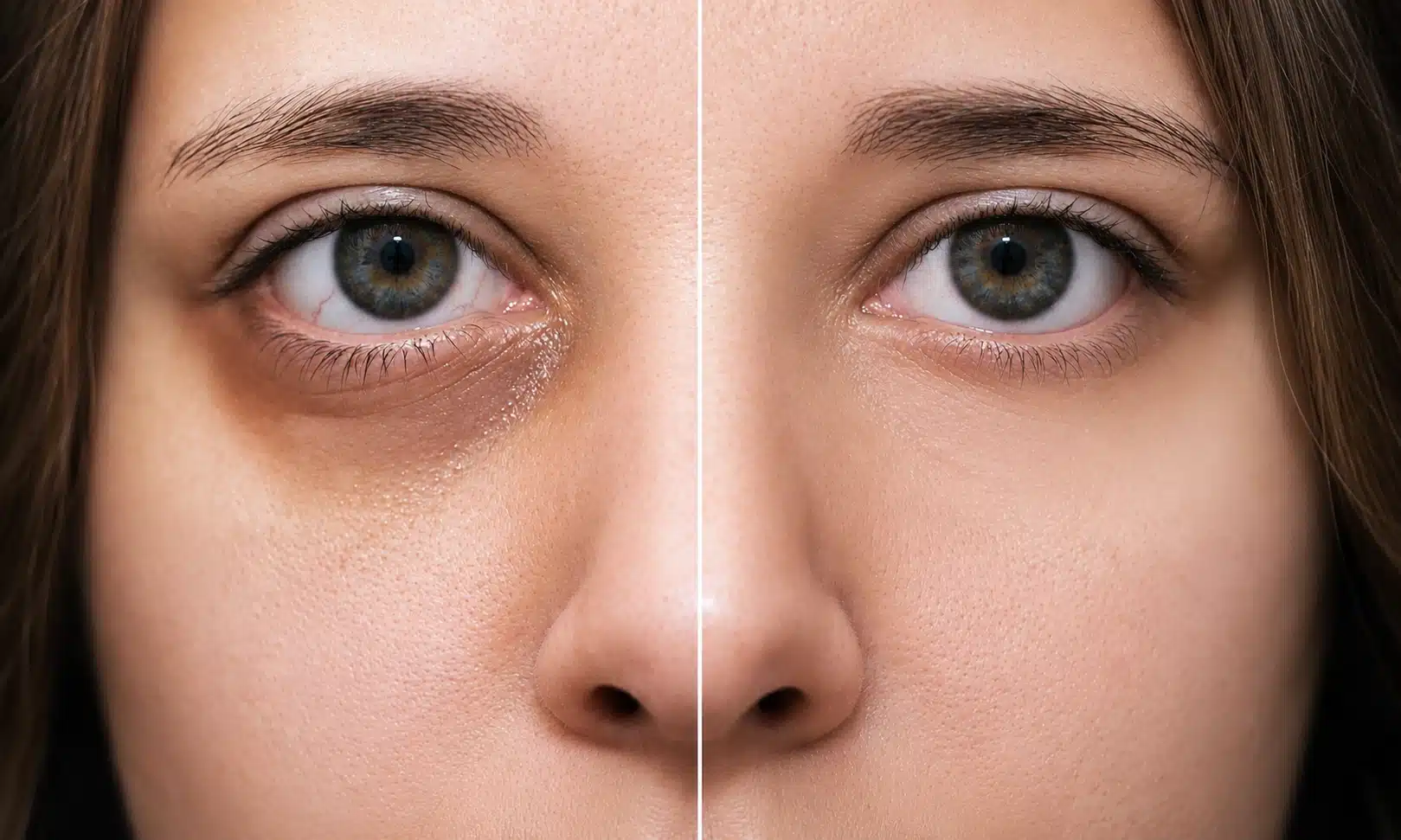
The Tyndall effect is a bluish or grayish tint that shows through the skin under the eyes when hyaluronic acid filler has been placed too close to the surface. It matters because under-eye skin is the thinnest skin on your body, which leaves almost nothing to hide the product behind, and because unlike a bruise this discoloration does not change color and does not fade on its own. It can sit there for as long as the filler does. The good news is that it is correctable, usually within a day or two, and it is almost entirely preventable with the right placement depth and the right product. Below we cover what the tint actually is, why the under-eye area shows it so readily, how to tell it apart from a bruise, what causes it, where filler belongs instead, how it is corrected, who should skip under-eye filler altogether, and what to ask before anyone injects you.
What Is the Tyndall Effect Under the Eyes?
The Tyndall effect under the eyes is a bluish or grayish discoloration that appears when light interacts with hyaluronic acid filler sitting too close to the skin surface. The name comes from John Tyndall, the 19th-century physicist who described how light scatters when it passes through particles suspended in a clear medium. Shorter wavelengths scatter most, and blue sits at the short end of the visible spectrum, scattering roughly ten times more than red through small particles. The same physics is the textbook explanation for why the sky looks blue.
Applied to aesthetics, the theory goes like this: a transparent gel deposited just under translucent skin scatters the light reaching it, the blue component scatters hardest, and the surface takes on a cool tint. It is the explanation nearly every clinic gives, and it is the one Google’s own summary of this topic repeats.
Whatever you call it, the appearance is distinctive and it is tied to filler rather than to injury. It shows up where product was placed, it stays put, and it does not behave like anything else that happens after injectable treatments. That combination is what makes it recognizable.
Why Does Under-Eye Skin Show Filler So Easily?
Under-eye skin shows filler so easily because it measures roughly 0.5 millimeters thick, making it the thinnest skin on the body and about four times thinner than the skin on your cheek. Thin skin is translucent skin. Anything sitting beneath it, including blood vessels, pigment and misplaced product, reads through to the surface instead of being hidden by the tissue above.
Translucency is only half the problem. The tear trough also has minimal subcutaneous fat, and in many people that layer is absent entirely, so there is no padding between the skin and whatever is deposited below it. Padding is exactly what camouflages filler everywhere else on the face, which is why the same product in the same hands can look seamless in a cheek and visible under an eye.
Movement compounds both. Your eyes blink somewhere around 15,000 to 20,000 times a day, and that constant motion, combined with facial expression and sleep position, works on anything placed superficially in this zone. The periorbital region also carries a dense network of small blood vessels, which is a separate reason that shallow placement here is the wrong instinct. Patients weighing their under-eye treatments tend to focus on which product to choose, when the anatomy is really arguing about depth.
Is the Blue Tint Really the Tyndall Effect?
The blue tint may not be the Tyndall effect at all, because a 2014 paper in Ophthalmic Plastic and Reconstructive Surgery concluded that the Tyndall effect is unlikely to cause dermal hue changes after hyaluronic acid placement. Rootman, Lin and Goldberg at UCLA’s Jules Stein Eye Institute examined the relevant optical principles directly and found the physics does not hold up. Their argument has two parts and both are worth knowing.
First, skin filters light on the way in. Shorter wavelengths are selectively absorbed and scattered at superficial depths, so very little blue light ever reaches filler sitting below the dermis. Little blue light reaching the filler means little blue light available to be scattered back. Second, the same filtering works in reverse. Any blue generated down there has to travel back out through the same tissue that filtered it going in, which makes it poorly detectable to anyone looking at the face.
Their alternative explanation is the one already used for veins. A vein is not blue, yet it looks blue, and that appearance comes from three things working together: how skin reflects light, how blood absorbs it, and how human vision interprets the contrast. Subdermal filler, the authors suggest, may simulate those same processes. Aesthetic practice guidance published in the Journal of Clinical and Aesthetic Dermatology reflects this uncertainty too, describing the scattering explanation as postulated rather than settled.
None of this changes what you should do about it. The name is debated and the cause is not. Product placed too shallow under thin skin produces a visible discoloration, product placed deep enough does not, and the correction is the same either way. We include the science because a clinic that can explain where the consensus is soft is a clinic that has actually read the literature.
Is It a Bruise or the Tyndall Effect?
It is the Tyndall effect rather than a bruise if the discoloration does not change color, does not fade within two weeks, and is not tender to the touch. Color change is the clearest tell. A bruise is blood outside a vessel, and your body breaks that blood down through a predictable sequence from purple to green to yellow as it clears. Filler discoloration has no blood in it and therefore no sequence to run through.
The comparison below draws on published filler complication literature, including the management protocols described by Urdiales-Gálvez and colleagues and the complication guidance published in the Journal of Aesthetic Nursing.
| Feature | Tyndall Effect | Bruise | Swelling |
|---|---|---|---|
| Color | Bluish, grayish or slightly purple, and stable | Purple, turning green then yellow | Usually no color, sometimes pink |
| Onset | Gradual, and can appear days or weeks later | Immediate or within hours | Immediate or within hours |
| Duration | Persistent, often as long as the filler lasts | Resolves in 7 to 14 days | Fades in a few days |
| Sensation | Painless | Tender or sore | Tight or full |
| What resolves it | Dissolving the filler, or waiting out its full lifespan | Time | Time |
Onset is the detail that catches people out most often. Because the tint can surface days or even weeks after an appointment, plenty of patients assume it cannot be related to a treatment they had a month ago. It usually is, and the location tells you so, since the discoloration maps onto exactly where product was placed.
One thing in this family is urgent and should never be confused with the rest. Severe pain, skin blanching to white, or vision changes after filler point toward a vascular complication rather than a cosmetic one, and that needs same-day medical attention. A painless blue tint is not that.
What Causes the Tyndall Effect After Filler?
The Tyndall effect is caused by hyaluronic acid filler sitting in a plane too superficial for the skin covering it, usually through placement depth, product choice, volume or individual anatomy. Placement depth leads the list in every published account of this complication. The other factors raise or lower how much margin for error that depth decision has:
- Superficial injection: product deposited in the dermis or just beneath it, where translucent skin cannot conceal it. This is the single most common cause
- Product selection: fillers built for deep structural support are too firm and too particulate for this zone, and highly hydrophilic products draw in water and swell where swelling shows most
- Overfilling: too much volume in a tight compartment has nowhere to go, so some of it is pushed upward toward the surface regardless of where it started
- Large bolus deposits: a single concentrated deposit creates a dense pocket rather than a thin even layer, which is more visible than the same volume spread properly
- Individual anatomy: very thin, fair or translucent skin shows product that thicker skin would hide, even when technique is sound
- Treating the wrong problem: hollowing driven by mid-face descent rather than a true tear trough deficit tempts an injector to chase the shadow with product placed where the shadow is instead of where the support is missing
Hyaluronic acid is hygroscopic, which is worth isolating because it explains a complaint that is not quite the same thing. Hygroscopic means it draws water into the tissue around it, and tissue that holds water in the tear trough looks puffy rather than corrected. A product that behaves beautifully in a cheek can do that here purely because of where it sits.
Where Should Under-Eye Filler Be Placed?
Under-eye filler should be placed in the deepest plane, directly on the orbital rim bone beneath all the soft tissue layers above it. Clinicians call this the supraperiosteal plane, meaning on top of the periosteum, the membrane covering the bone. Filler placed there sits below everything that could reveal it, provides support from the foundation upward, and stays invisible.
The under-eye area has four layers, and each one answers the placement question differently:
- Epidermis, the outer surface. Filler never belongs here. It would be visible immediately and would create texture irregularities rather than smoothness
- Dermis, divided into a superficial papillary layer and a deeper reticular layer. This is where the discoloration comes from. Product in the superficial dermis sits directly beneath translucent skin with nothing to hide it
- Subcutaneous fat, which is thin here and often absent in the tear trough itself. Some products can go in the deeper part of this plane, but only after an honest assessment of how much tissue a given face actually has
- Supraperiosteal plane, on the orbital rim bone. The target. Deep enough to be concealed, structurally useful, and the plane that keeps a dermal filler doing its job without announcing itself
Notice how narrow that stack is. All four layers together occupy a few millimeters, which is why under-eye injection is a precision procedure rather than a quick add-on at the end of an appointment.
Cannula or Needle for the Tear Trough?
A cannula is a blunt-tipped instrument that enters through a single small point and glides beneath the tissue rather than puncturing through it at every deposit. Gliding beneath the tissue means fewer entry points, less bruising, and a lower chance of entering a vessel in a region packed with them. Experienced injectors do use needles here successfully, so this is a preference rather than a rule, but the preference leans one way for good anatomical reasons.
What Makes a Filler Safer for the Under-Eye Area?
A filler is safer for the under-eye area when it has low viscosity, high cohesivity and low water-attracting behavior, so it integrates smoothly, holds its shape and does not swell. Those three properties matter more than any brand name, and they are the vocabulary worth taking into a consultation.
Low viscosity means a softer, more pliable gel that spreads into tissue without forming visible edges or firm lumps. High cohesivity means the product holds together as a unit rather than migrating or dispersing unpredictably, which keeps it where it was placed. Low hydrophilicity means it attracts a modest amount of water instead of a dramatic amount, which is the difference between a subtle correction and a puffy one in an area where even minor swelling is obvious.
Products built for deep structural lift sit at the opposite end of all three scales, which is exactly why they work in a cheek or a jawline and fail here. We carry several hyaluronic acid families, including the RHA fillers, and we select from them by matching these properties to the zone rather than by using one product everywhere.
What Is the Riskiest Place for Fillers?
The riskiest places for fillers are the tear trough, the glabella between the brows and the nose, because all three combine thin tissue with dense or critical blood supply. The tear trough earns its place through thinness and the absence of a fat pad to hide product. It is the zone where visibility problems concentrate.
The glabella and nose are risky for a different reason. Both sit along vascular pathways connected to the eye, which is why the rare but serious complications in filler literature are associated with those areas. Grouping all three as high-risk is useful shorthand, but the risks are not the same kind of risk, and a provider who treats them as interchangeable has not thought about it carefully.
The common thread is that every one of these zones punishes a routine approach. A provider who runs the same depth, product and volume across a whole face will eventually run into trouble in one of them.
How Long Does Under-Eye Filler Last?
Under-eye filler lasts roughly 12 to 18 months when placed correctly in the deep plane, which is longer than lip filler and slightly shorter than structural cheek filler. Constant movement from blinking and expression gradually metabolizes hyaluronic acid, which is why this zone sits where it does on that scale.
Filler does not vanish on a deadline. It softens progressively, so the change is gradual enough that most people notice it as a slow return of shadow rather than a sudden loss. Many patients plan a reassessment before the product has fully metabolized, which keeps results consistent and avoids starting from scratch each time. Anyone dealing with broader facial volume loss rather than an isolated tear trough deficit should expect a different maintenance rhythm, since the mid-face usually drives what the under-eye looks like.
How Long Does It Take for the Tyndall Effect to Go Away?
The Tyndall effect does not go away on its own until the filler itself has metabolized, which can take 12 to 18 months and sometimes longer. Metabolizing is the only natural exit route, because nothing about the discoloration resolves independently of the product creating it. There is no healing process to wait out the way you would with a bruise.
Waiting is a legitimate choice if the tint is faint and genuinely does not bother you. It is a poor choice if it does bother you, since you would be accepting a visible cosmetic problem for a year or more when the alternative takes a day or two. Most people who find this article have already decided which camp they are in.
How Is the Tyndall Effect Treated?
The Tyndall effect is treated by dissolving the hyaluronic acid filler with hyaluronidase, an enzyme that breaks down hyaluronic acid and typically clears the discoloration within 24 to 48 hours. Hyaluronidase is not new or experimental. It has been used in general medicine since 1949 and has become the standard tool for reversing hyaluronic acid filler in aesthetic practice.
The sequence is straightforward. A clinician injects a small amount into the affected area, the enzyme breaks down the product over the following day or two, the area is reassessed, and the process is repeated if a trace remains. A skin test is routinely performed beforehand to rule out allergic reaction, since that is the one uncommon risk worth screening for. Mild redness or swelling at the injection site is the usual extent of the side effects.
Timing afterward matters as much as the dissolving itself. Tissue needs a few weeks to settle before anyone evaluates what is actually there, so retreatment is generally planned for two to four weeks later rather than the same visit. Rushing back into a treated area is how one correction becomes two.
Can It Be Corrected Without Dissolving Everything?
It can often be corrected without dissolving everything, because hyaluronidase can be targeted at the superficial deposit while correctly placed deeper product is left in place. Some clinicians use ultrasound guidance to see exactly where product sits before injecting, which makes that selectivity far more precise than treating by feel. When discoloration is caught in the first days after treatment, firm massage or careful aspiration sometimes disperses a shallow deposit before dissolving becomes necessary. Any of these decisions belong to the clinician evaluating the area in person rather than to a plan made in advance.
Do Fillers Age You Over Time?
No, fillers do not age you over time, because hyaluronic acid is metabolized by the body and leaves the tissue it occupied in the condition it found it. Metabolized means broken down and cleared, not left behind as residue that damages anything. The fear usually comes from watching faces that look overfilled, and overfilling is a decision about volume rather than a property of the product.
What does happen is that your face keeps aging on its own schedule while filler is in place. Bone remodels, fat compartments shift, and skin loses elasticity, so the face you return to when product fades is genuinely a year or two older than the one you started with. That can feel like the filler caused the change when it simply stopped masking it. Reviewing your injectable options periodically rather than repeating the same plan indefinitely is the sensible response.
Who Is Not a Good Candidate for Under-Eye Filler?
You are not a good candidate for under-eye filler if you have very thin skin with almost no subcutaneous tissue, significant under-eye bags from herniated fat, or hollowing driven mainly by mid-face descent rather than a true tear trough deficit. Herniated fat is the clearest case. Adding product beneath a bulge makes the whole area fuller rather than smoother, and surgery that repositions the fat addresses both the bulge and the hollow at once.
Very thin skin is a judgment call rather than an absolute exclusion. Some faces show product no matter how correctly it is placed, and an honest assessment says so before treatment instead of after. Mid-face descent is the third pattern and the most commonly missed, since restoring support higher up often reduces the shadow enough that little or no tear trough product is needed.
Active infection or inflammation in the area, a history of serious reaction to hyaluronic acid products, and recent lower eyelid surgery all push treatment later rather than ruling it out permanently. At our Bingham Farms practice these conversations happen before anything is scheduled, because the under-eye area is the last place to find out mid-appointment that the plan was wrong.
What Can I Do Instead of Under-Eye Fillers?
Instead of under-eye fillers you can use regenerative injectables, skin quality treatments, muscle stimulation and prescription options that improve the area without placing gel beneath thin skin. Regenerative approaches are the closest substitute in spirit, since they add volume and tissue quality rather than a transparent product that light can find.
Biofiller made from your own blood is one route. EZ Gel biofiller is prepared from your own plasma into a gel that supports volume while stimulating your tissue rather than simply occupying space, and because it is not a clear synthetic gel it does not create the same optical problem.
Platelet-based treatments work on the same principle with a different emphasis. Platelet-rich fibrin releases growth factors into the area gradually, improving skin quality and tone under the eye over a series of sessions. Results build rather than appear, which suits patients whose complaint is crepiness and dullness more than hollowing.
Muscle and support structures are a third angle entirely. Emface Eyes works on the tissue around the eye without any injection at all, which makes it a reasonable starting point for anyone who wants improvement without product.
How to Plump Under Eyes Without Fillers
You plump under eyes without fillers by improving the quality and thickness of the skin itself rather than adding volume beneath it. Collagen-stimulating and hydrating treatments thicken and firm thin under-eye skin over time, which reduces translucency and softens shadow at the source. Medical-grade skincare with retinoids and peptides supports the same change more slowly. For eyes that look tired because the upper lid sits low rather than because the lower lid is hollow, Upneeq addresses a completely different mechanism, and no amount of under-eye product would have fixed it.
What Is the Ideal Age to Get Under-Eye Fillers?
The ideal age for under-eye fillers is the mid-thirties through the fifties, when volume loss has become visible but the skin still has enough thickness and elasticity to conceal product well. Visible volume loss is the real criterion rather than a birthday, and plenty of people in that range never need it while others outside it do.
Younger patients often have hereditary shadowing rather than volume loss, and shadowing from pigment or from the natural shape of the orbital rim does not respond to filler the way a hollow does. Treating it anyway is one of the more common routes to disappointment in this area. Older patients face the opposite issue, since thinner skin and reduced elasticity narrow the margin for concealing product and often mean restoring volume in the mid-face first produces a better result than treating the tear trough directly.
How We Prevent the Tyndall Effect
We prevent the Tyndall effect by assessing the tissue before choosing anything, placing product in the deep supraperiosteal plane, selecting by product property rather than habit, and treating conservatively across more than one visit. Assessment comes first because every later decision depends on it, including the decision not to treat.
Our assessment looks at how thick and translucent the skin is, how much subcutaneous tissue sits beneath it, whether the hollow is a true tear trough deficit or a shadow cast by mid-face descent, and what any previous treatment left behind. Previous treatment matters more than patients expect, since product placed elsewhere changes what the area needs now.
From there we work deep, conservative and staged. Deep means on the bone rather than in the soft tissue above it. Conservative means small volumes, often in the range of a few tenths of a milliliter per side to start, placed incrementally rather than as a single deposit. Staged means reassessing after the area settles and adding only if it is still needed, which is almost always less than people expect at the first appointment. Patients across the Detroit metro come to us having been told that one visit should do everything, and that expectation is itself a risk factor. The rest of our injectable work follows the same logic, though nowhere else on the face is the margin this fine.
What to Ask Before Under-Eye Filler
Ask which tissue plane the filler will go into, which product will be used and why it suits thin skin, whether a cannula or needle will be used, and how much volume is planned. The plane question is the one that separates a specialist from a generalist, and the answer you want names the supraperiosteal plane or the orbital rim bone rather than describing the technique vaguely.
Four more are worth adding. Ask whether your hollowing is a tear trough problem or a mid-face problem, and listen for whether the answer distinguishes them at all. Ask what happens if you develop discoloration afterward and who would correct it. Ask whether a second visit is part of the plan rather than an upsell. And ask what would make you a poor candidate, because a provider who cannot name a single disqualifying feature has not thought about the question.
Frequently Asked Questions
Can the Tyndall Effect Happen Anywhere Other Than Under the Eyes?
The Tyndall effect can happen anywhere filler is placed superficially under thin skin, with the lip border, the fine lines around the mouth and occasionally the nasolabial folds being the other reported sites. The under-eye area dominates the reports because it combines the thinnest skin on the body with an absent fat layer. Anywhere the skin is thicker, the same depth error is usually hidden.
Can Non-HA Fillers Cause the Tyndall Effect?
Non-hyaluronic acid fillers do not cause the classic blue tint in the same way, because the effect is described in connection with transparent hyaluronic acid gels. Other product categories carry their own considerations, including the significant one that they cannot be dissolved with hyaluronidase if something goes wrong. Reversibility is one of the strongest arguments for using hyaluronic acid in high-risk zones.
Is Hyaluronidase Safe?
Hyaluronidase is considered safe and has been in medical use since 1949, with the most common side effects being mild redness, swelling or small bruises at the injection site. Allergic reaction is the rare exception, which is why a skin test is routinely performed first. It does also break down some of your own naturally occurring hyaluronic acid in the treated area, which your body replaces over the following weeks.
Can Makeup Cover the Tyndall Effect?
Makeup can partially cover the Tyndall effect using a peach or orange toned color corrector under concealer, since those tones sit opposite blue on the color wheel and neutralize it. Coverage works better in soft indoor light than in direct sunlight or flash photography, both of which tend to reveal what concealer is doing. It is a reasonable short-term measure rather than a solution.
How Soon Can You Have Filler Again After Dissolving?
You can usually have filler again two to four weeks after dissolving, once the tissue has settled enough to show what is genuinely there. Treating sooner means injecting into an area that is still changing, which makes the result difficult to judge and easy to overcorrect. Many people find they need noticeably less product the second time, particularly when the original plan involved too much.
What Is the Difference Between the Tyndall Effect and a Vascular Complication?
The difference is that the Tyndall effect is painless and purely cosmetic, while a vascular complication involves severe pain, skin turning white or mottled, and sometimes vision changes. A vascular complication is a medical emergency that needs same-day attention, and it presents during or shortly after treatment rather than weeks later. A blue tint that appeared a month after your appointment and does not hurt is not that.
The Bottom Line
The Tyndall effect is a bluish tint that shows through when hyaluronic acid filler sits too close to the surface of skin that is only about half a millimeter thick with no fat layer beneath it to hide anything. It does not change color, it does not fade like a bruise, and left alone it can stay for the 12 to 18 months the filler lasts. Interestingly, the physics behind the name is contested, with research from UCLA’s Jules Stein Eye Institute arguing that light scattering does not adequately explain the hue and that the optics of vein coloration fit better. What is not contested is the cause or the fix. Product placed too shallow shows, product placed on the bone does not, and hyaluronidase clears the discoloration in a day or two when it has already happened.
If you are considering under-eye treatment, the questions worth asking are about plane, product and volume rather than about brand names, and the honest answer for some faces is that filler is not the right tool at all. We work across injectables, regenerative treatments and skin quality options at FACE Skincare, which means we have no reason to steer you toward one when another suits your anatomy better. If you want the area assessed properly, or you are living with discoloration from treatment done elsewhere, book a consultation and we will tell you plainly what we see.