No single treatment reliably makes you look 10 years younger, but a combined plan can come close. In a 2010 Dermatologic Surgery study, blinded dermatologists rated women 6.1 to 7.3 years younger after full-face hyaluronic acid filler. A 2012 rater study put surgery at 8.9 years younger. Filler, wrinkle relaxers, tightening, and resurfacing each fix one sign of aging.
Key Takeaways
- A combination plan, not one procedure, gives the widest change in apparent age.
- Full-face hyaluronic acid filler lowered apparent age by 6.1 to 7.3 years in a small 2010 study.
- Botox Cosmetic smooths movement lines, while Ultherapy lifts sagging skin, so the two treat different problems.
- Laser resurfacing is the most effective tightening procedure, per the American Academy of Dermatology (AAD).
- A 2010 review found fillers, peels, lasers, and light-based treatments useful on their own in women over 65.
What Treatment Makes You Look 10 Years Younger?
The answer is a combination plan of filler, wrinkle relaxers, tightening, and resurfacing, not one procedure. Studies report apparent age drops of roughly 4.6 to 9 years. Each treatment in the plan fixes a different sign of aging.
Wrinkle relaxers soften movement lines, filler restores lost volume, and ultrasound or radiofrequency lifts loose tissue. Lasers then refine texture and spots. A facial rejuvenation plan links these steps in the right order.
The 2010 filler study treated 10 women with 6 to 8 mL of hyaluronic acid. Three blinded dermatologists rated each woman’s age from photographs. They reported 6.1 years younger at 2 weeks and 7.3 years younger at 4 weeks.
The graphic below shows the three studies behind these numbers.
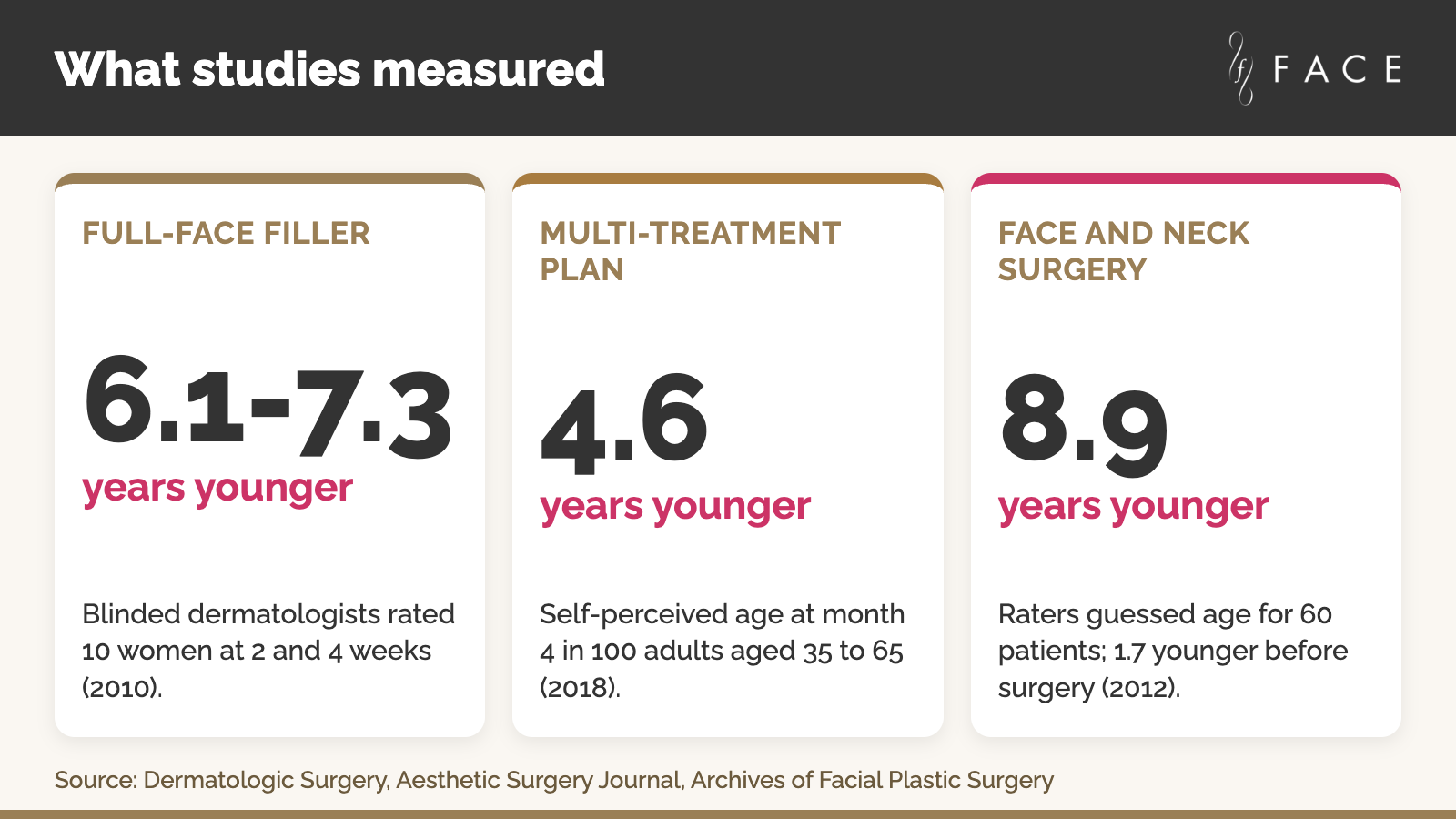
The HARMONY study followed 100 adults aged 35 to 65 who received fillers, onabotulinumtoxinA, and bimatoprost. Self-perceived age moved from 0.2 years older than actual age to 4.6 years younger at month 4, per the Aesthetic Surgery Journal.
A 2012 study of 60 aging-face surgery patients used raters to estimate age. Raters guessed patients were 1.7 years younger than real age before surgery and 8.9 years younger after. The largest change came after a face and neck lift combined with eyelid and forehead lifts.
The phrase “10 years younger” is a rater estimate, not a measurement of skin. Raters judge photographs, and patients judge their own mirrors. Both views matter, but they differ.
These studies used different methods and small groups, so the numbers cannot be added together. Results also vary with skin, age, and starting point. The next section turns the evidence into steps.
How to Take 10 Years Off Your Face?
Take 10 years off your face by treating each sign of aging in order: sun damage, lines, volume, laxity, then texture. Each step builds on the one before it. The list below follows that order.
- Protect skin daily with a broad-spectrum sunscreen of SPF 30 or higher, reapplied every two hours outdoors, per WebMD.
- Add a retinoid, which WebMD calls the most proven medical treatment for wrinkling, roughness, and uneven pigmentation.
- Relax movement lines with a neuromodulator such as Botox Cosmetic. The FDA label lists forehead lines, frown lines, crow’s feet, and neck bands.
- Restore lost volume with volume fillers placed in several areas of the face.
- Lift sagging tissue with ultrasound or radiofrequency (RF) energy.
- Resurface rough or spotted skin with a laser or chemical peel.
Order matters because each step changes what the next step has to do. Relaxed muscles make filler placement easier to judge, and lifted tissue makes resurfacing results look smoother. Creams cannot replace the middle steps. The AAD states that skin-firming creams give subtle results at best because a cream cannot reach deep enough to lift sagging skin.
The lifting step raises the next question, because speed matters to many people planning an event.
What Tightens Skin Immediately?
Radiofrequency tightens skin immediately for some people, according to the AAD. The AAD notes that most people have one RF treatment and feel some tightening right away. Full results take about 6 months as the body builds new collagen.
Results from RF can last 2 to 3 years with the right skin care, per the AAD. Some people benefit from more than one session. A RF tightening guide explains how the energy reaches the deeper layers.
Ultrasound works more slowly. The AAD reports modest lifting and tightening within 2 to 6 months after one treatment. Non-ablative lasers need 3 to 5 treatments, with results appearing between 2 and 6 months after the last one.
Most non-invasive procedures take 1 hour or less, and makeup can often be applied right after, per the AAD. The graphic below lays out when each treatment shows results.
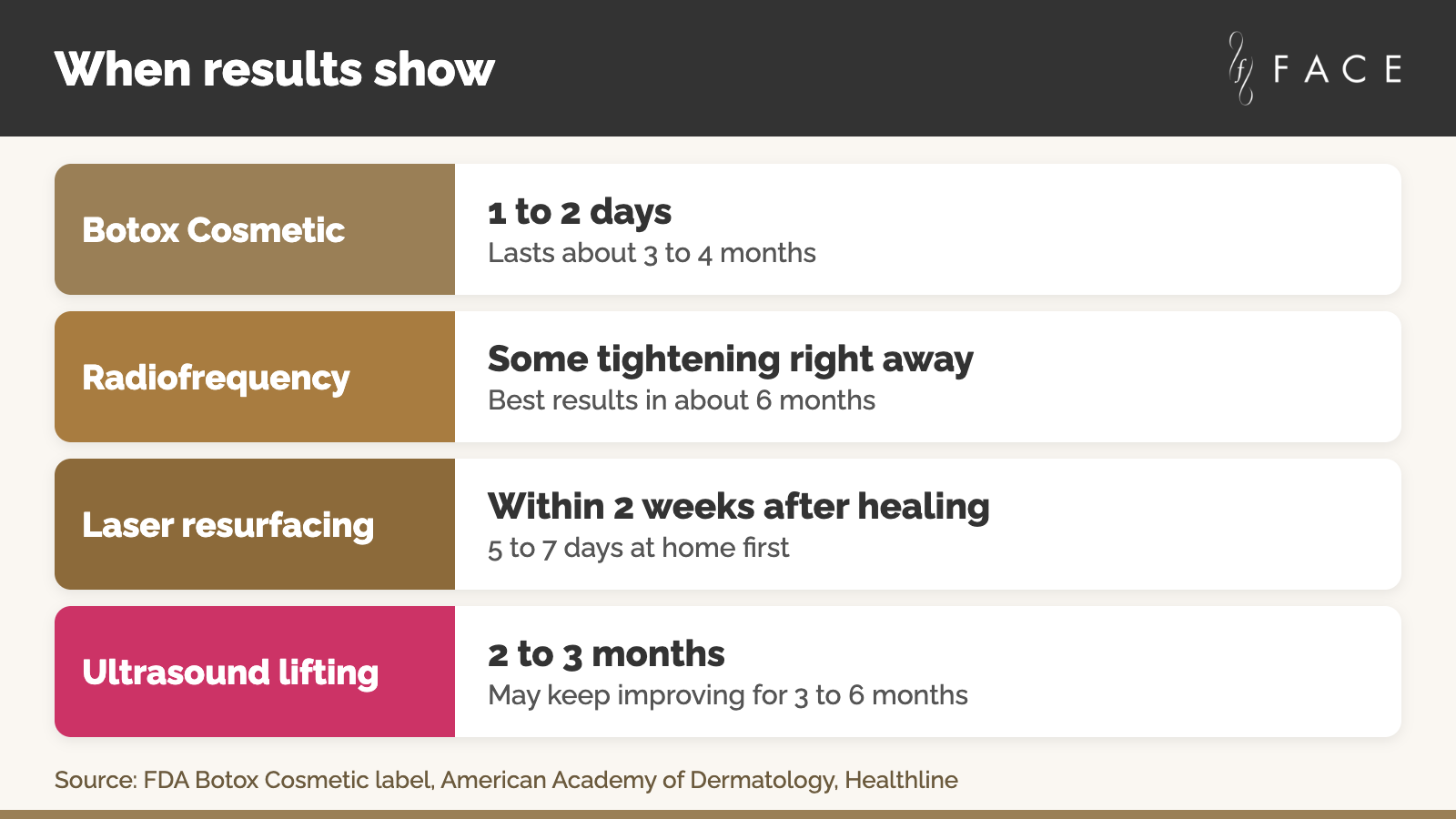
Immediate tightening and lasting lift are different goals. The comparison between Botox and Ultherapy shows why.
Which Is Better Botox or Ultherapy?
Neither is better, because Botox smooths movement lines while Ultherapy lifts sagging skin. The right choice follows the sign of aging. Many plans use both.
The table shows the main difference first: Botox acts on muscle movement, and Ultherapy acts on collagen. Sources for the figures are the FDA Botox Cosmetic label and Healthline’s review of Ultherapy.
The FDA label reports that frown-line severity stayed lower than placebo for up to 120 days. Retreatment in the label studies took place at day 120. Wrinkle relaxers such as neuromodulator injections therefore need repeat visits to hold results.
Ultherapy is FDA-cleared for brow, neck, and under-chin lifting, per Healthline. A 2014 study found skin laxity improved at 3 months in 58.1 percent of 93 people. Ultherapy results may keep improving for 3 to 6 months, and ultrasound lifting may need a yearly repeat.
Both treatments leave volume loss untouched. Resurfacing handles a different concern, so the next section compares the options.
What Is the Best Facial Resurfacing Procedure?
No single resurfacing procedure suits every face, but laser resurfacing is the most effective procedure for tightening loose skin, per the AAD. Peels offer a gentler path with less dramatic change. The choice follows skin concerns and downtime.
Facial resurfacing removes the top layer of skin and parts of the middle layer, per Nebraska Medicine. The process also triggers new collagen. Skin takes 5 to 10 days to heal on average.
The AAD lists 5 to 7 days at home after laser resurfacing. Tightening and fewer wrinkles appear within 2 weeks after healing. A CO2 laser results article shows what that change looks like.
Chemical peels come in light, medium, and deep strengths. Light peels heal faster but give less dramatic results than deep peels, per Nebraska Medicine. Peels suit pigment and fine wrinkles, while lasers add precision and collagen heating.
WebMD lists carbon dioxide (CO2), erbium, and fractional lasers as the main resurfacing methods. Each method uses intense light to remove the outer skin layer and boost collagen. A provider matches the laser type and number of sessions to wrinkle depth and skin tone.
Resurfacing prepares skin for the last question, which concerns age and expectations.
What Is the Best Cosmetic Procedure for a 70 Year Old Woman?
No single cosmetic procedure fits every 70 year old woman. Dermal fillers, peels, lasers, and light-based treatments each work on their own, per a 2010 dermatology review. That review of women over 65 also reports that wrinkle relaxers are more often combined with other procedures.
The answer to what treatment makes you look 10 years younger shifts with age. Older skin has lost more volume and firmness. The review authors note little scientific evaluation of aesthetic procedures in women over 65. Women in this age group differ from younger women. Evidence limits mean a provider should set goals after a skin and health review.
Surgery gives the strongest lift. The AAD says a facelift or eyelid surgery gives the most dramatic results, while other options offer less downtime and lower cost. A full-face rejuvenation visit can compare both paths.
Good candidates for non-surgical tightening keep a healthy weight and avoid smoking, per the AAD. They also protect skin from the sun and have little sagging. Large amounts of loose skin may not respond. Preparation improves any plan, as the next section explains.
How Should You Prepare for These Treatments?
Prepare for facial treatments by starting daily sun protection and a provider-approved skin routine before the visit. Nebraska Medicine notes that prep creams used days ahead can quicken healing after resurfacing. Providers also review medications and health history first.
- Wear SPF 30 or higher every day.
- Share all medications and supplements with your provider.
- Plan 5 to 7 days at home for laser resurfacing.
- Skip makeup on healing skin until your provider approves it.
Skin type, health history, and past treatments all shape the plan. A provider checks the face in motion and at rest, then sets realistic goals. Photos taken at the first visit give a fair baseline for later comparison.
Visits for non-invasive tightening or injections need little planning. The AAD says most take an hour or less. Extra detail on timing and upkeep appears in the next section.
What Else Should You Know About Looking Younger?
How Long Do Younger-Looking Results Last?
Younger-looking results last from about 3 months to 3 years, depending on the treatment. Botox Cosmetic lasts about 3 to 4 months per the FDA label. FDA lists hyaluronic acid filler effects at about 6 to 12 months and calcium hydroxylapatite at about 18 months.
Poly-L-lactic acid filler builds over several months and may last up to 2 years, per the FDA. Learn the specifics of Botox timing before planning visits. Ultherapy can last about a year, and RF can last 2 to 3 years.
Repeat sessions keep a plan on track. A guide to filler durability helps set a realistic calendar.
Can Skincare Alone Make You Look Younger?
Skincare alone gives subtle change, not a 10-year shift. The AAD says creams cannot lift sagging skin. WebMD names retinoids as the most proven medical option for fine lines and roughness.
A retinol guide explains how to start gently. Daily sunscreen protects the gains from every other treatment.
Should You Treat the Neck Too?
Treat the neck too, because neck skin ages from the same causes as facial skin. WebMD links neck wrinkles to sun damage, smoking, and bending the head over screens. Retinoids and hyaluronic acid skincare also work on the neck.
A review of neck aging options covers lifting choices for the area below the jaw.
How Does FACE Medspa Help You Look Younger?
FACE Medspa builds a step-by-step plan that pairs injectables, tightening, and resurfacing around your goals. We start with a skin review, then set an order and a schedule. Our providers explain what to expect before any treatment begins.
Patients from Bloomfield Hills and nearby towns visit the FACE Medspa office for a consultation. We discuss timelines honestly and never promise a set number of years. Our answer to what treatment makes you look 10 years younger starts with listening to your goals.