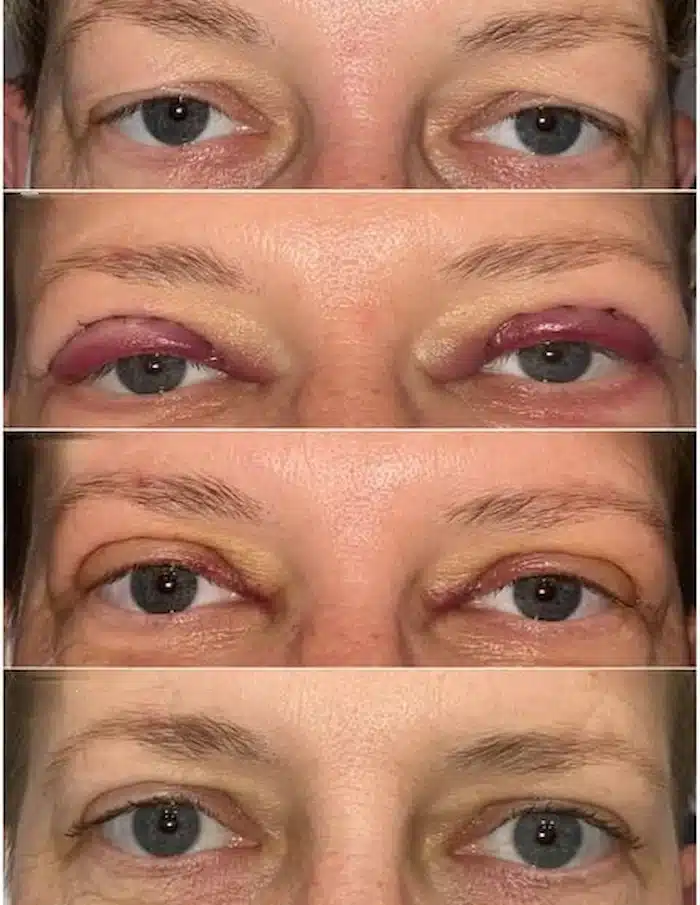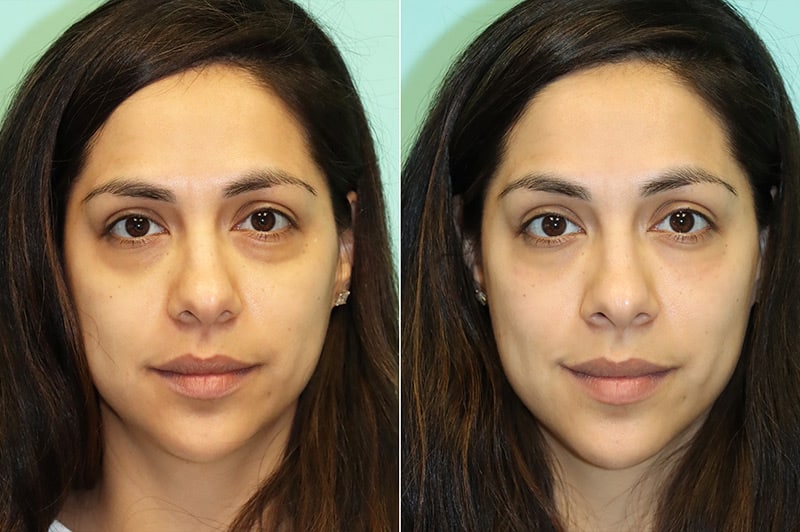
Under-eye filler for hollow eyes restores lost volume in the tear trough groove, which removes the shadow that reads as a dark circle and smooths the abrupt transition between the lower eyelid and the cheek. It matters because a hollow is a structural problem rather than a skin problem, and that distinction decides whether any treatment will work for you. Some hollows come from bone and fat changes that began in your thirties. Some you were born with. Some are not really under-eye problems at all, but cheek problems casting a shadow upward. Below we cover what creates a hollow, how to tell which kind you have, why the darkness is usually a shadow rather than pigment, why the cheek beneath often decides whether tear trough filler works, when filler is the wrong answer, and what else can fill a hollow.
What Causes Hollow Under Eyes?
Hollow under eyes are caused by bone recession around the eye socket, downward movement of the midface fat pads, inherited facial structure, and lifestyle factors that accelerate volume loss. Most people have more than one of these working at once, which is why two people the same age can have very different under-eye areas. Here is what contributes:
- Bone recession: facial bone regeneration slows after roughly age 35, and the eye socket gradually widens as the bony rim recedes. The structural scaffold holding everything forward quietly retreats
- Fat pad descent: the midface fat compartments that once sat high and full drop and thin, which separates the lower eyelid from the cheek and opens a groove between them
- Genetics: some people inherit a deep-set eye socket or a naturally pronounced tear trough and have had the same shadow since their teens
- Sun exposure: ultraviolet damage breaks down collagen in skin that measures about half a millimetre to begin with, thinning it further and making what sits underneath more visible
- Smoking: affects the skin internally and externally, accelerating collagen loss and the volume depletion that follows
- Weight loss: significant or rapid loss takes facial fat along with body fat, and the face is often where people notice it first
Notice that four of those six describe things happening below the skin rather than in it. That is the whole reason creams and concealers disappoint people with hollows, and it is also why addressing facial volume loss usually means replacing structure rather than treating the surface.
Are Hollow Eyes Genetic or Age-Related?
Hollow eyes are genetic when the shadow has been there since your teens or twenties, and age-related when it appeared gradually and has deepened over the last several years. The timeline is the simplest way to tell, and it matters because the two behave differently over time.
Genetic hollowing comes from the shape of the bone. Deep-set eyes sit further back in the socket, which means the brow and the orbital rim project forward relative to the eye itself and cast a shadow regardless of how much fat or collagen you have. People with deep-set eyes are frequently told they look tired from adolescence onward, which is both unfair and anatomical. Nothing has been lost here, so there is nothing to restore. The question is whether the groove can be softened rather than whether anything can be replaced.
Age-related hollowing is loss. Bone has receded, fat has descended, and the result is a deficit where there used to be fullness. It tends to progress, and treatment restores something that genuinely used to be there.
The two often overlap. Someone with naturally deep-set eyes who then loses midface volume in their forties has both, and the plan has to address the loss while respecting the structure that was always there. Treating inherited depth as though it were a deficit is one of the easier ways to end up overfilled.
Why Do Hollow Eyes Look Like Dark Circles?
Hollow eyes look like dark circles because a groove in the skin casts a shadow, and the eye reads that shadow as discolouration even though the skin colour has not changed. A shadow sitting in a depression behaves exactly like a shadow anywhere else, which is why under-eye darkness often looks worse under overhead lighting and better when light comes from below.
Pigment is a separate cause producing a similar appearance. Melanin in the skin, visible vessels showing through thin tissue, and post-inflammatory discolouration all darken the area without any groove being involved. Plenty of people have both, which is why treatment sometimes improves the area substantially without clearing it completely.
There is a reliable test you can do before you book anything. Stand in front of a mirror in good light and tilt your head up so light falls directly into the under-eye area. If the darkness lightens or disappears as light fills the hollow, you are looking at a shadow and filler can help. If the colour stays exactly where it was, you are looking at pigment and no amount of volume underneath will change it. We go through the full range of under-eye treatments for the pigment side separately, since those need brightening or light-based approaches rather than volume.
Does Under Eye Filler Work for Hollow Eyes?
Yes, under-eye filler works for hollow eyes when the hollow is genuinely a volume deficit and the cheek beneath it provides enough support to hold the product. Both halves of that sentence are conditions, and the second one is the half most people have never heard.
The mechanism is straightforward. Hyaluronic acid gel placed deep along the orbital rim fills the depression, the depression stops casting a shadow, and the transition from lower lid to cheek becomes a gradual curve rather than an abrupt ledge. Results are visible immediately, swelling settles over one to three weeks, and the final appearance is apparent by about the third week.
Clinical approval has caught up with the practice here. Select hyaluronic acid formulations now carry FDA approval specifically for improving infraorbital hollows in adults over 21, rather than being used off-label from approvals granted for other parts of the face. The material science behind why hyaluronic acid is the only category used here is worth its own discussion, and our injectable treatments page covers the product families we work with.
Do Under-Eye Fillers Make You Look Younger?
Under-eye fillers make you look more rested rather than younger, and the two read differently to the people around you. Rested is the honest description of the result, and it is also the more useful one, because a face that reads as rested gets a different response than one that reads as worked on.
What actually changes is the signal. Hollowing under the eyes is one of the most reliable visual cues of fatigue, which is why people with it are asked whether they slept badly on days they slept fine. Removing the shadow removes the cue. Most patients report that colleagues notice something has improved without identifying what.
Where the younger framing misleads is in scale. The change is intentionally subtle, and if someone who knows you well can immediately tell you have had something done, that usually means too much product rather than a good result. Treating the under-eye as a way to take years off tends to produce exactly the overfilled look people were hoping to avoid.
Why Cheek Support Decides Whether Tear Trough Filler Works
Cheek support decides whether tear trough filler works because product placed in the groove needs a structural shelf beneath it, and a deflated upper cheek provides no shelf. A shelf is the right word for it. The upper cheek sits directly below the tear trough, and it is what holds anything placed in the groove in position.
Without that support, two things go wrong. Product drifts from where it was placed, because there is nothing holding it, which is how migration happens in this area more than anywhere else on the face. And the correction looks puffy rather than smooth, because volume sitting in soft tissue with no foundation beneath it reads as a pillow rather than as a restored contour.
This is why a significant share of people who present asking for tear trough filler are better served by treating the cheek first. Restoring upper cheek volume lifts the tissue that was collapsing into the groove, which reduces the shadow at its source and often means very little tear trough product is needed afterward. The cheek takes a firmer product than the under-eye does, and it sits on bone rather than in thin tissue, which is why facial contouring in the midface follows different rules from anything done under the eye.
Asymmetry is worth checking here too, since a volume difference between one upper cheek and the other produces a hollow that looks like an under-eye problem on one side only. In our Bingham Farms practice this comes up often enough that we assess the cheeks before the trough as a matter of routine, not as an afterthought.
Can You Treat Hollows If You Also Have Mild Eye Bags?
Yes, you can treat hollows alongside mild eye bags, because filling the hollow next to a small bag makes the bag look smaller by comparison. The relationship is easier to picture geometrically. The hollow tear trough is a valley and the small bag beside it is a hill. Raising the floor of the valley makes the hill look considerably less prominent without touching the hill at all.
Blending the two is a legitimate and common approach, and it is why some people with slight puffiness are still good candidates despite reading elsewhere that bags rule filler out. The transition between the puffy area and the hollow is what the eye picks up, and softening that transition does most of the work.
The limit is real though. With larger bags caused by genuine fat prolapse, adding volume around the bulge raises the whole area and makes the bag more obvious rather than less. The valley gets filled and the hill is still a hill, only now the whole landscape sits higher. Judging where a case falls on that spectrum is the single most important assessment call in this area, and it is not something to decide from a photograph.
Does Hollowing Need a Different Approach in Older Skin?
Hollowing needs a more structural approach in older skin, because the deficit is usually bone and deep fat rather than a shallow groove, and the skin above it has less capacity to conceal product. Deeper deficit and thinner cover pull the plan in two directions at once, which is what makes older anatomy more demanding rather than simply more involved.
Practically, that means working from the foundation up. Volume placed at bone level in the midface addresses the recession driving the whole pattern, and it provides the support that any under-eye work then sits on. Treating the groove alone in a face that has lost structural volume more broadly tends to produce a corrected patch in an otherwise deflated landscape.
Collagen-stimulating approaches also become more useful with age, since they rebuild tissue over months rather than occupying space immediately. Sculptra works on that mechanism across the midface, and the gradual nature of the change suits patients who want the structural deficit addressed without an obvious before and after.
Is 60 Too Old for Fillers?
Sixty is not too old for fillers, and patients in their sixties and beyond are treated routinely. What changes is the planning rather than the eligibility. Skin is thinner, the volume deficit is usually larger, and skin laxity often accompanies it, so the plan tends to involve more structural work, more conservative placement under the eye itself, and realistic acknowledgement that filler does not tighten skin. A thorough assessment matters more at 60 than at 40, and the honest answer for some patients that age is that a surgical option would serve them better.
Which Is Better for Under Eyes, Botox or Filler?
Filler is better for under-eye hollows and Botox is better for lines created by muscle movement, because the two treat entirely different causes of the same tired appearance. Different causes is the key idea, and it is worth seeing the full map rather than just the two options in the question.
The table below matches each underlying cause of under-eye appearance to the category of treatment that actually addresses it, drawing on the published guidance across dermatology and oculoplastic practice.
| What is actually causing it | How it looks | What addresses it |
|---|---|---|
| Tear trough hollowing | A groove casting a shadow, worse under overhead light | Hyaluronic acid filler, after cheek support is assessed |
| Midface volume loss | Flat upper cheek with the hollow appearing to extend downward | Structural cheek volume or collagen stimulation |
| Pigmentation | Colour that stays when light falls directly on the area | Brightening treatments, lasers or light-based therapy |
| Fat prolapse (true bags) | A bulge pushing forward, often worse in the morning | Lower eyelid surgery; filler can worsen it |
| Dynamic lines | Creases that appear or deepen when you smile | Neuromodulator treatment |
| Skin laxity and crepiness | Fine crinkling and loose texture at rest | Energy-based tightening or regenerative skin treatments |
Reading the table down rather than across is the useful exercise, because most people arrive convinced they have one of these and turn out to have two or three. A plan that treats only the dominant cause often disappoints, and a plan that treats all of them at once tends to overcorrect. Sequencing is how experienced injectors handle it, and our approach to dermal filler work in this area always starts by naming which row applies.
On the specific comparison in the question, the two treatments are not really competitors under the eye. Muscle-driven creases at the outer corner respond to neurotoxins, hollowing responds to volume, and neither does the other’s job. Plenty of plans include both for different reasons.
When Hollow Eyes Should Not Be Treated With Filler
Hollow eyes should not be treated with filler when the darkness is pigment, when significant fat prolapse is present, when the midface lacks the support to hold product, or when the skin is too thin to conceal it. Four situations, and each one produces a worse appearance rather than no change, which is why they matter more than ordinary caution would suggest.
Pigment is the most common. Volume placed under pigmented skin does nothing to the colour and can draw more attention to the area by making it more prominent. Significant fat prolapse is the second, for the reasons covered earlier. Insufficient cheek support is the third, since product with nothing beneath it migrates or looks puffy.
Very thin, translucent skin is the fourth and the most individual. Some faces show product no matter how correctly it is placed, which can produce a bluish or greyish tint through the surface. That complication has its own prevention and correction story, which we cover separately, and the relevant point here is that it is a candidacy consideration rather than an unavoidable risk.
Active infection or inflammation in the area, and conditions or medications affecting healing and bleeding, delay treatment rather than ruling it out. None of these makes someone a lost cause, and most of them point toward a different treatment rather than toward nothing.
Why Fat Transfer Is Not the Answer for Hollow Eyes
Fat transfer is not the answer for hollow eyes because grafted fat is texturally unpredictable under thin eyelid skin and extremely difficult to remove if it does not settle well. Unpredictable is the operative word, since the appeal of fat is that it is your own tissue and the problem is that it stops behaving like your own tissue once it is moved.
Three issues drive this. Grafted fat loses its original blood supply, which makes its texture inconsistent, and inconsistent texture shows through skin measuring half a millimetre as lumps and irregularities. Absorption is unpredictable as well, with published data indicating anywhere from 30 to 70 percent of grafted fat may be lost, which frequently means a second procedure. And correction is surgical. Removing transferred fat from the lower eyelid is an intricate, costly operation, compared with dissolving hyaluronic acid gel in a few minutes with an enzyme.
That comparison is the entire argument for using a reversible gel in this location. The approach to restoring volume elsewhere on the face can tolerate materials that cannot be undone, because thicker tissue conceals irregularities and the stakes of a texture problem are lower. The lower eyelid tolerates nothing of the kind.
What Else Can Fill Hollow Eyes?
Hollow eyes can also be filled with preparations made from your own blood, which add volume while improving the quality of the tissue around them. Your own blood is the meaningful distinction, since these preparations are biological tissue rather than a clear gel, which changes how they behave optically under thin skin.
EZ Gel biofiller is prepared by processing your plasma into a gel that restores volume while the growth factors in it stimulate collagen and elastin in the surrounding tissue. Because it is not a transparent synthetic gel, it does not produce the light-scattering problems that come with product placed too close to the surface, and it suits faces where a conventional filler would be visible.
Platelet-rich fibrin works on the same principle with the emphasis on tissue quality rather than volume. It improves the thickness, texture and tone of lower eyelid skin across a series of sessions, which makes it the better option when the complaint is crepiness and dullness rather than a defined groove. It also pairs well with filler, since better skin quality above a correction makes the correction read more naturally.
For hollowing driven by broader midface deflation, biostimulation rebuilds structure gradually rather than placing volume immediately. The change arrives over months and what you are left with is your own tissue, which suits patients who would rather improve slowly than change visibly.
Is Getting Under Eye Fillers Worth It?
Under-eye filler is worth it when your darkness is a shadow from a true hollow and your midface supports the correction, and it is not worth it when either of those is missing. The conditional answer is the only honest one, because the same treatment produces an excellent result in one face and a disappointing one in another for reasons that have nothing to do with the injector.
When it works, it works well for the effort involved. The appointment runs around 30 to 45 minutes, there is no meaningful downtime, results are visible immediately and settle fully within one to three weeks, and most people get 6 to 12 months before the area needs revisiting. For a complaint that concealer manages badly and sleep does not touch, that is a reasonable trade.
When it does not work, the money is the smallest of the problems. Product in the wrong candidate produces puffiness, migration or a visible correction that then needs dissolving, which means two appointments to return to where you started. That asymmetry between a good outcome and a poor one is exactly why the assessment matters more than the injection.
How We Assess Hollow Eyes
We assess hollow eyes by identifying the cause before discussing any treatment, starting with whether the darkness is a shadow at all. Identifying the cause first sounds obvious and is routinely skipped, which is why so many people have been treated for the wrong thing. The sequence we work through:
- Test shadow against pigment. Examining the area under several lighting conditions and with the head tilted, since the answer determines whether volume is relevant at all
- Establish whether the hollowing is inherited or acquired. A groove present since adolescence is structural, and one that appeared over five years is a deficit
- Assess midface support before the trough. Checking whether there is a cheek shelf to hold product, and whether asymmetry between sides is coming from the cheeks
- Distinguish hollow from bag. Deciding whether any puffiness is slight enough to blend or substantial enough to rule filler out
- Measure skin thickness and translucency by hand. Thin, translucent skin narrows the options and shifts the plan toward smaller volumes or a regenerative route
- Review treatment history. Product placed anywhere in the midface previously changes what the area needs now
- Photograph in consistent lighting. So the result is judged against a record rather than against memory at the follow-up
- Build the plan from the foundation upward, and stage it. Structure first, refinement second, with a reassessment at two weeks before anything is added
Patients across the Detroit metro often arrive certain the problem is their under eyes, and a meaningful share of the time the assessment finds the driver sitting somewhere else on the face. Our injectable assessment exists to catch that before anything is placed, since the most expensive version of this treatment is the one performed on the wrong diagnosis.
Frequently Asked Questions
Can Hollow Eyes Be Fixed Without Filler?
Hollow eyes can be improved without filler using preparations made from your own blood, collagen-stimulating injectables and energy-based skin treatments, though none of these replaces volume as directly or as immediately. Regenerative approaches build tissue over months rather than filling a groove in minutes. For hollows driven mainly by thin, poor-quality skin rather than a deep deficit, they often produce the more natural result.
Do Hollow Eyes Get Worse With Age?
Hollow eyes generally do get worse with age, because the bone recession and fat pad descent that create them are progressive rather than one-time changes. Facial bone regeneration slows after around age 35 and the eye socket gradually widens from there. Inherited hollowing from deep-set eyes changes less, since its cause is the shape of the bone rather than the loss of anything.
Can Weight Loss Cause Hollow Eyes?
Weight loss can cause hollow eyes, because facial fat is lost alongside body fat and the midface is one of the first places the change shows. People who have lost weight quickly often notice under-eye hollowing that was not there a year earlier. In these cases the midface is usually the more productive place to start, since restoring the support that was lost addresses the hollow at its source.
Do Hollow Eyes Run in Families?
Hollow eyes do run in families, since the shape of the orbital rim and the depth of the eye socket are inherited traits. If you have had the same shadow since your teens and a parent has it too, you are looking at structure rather than loss. Inherited hollowing can still be softened, though the goal is modifying a shape rather than replacing something that disappeared.
How Soon Will Hollow Eyes Look Better After Filler?
Hollow eyes look better immediately after filler, with the final result visible at one to three weeks once swelling settles. The first few days can look slightly fuller than the eventual outcome, which is normal and not a sign that too much was placed. Judging the result in the first week is the most common reason people worry unnecessarily.
Can Hollow Eyes Come Back After Treatment?
Hollow eyes do come back after treatment, because hyaluronic acid is metabolised by the body over roughly 6 to 12 months and the underlying bone and fat changes continue regardless. Returning before the previous treatment has fully cleared usually means needing less product the second time. The hollow returning is the product fading rather than anything rebounding or worsening because of treatment.
The Bottom Line
A hollow under the eye is a structural problem, and the single most useful thing you can establish before treating it is what the structure is actually doing. If the darkness lightens when light falls into it, you have a shadow and filler can remove it. If it stays, you have pigment and volume will not help. If your upper cheek has deflated, the groove beneath your eye may be a symptom of something happening above it, and treating the cheek will do more than treating the trough. If you have had the same shadow since you were sixteen, nothing has been lost and the goal is softening a shape rather than restoring volume.
That is a lot of branching for one complaint, which is precisely why under-eye hollowing is treated well by practices that assess first and badly by practices that reach for a syringe. We would rather tell you that your hollow is a cheek problem, or a pigment problem, or a case for surgery, than place product that leaves you looking puffier than you started. If you want to know which kind of hollow you have, book a consultation and we will work through it properly. The full range of options for this area sits under one roof at FACE Skincare, which means the answer can be whichever one fits your face.