No, 60 is not too old for Ultherapy. The manufacturer lists no age limit on its FAQ page, and published micro-focused ultrasound studies enrolled adults up to about 85. The American Academy of Dermatology (AAD) ties results to the amount of sagging, not to the birthday. Mild to moderate sagging responds best, while heavy sagging may call for a surgical lift.
Key Takeaways
- Ultherapy has no listed age limit; the manufacturer describes the typical candidate by mild to moderate skin laxity.
- Reviews of ultrasound and radiofrequency (RF) treatments include participants from about 20 to 85, but none report results by age group.
- Heavy sagging and jowls respond less to ultrasound, and the AAD says a surgical lift gives the most dramatic change.
- Microneedling has an FDA-listed minimum age of 22 and no listed upper age.
- A consultation with a provider decides the fit, since skin laxity matters more than the number.
Is 60 Too Old for Ultherapy?
No, 60 is not too old for Ultherapy, because the manufacturer lists no age limit on its FAQ page. The same page describes a typical candidate as someone with mild to moderate skin laxity. Ultherapy does not replace a surgical facelift.
The question is whether skin has the right amount of sagging for ultrasound. An ultrasound skin tightening visit checks laxity, sun damage and goals before any plan starts. The AAD adds that results are likely best with a healthy weight, no smoking, sun protection and a small amount of sagging.
Research on age looks wider than many people expect. A systematic review of micro-focused ultrasound (MFU) found 16 studies with mean ages from 35.4 to 64.4 years. Participants ranged from roughly 20 to 85 years.
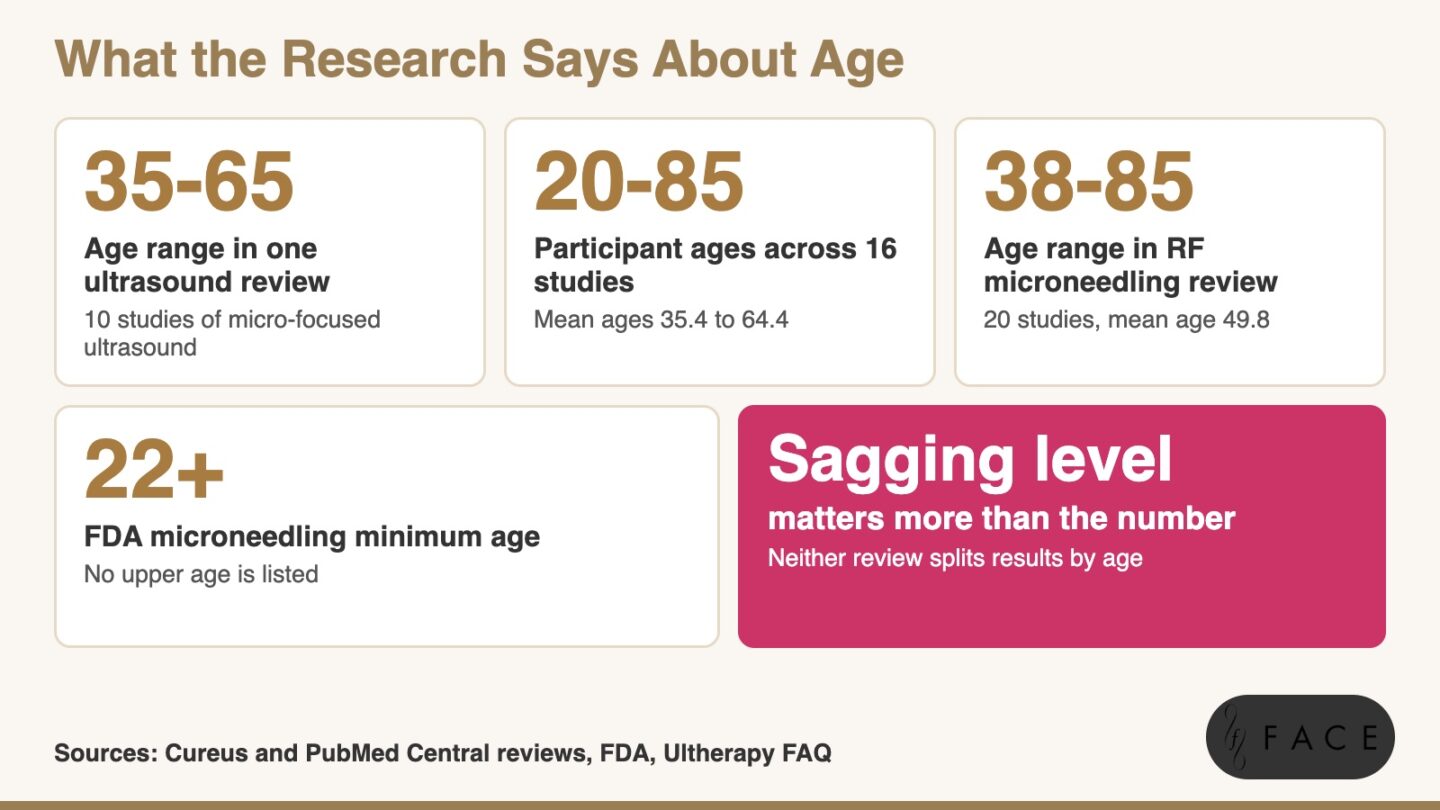
The graphic above shows the age ranges reported in the research and FDA labeling. Neither review breaks results out by age group. The studies therefore support candidacy by sagging level, not by a cutoff age. The next section covers what age does change.
Ultherapy uses micro-focused ultrasound to heat tissue below the skin surface. The Cureus systematic review reports depths up to 5 mm, reaching the dermis and the deeper SMAS layer. The heat contracts collagen at once, and new collagen follows over the next months.
The FDA cleared the Ulthera System in 2012 under 510(k) number K121700. The FDA lists the device class as focused ultrasound for tissue heat or mechanical cellular disruption.
What Is the Best Age to Get Ultherapy?
The best age to get Ultherapy is any age with mild to moderate sagging, since the manufacturer describes candidates by laxity. Its FAQ calls the typical candidate someone in their 30s, and it also names people who want to stay ahead of sagging. No age limit appears on the page.
Ultrasound aims to rebuild collagen, the protein that keeps skin firm. Learning about collagen loss explains why sagging grows. The AAD says ultrasound heat sent deep into the skin can prompt collagen production.
The MFU review that covered 35 to 65 year olds reported significant improvement in sagging of the mid and lower face. A second review of 16 studies found lower benefit as baseline laxity rose. Sagging level therefore matters more than timing.
Does Ultherapy Lift Jowls?
Ultherapy may modestly tighten skin along the jawline, but the studies do not measure jowl lift directly. The manufacturer lists the brow, the neck and the skin under the chin as FDA-cleared areas. Jowls are not named on that list.
One study in the MFU review, with 20 participants, reported wrinkle scores dropping 0.9 points at 3 and 6 months. The greatest effect appeared on the jawline and cheek area. A wrinkle score measures lines, not lift, so the result describes smoother skin there.
Heavier jowls need a different plan. The review authors state that MFU is not as effective in more severe laxity and suggest surgery for those patients. The jawline tightening guide covers a radiofrequency option for mild to moderate laxity. Evidence on value comes next.
Is Ultherapy for Face Worth It?
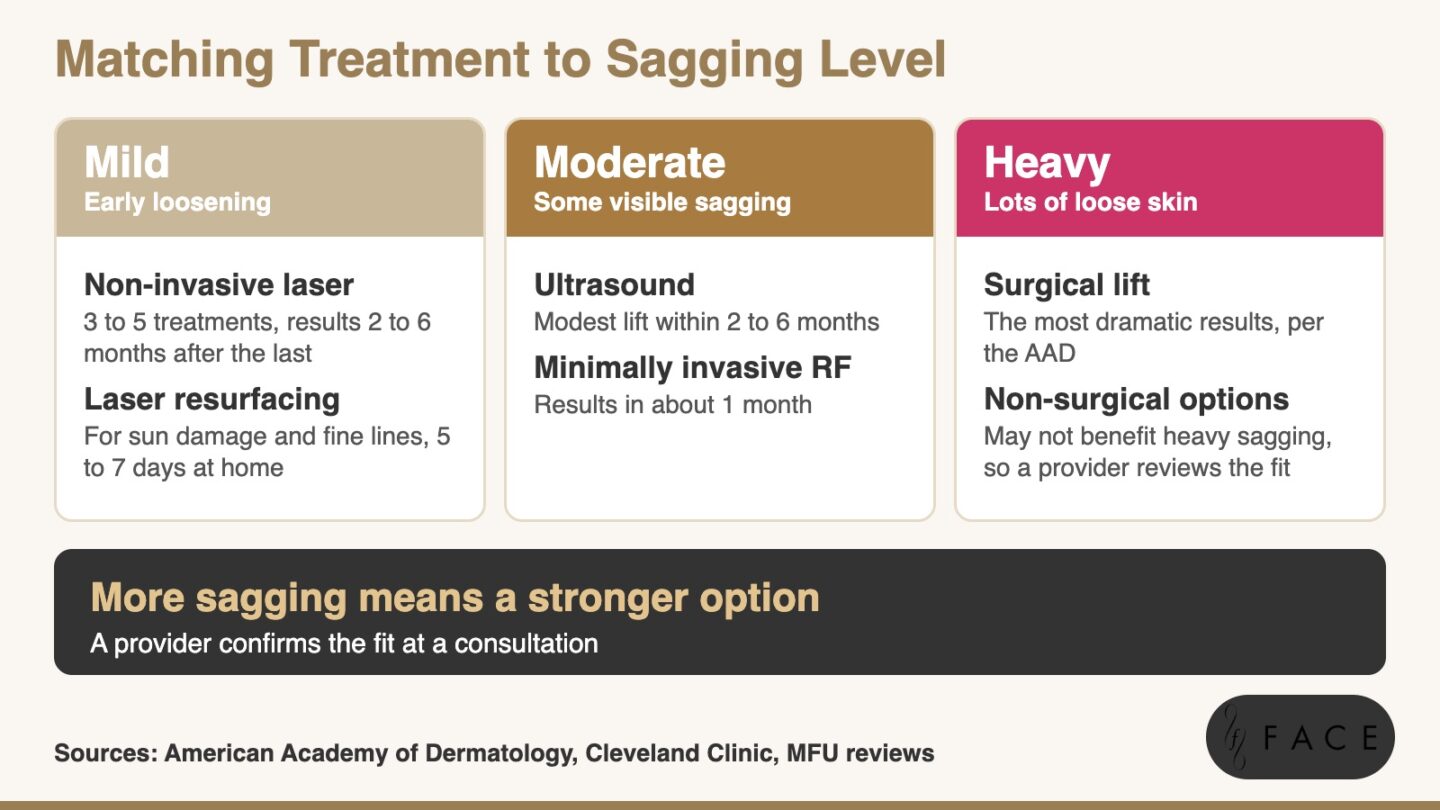
Ultherapy for the face is worth it when the expected result matches the evidence: modest lifting that builds over months. The AAD says one ultrasound treatment gives modest lifting and tightening within 2 to 6 months. More treatments may add benefit.
The pooled data support that modest result. Investigators rated 92% of participants as improved at day 90 in the MFU facial review. Shome and colleagues reported blinded evaluators saw improvement in 93% of patients at 6 months. Patient satisfaction reached 85% and held at 1 year.
The evidence has limits. A brow study of 25 participants found brow height 0.12 mm below baseline at 180 days, not a significant change. Longer-term data are not available, according to the facial review authors.
The Ultherapy Prime page explains the newer device version. Results depend on the starting laxity, and a provider can describe a realistic outcome. Ultrasound is one choice, and microneedling is another, so the next section covers age and microneedling.
Is 60 Too Old for Microneedling?
No, 60 is not too old for microneedling, because the FDA lists a minimum age of 22 and no upper age. The FDA clears certain devices for facial acne scars, facial wrinkles and abdominal scars. A provider reviews health history first.
The FDA lists conditions to discuss with a provider before treatment. Examples include blood thinners, an active skin infection, an autoimmune disease and keloid scars. Pregnancy and breastfeeding also belong on that list.
A systematic review of RF microneedling covered 20 studies and 558 participants. The mean age was 49.8 years, with a range of 38 to 85 years. Tightening appeared in 5 of the 20 studies, and the authors rated certainty as moderate.
Is 50 Too Old for Microneedling?
No, 50 is not too old for microneedling, since the RF microneedling review had a mean participant age of 49.8 years. The FDA sets a minimum age of 22 and no maximum. People in their 50s sit near the middle of the studied group.
RF microneedling heats the deeper skin with tiny needles. The AAD says minimally invasive RF shows results in about 1 month. Minimally invasive RF cannot match a facelift, eyelid surgery or neck lift.
The microneedling sessions page covers the basics for adults of any age. A provider reviews health history, medicines and skin type before any device is chosen. The FDA also advises asking about the provider’s training and a new needle cartridge for each patient and session.
Most of that RF evidence comes from case series, and only four trials were randomized. Follow-up lasted 3 to 6 months in most studies, and none went past 12 months. Our Secret RF page covers the radiofrequency version used for tightening. Laser is another route for older skin, which the next section covers.
Is Laser Good for Older Skin?
Laser is good for older skin that has sun damage, age spots or fine lines, according to Cleveland Clinic. The same page lists deep wrinkles and excessive sagging skin as poor fits. Laser resurfacing does not lift heavy sagging.
The AAD calls laser resurfacing the most effective procedure for tightening loose skin. Healing takes 5 to 7 days at home, and tightening appears within 2 weeks after healing. Fractional CO2 healing takes one full week, per Cleveland Clinic.
Non-invasive lasers need less recovery. The AAD says 3 to 5 treatments may be needed, with results 2 to 6 months after the last one. Non-ablative laser tightening suits mild loosening and needs a short series of visits. The non-ablative laser guide covers that gentler series.
Daily sunscreen after healing is part of the plan, per the American Society of Plastic Surgeons. Pink skin lightens over 2 to 3 months. A review of realistic CO2 resurfacing results covers the stronger option. The next section compares all of these options for a woman in her 70s.
What Is the Best Cosmetic Procedure for a 70 Year Old Woman?
No single procedure fits every 70 year old woman, because the amount of sagging decides the option. The AAD ranks surgical lift as the most dramatic and non-invasive options as gentler with less downtime. The table below compares four non-surgical paths with the surgical lift.
The table shows surgery for heavy sagging and gentler options for mild to moderate laxity. A facelift alternatives article explains where RF stops short of surgery. The graphic below sorts the same options by how much sagging a person has.
Neck skin often needs its own plan. The aging neck guide covers neck laxity treatments. A provider checks health history and medications first.
What Else Should You Know About Skin Tightening After 60?
Skin tightening after 60 follows the same steps as at any age. The answers draw on the manufacturer, the AAD and the research reviews.
People who ask is 60 too old for Ultherapy usually want timing and preparation details next. The answers below cover the candidate profile, session length, results and planning.
Who Is a Good Candidate for Ultherapy After 60?
A good candidate after 60 is someone with mild to moderate sagging and steady health habits, per the AAD. The AAD lists the factors below as signs of a stronger result.
- A small amount of sagging skin
- A healthy weight and diet
- No smoking and little alcohol
- Daily sun protection and no indoor tanning
How Long Does an Ultherapy Session Take?
An Ultherapy session takes about 30 to 90 minutes, depending on the area treated, per the manufacturer. Patients feel heat or tingling as the energy is delivered. Normal activity resumes right away. Planning an ultrasound appointment therefore fits into a normal day.
How Long Do Ultherapy Results Last?
Ultherapy results last up to a year or more from a single treatment, per the manufacturer. Full results develop over 2 to 3 months, according to the same FAQ. The AAD gives a wider window of 2 to 6 months.
Can You Combine Skin Tightening Treatments?
Yes, a provider can pair treatments by layer, since each device heats a different depth. See the combination therapy article for one example. One plan may pair ultrasound for lift with laser for surface texture.
How Should You Prepare for a Skin Tightening Consultation?
Prepare for a consultation by listing goals, medicines and past treatments before the visit. The AAD names pregnancy, a skin infection and certain medications as reasons a procedure may not fit. Follow these steps.
- Write down the areas of sagging that matter most.
- List all medicines, including blood thinners, and health conditions.
- Note any past laser, filler, thread or surgical treatments.
- Ask which devices the provider uses and how many visits are planned.
- Plan daily sunscreen and sun protection before and after treatment.
How Does FACE Medspa Help With Skin Tightening After 60?
FACE Medspa helps by matching the treatment to the level of sagging, starting with a skin assessment. We offer Ultherapy, RF microneedling and laser options at our Bloomfield Hills area practice. Each plan starts with goals and health history.
The answer to is 60 too old for Ultherapy comes down to which option fits your skin. Our team explains realistic timing, such as the 2 to 6 months the AAD gives for ultrasound results. The FACE Medspa staff also reviews neck and jawline needs.
Bring photos of past treatments and a full list of medicines to the visit. That list keeps the discussion focused on realistic options. To plan next steps, contact FACE Medspa today.